Get Full Government Meeting Transcripts, Videos, & Alerts Forever!
Get email alerts on the Chesapeake Bay Preservation topic
No spam. Unsubscribe anytime.
Norfolk staff reviews Chesapeake Bay preservation rules, shoreline projects and upcoming state resiliency requirements
Summary
City environmental staff reviewed Norfolk's wetlands, erosion control, dune protections, living shorelines and enforcement, and outlined state-mandated updates that will require sea-level-rise and storm modeling for waterfront work.
James Clark, Norfolk's environment manager, told the Planning Commission that the city enforces multiple water-quality programs in the Chesapeake Bay Preservation Area, including wetland permitting, erosion and sediment (E&S) inspections, the Virginia Stormwater Management Program (VSMP) construction permit oversight, and dune protections.
Clark said Norfolk has about seven miles of bayfront beaches and roughly 4,000 properties inside the city's Chesapeake Bay Preservation Area (CBPA). He described routine biweekly inspections of active construction sites, and said the city typically has about 175 active construction sites and more than 800 stormwater outfalls that lead directly to waterways.
The presentation summarized the city's permitting approach for shorelines: failing bulkheads are increasingly being replaced with living shorelines that restore marsh and plantings; homeowners and developers seeking shoreline work file joint permit applications, and many projects require multiple state and local permits. Clark said living shorelines are now the preferred erosion-control alternative because they enhance water quality and stabilize banks.
Why this matters: the CBPA and related programs are the city's main tools for limiting nutrient and sediment runoff into tidal waterways, protecting habitat and limiting shoreline erosion, and the city both issues permits and enforces violations such as unpermitted tree removals or unauthorized clearing.
Clark outlined several enforcement and outreach points: city staff and an on-staff arborist review tree-permit requests in the CBPA; most wetland and tree violations are reported by neighbors through NorfolkCares; the city sends certified letters and issues stop-work orders when necessary. He noted about 120 dune-vegetation management permits have been issued to allow residents to remove invasives while protecting state-listed dune species.
Clark described coordinated efforts on abandoned boats and dilapidated piers. Boats that are abandoned or stripped of identification are tagged; if an owner cannot be located the city removes and disposes of smaller vessels with public-works crews and contracts out larger removals. He said city crews and grant-funded partnerships recently removed several abandoned boats from Willoughby Bay.
On funding and restorations, Clark said Norfolk has secured multi-million-dollar grants for living-shoreline and marsh restoration projects. He cited a large restoration at Riverside Memorial Park on the Elizabeth River funded by approximately a million-dollar grant that is now completing.
Upcoming state changes: Clark said the Commonwealth is updating CBPA resiliency and adaptation guidance, and localities will have to adopt new requirements. Under the draft guidance he described, applicants proposing additions or accessory structures within the Chesapeake Bay preservation area will need to evaluate future conditions using scenarios such as a mid-range 2050 sea-level-rise projection and a hurricane scenario to show whether proposed work is viable and what flood-risk mitigations may be required. Clark said the city has submitted comments to the Hampton Roads Planning District Commission and will continue work as the state guidance is finalized.
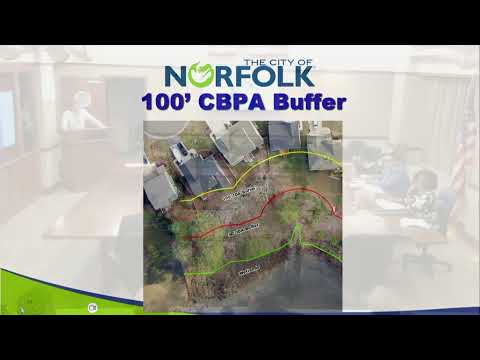
Clark and staff encouraged property owners to consult the city's online CBPA map to determine whether a parcel is in the preservation area; he added that the city provides guidance checklists, sample site-plan requirements, lists of salt-tolerant trees and shrubs for mitigation plantings, and free courtesy flagging of wetlands for new surveys.
For residents: Clark said permitted redevelopment that increases buffers and installs modern stormwater controls typically results in improved water quality compared with historic development patterns, where many older lots have houses within 30'–50 feet of the water and limited vegetation.
Ending: Clark invited commissioners and residents to attend a CBPA wetland seminar the city holds annually and offered to provide a site visit for interested commission members to view recent living-shoreline projects, including the Riverside Memorial Park restoration on the Elizabeth River.