Get Full Government Meeting Transcripts, Videos, & Alerts Forever!
Get email alerts on the Tenant Protections topic
No spam. Unsubscribe anytime.
Saint Paul committee reviews history, legal risks and next steps for tenant-protections work
Summary
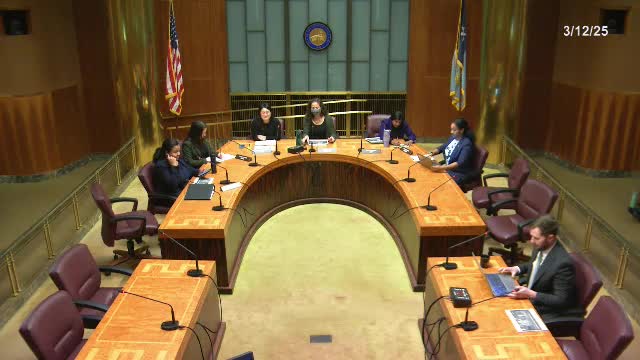
Members of the Oregon Policy Committee of the Saint Paul City Council received a briefing on the city's safe-housing and tenant-protections work, including the legal history that led the council to rescind an earlier ordinance and how that work intersects with the city's rent-stabilization law.
Members of the Oregon Policy Committee of the Saint Paul City Council received a briefing on the city's safe-housing and tenant-protections work, including the legal history that led the council to rescind an earlier ordinance and the interaction between that work and the city's rent-stabilization law.
Faith Dietz, Fair Housing Coordinator in the City of Saint Paul Office of Financial Empowerment, told the committee the effort began with broad community engagement across the city's seven wards and aimed to reduce displacement, increase access and "affirmatively further fair housing." Dietz said the city's work grew from data showing a majority-renter population and continued reports of evictions and maintenance complaints.
Megan Hafner, an assistant city attorney, described the federal lawsuit against the first tenant-protections ordinance and the court's reasoning in granting a preliminary injunction. "The court found that [the ordinance's] just-cause notice provision . . . was unconstitutional" in effect, Hafner said, and that a screening provision in the ordinance also raised constitutional concerns by limiting owners' ability to refuse applicants in ways the court viewed as problematic. Hafner said the combined effect of those provisions led the court to find the ordinance likely unconstitutional and that the council subsequently rescinded the SAFE ordinance.
Hafner reviewed the timeline: community engagement in 2019, passage of the initial tenant-protections ordinance in 2020 (with a delayed effective date), the 2021 lawsuit and preliminary injunction, subsequent voter-approved rent stabilization in 2021 and the implementation and revision of that ordinance in 2022 and 2023. She said litigation over related provisions in Minneapolis reached the Eighth Circuit, which declined to order an injunction in that city's case.
City staff emphasized that the legal issues that produced the injunction were tied to the specific language and how the measures worked together, rather than to a single isolated clause. Hafner advised that future ordinance language should clearly tie problems the city wants to address to the remedies proposed, consistent with the court's critique of the SAFE ordinance's findings and whereas clauses.
Director Wiese of the Department of Safety and Inspections summarized existing city tools and more recent state changes that affect landlord-tenant relations. Wiese noted the city already enforces a fire certificate-of-occupancy inspection program, Chapter 54 application-transparency requirements, and has the Housing and Equal Rights Office (HERO) with HUD authority for discrimination investigations. On rent stabilization, Wiese said the typical allowable rent increase tied to a just-cause vacancy is "8% plus CPI," and that the most common just-cause vacancy approval is for voluntary moves such as tenants moving to a different-size unit.
Committee members asked staff to identify current high-priority policy risks and outstanding questions. Council discussion touched on criminal-history screening limits in previous ordinance language (a seven-year lookback for felony convictions and three years for misdemeanors were noted as part of the earlier text), security-deposit limits, tenant screening standards, notice-of-sale requirements and tenant education obligations included in the earlier ordinance.
Staff and council members also discussed broader changes at the state level since 2019, including 2023'24 amendments to Minnesota landlord-tenant law that address screening, support-animal protections, move-in/move-out inspections, disclosure requirements and other tenant protections. Director Wiese and the city attorney's office said those state changes will be considered when drafting revised local language.
Council members and staff agreed on next steps: re-engage ward-level and citywide stakeholders (renters, housing providers, developers, reentry partners and advocacy organizations), review state law updates and the litigation record, and prepare revised ordinance language and outreach plans. At the meeting close, council leadership said the council intends to return to tenant-protections proposals "in the next few weeks," and encouraged members to follow up with city staff.
The presentation was informational; no formal motions or votes on new ordinances were taken at the meeting.