Get Full Government Meeting Transcripts, Videos, & Alerts Forever!
Get email alerts on the Career And Agriculture Education topic
No spam. Unsubscribe anytime.
Bill would require excused absences for FFA and 4‑H activities; education groups support measure
Summary
House Bill 16‑60 would require school corporations to excuse up to six days per school year for student participation in specified agricultural and youth development activities; superintendents and principal associations testified in favor, citing educational benefits.
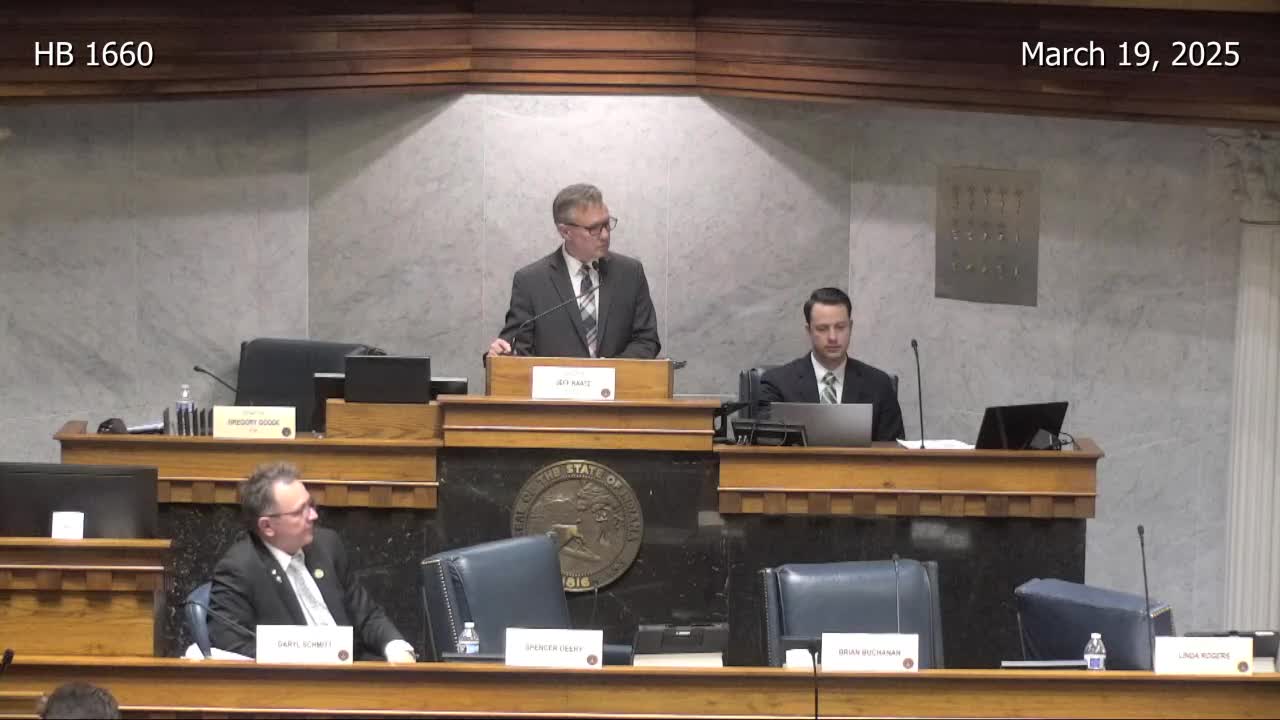
House Bill 16‑60, presented on behalf of Senator Buchanan by Representative Baird, would require school corporations to excuse students who participate in events organized by Future Farmers of America (FFA) or 4‑H, subject to limits: up to six excused absences per school year, and a requirement that students maintain good academic standing. The bill also prohibits penalties for students using the excused absences.
Representative Baird said the bill balances academic obligations with participation in agricultural education and leadership development opportunities. Supporters included the Indiana Association of Public School Superintendents, the Indiana Association of School Principals and the Indiana Small and Rural Schools Association. Bob Taylor (IASP) and Chris Lagoni (ISRSA) emphasized the wide educational benefits of FFA and 4‑H activities, and noted coordination with Purdue Extension and the College of Education on related dual‑credit and prior‑learning initiatives.
Witnesses told the committee the measure addresses access problems where some school corporations had declined to excuse students for FFA or 4‑H activities; supporters said most contests are scheduled outside the regular school day but that some events or judging teams can require daytime absences and should be excused. Committee members asked clarifying questions about overlap with other excused absence provisions and about the cumulative effect of multiple excused‑absence policies; witnesses acknowledged that a large number of excused absences overall can approach thresholds commonly associated with chronic absenteeism but said these activities produce educational benefits that justify the policy.
The committee did not take a final vote on the bill at this meeting and left further consideration for later action.