Get Full Government Meeting Transcripts, Videos, & Alerts Forever!
Get email alerts on the Sexual Assault Kits topic
No spam. Unsubscribe anytime.
Committee hears bill to fund testing of sexual-assault kits; advocates and survivor testify, bill held for amendments
Summary
Lawmakers heard House Bill 1413 to create a fund to reduce the backlog of untested sexual-assault kits. Supporters said the bill would pay labs and staff, and set deadlines for backlog elimination; the committee took testimony and held the bill for amendment and fiscal work.
The Senate Corrections and Criminal Law Committee heard House Bill 1413, which would establish a fund to address the backlog of untested sexual-assault kits and provide grants to crime labs and law enforcement agencies to process kits, buy equipment and pay competitive wages.
Representative Cash, presenting the bill, said Indiana currently has a six- to eight-month backlog for kits that must be sent to crime labs under Indiana law. She said the backlog exists partly because of insufficient equipment and staffing and because crime-lab work requires higher-level qualifications that make lab staff competitive hires. "This bill establishes the SAK backlog fund to provide funding for assisting law enforcement agencies and testing labs in eliminating the backlog of untested SAK kits," she told the committee.
Cash said funds could be used to purchase equipment, process kits, hire staff, and provide competitive wages, and that the bill includes reporting deadlines and a target timeline: testing agencies and law enforcement should process kits and report status by set dates, with the bill requiring completion of the listed kits by Jan. 1, 2026.
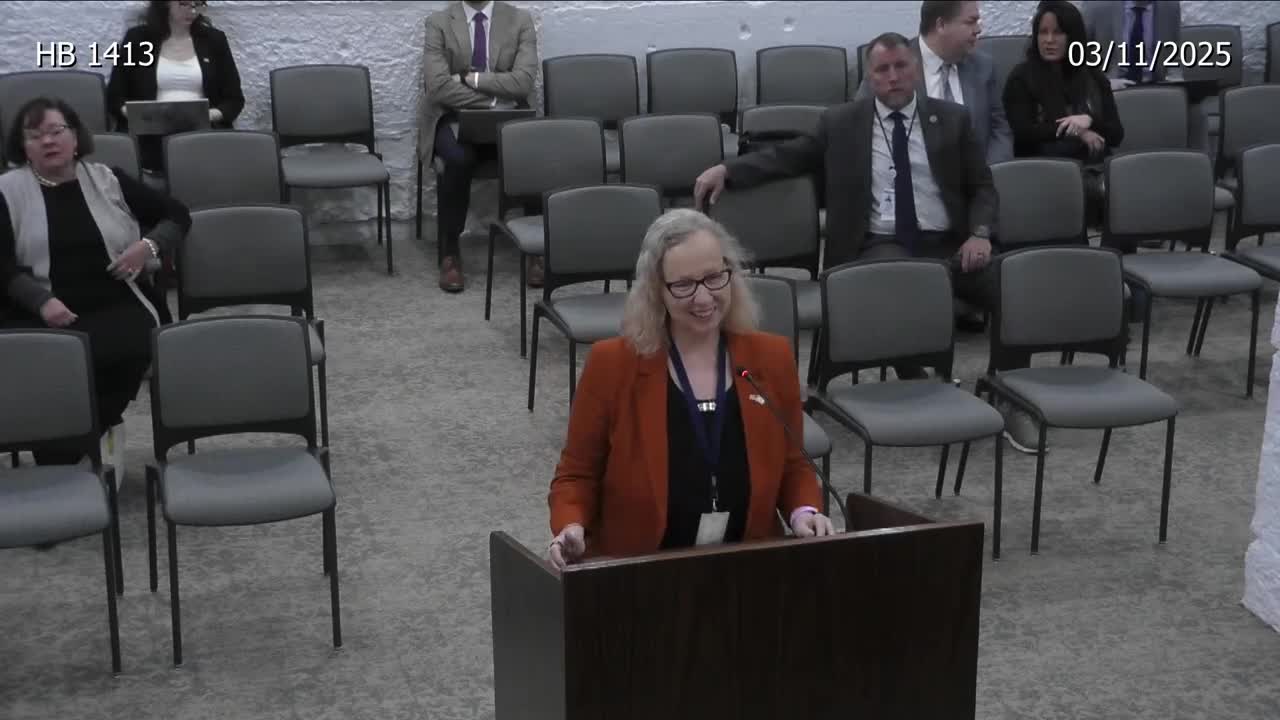
Beth White, president and CEO of the Indiana Coalition to End Sexual Assault, testified in strong support and yielded her time to Michelle Kuper, a survivor who described a decades-long experience that she said illustrated why timely testing matters. Kuper testified about delays in earlier decades, recounted the impact of late identification on victims and urged lawmakers to fund forensic capacity.
Committee members asked technical questions about grant administration, whether the money would go to local labs or through the Indiana State Police and what the estimated number of backlogged kits is. Representative Cash said the backlog is about 600 to 800 kits and that the funding would flow through the Indiana State Police grant process to existing state crime labs. She said all named stakeholders 9including the Indiana State Police and the Indiana Criminal Justice Institute9supported the bill.
The committee did not vote on HB 1413; the chair said members would hold the bill to allow for drafting amendments and to explore whether appropriations could be avoided by placing funds in an existing line item.
The hearing included emotional testimony from a survivor and advocacy groups; the committee indicated interest in amendments and deferred a vote to a later hearing.