Get Full Government Meeting Transcripts, Videos, & Alerts Forever!
Get email alerts on the Property Tax Reform topic
No spam. Unsubscribe anytime.
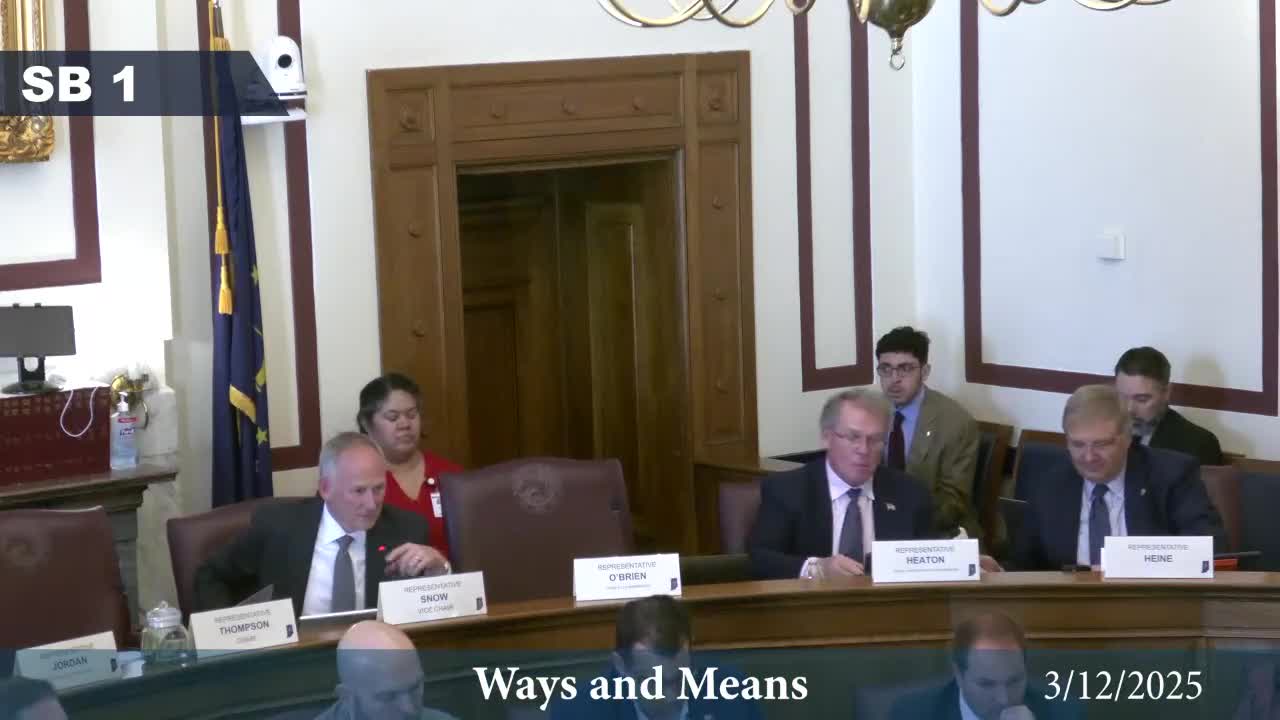
Chairman Thompson unveils broad property-tax overhaul; county, municipal and school leaders warn of local impacts and urge careful phasing
Summary
Chairman Thompson presented a sweeping property-tax and local-tax restructuring proposal (drafted as bill 1402) that would change deductions to credits, phase out the business personal property (BPP) floor, raise de minimis thresholds, and shift some revenue authority to local option income taxes. The hearing drew extensive testimony from cities,
Chairman Mike Thompson presented a comprehensive property-tax and local-tax reform package the transcript identifies as the draft under discussion (referred to in committee as 14o2). The package is wide-ranging: it would convert some deductions to credits, change how local units reach the constitutional cap, reorganize local-option income-tax (LIT) authority and distribution, and phase down business personal property (BPP) assessments over several years while increasing the de minimis threshold.
Thompson described the underlying goal as eliminating cap-loss distortions that create incentives for units of local government to increase levies without producing direct homeowner benefit. "If you keep the system we've got, we've got to expect the same result," Thompson told the committee. He proposed a long-term framework in which every parcel would effectively hit the constitutional tax cap at a $3 rate under the planned changes; he framed that as creating a stable, rate-based system and removing perverse incentives that have emerged under a levy-focused approach.
The bill would:
- Convert some property-tax deductions to refundable credits so eligible residents receive a direct benefit rather than a deduction that can be nullified by cap limits. - Raise the BPP de minimis threshold (proposed from $80,000 to $200,000) and phase out the 30% aggregate floor for business equipment over several years, with a limited phase-down for newly purchased property. - Reallocate or reorganize local-option income tax authority so counties set a base rate and municipalities potentially set additional stacked rates; the draft also contemplates readoption processes and required votes by units that would receive LIT distributions. - Address distribution rules for fire/EMS and rework several carve-outs currently embedded in LIT distributions.
Local officials and associations gave mixed but substantive responses. The Association of Indiana Counties and the Indiana Township Association said they support moving toward more transparent LIT structures but warned that the details matter and that some units rely on predictable LIT shares to run day-to-day services. The Association of Indiana Municipalities (AIM) and individual mayors expressed support for giving cities and towns more control over LIT but asked for protection for small municipalities and townships that do not have the voting clout of larger places.
Mayors and council members, including Ryan Daniel of Columbia City and Ken Sicard of Ferdinand, described local budgets and the services that could be affected if revenues fall short. Sicard listed specific potential cuts — to road work, parks maintenance, trash pickup, and even delaying fire apparatus — if a community loses a share of its tax base and cannot replace revenue.
School representatives stressed operating-fund pressures. David Marcotte of the Indiana Urban Schools Association and the Indiana Small and Rural Schools Association presented a study showing that a large share of school operating funds is already consumed by nondiscretionary costs (transportation, utilities, and property/casualty insurance), leaving little room to absorb further revenue shifts without referendums, transfers from other funds, or cuts. Marcotte warned that high circuit-breaker losses in some districts leave the operating fund with negative coverage for basics like transportation.
Business and manufacturing groups, including the Indiana Manufacturers Association and the Indiana Chamber, generally supported BPP relief as a way to encourage investment but cautioned about the distributional consequences and the short-term fiscal shock in some counties. Grocery and convenience-store groups voiced concerns about operational details such as tax-stamp logistics if new tobacco-tax categories are adopted elsewhere in the code.
Why it matters: Thompson's plan attempts a systemwide reset designed to remove cap-loss incentives and create clear rate caps for each class of local service. Supporters said the move would simplify long-term planning and reduce gamesmanship among local units; critics warned that the detailed mechanics, fiscal transitions and timing matter a great deal and that some units would experience material revenue declines without carefully phased replacement mechanisms.
What the committee heard: extensive testimony from counties, cities, towns, school associations, township groups, chambers of commerce, manufacturers, farmers, library leaders, and retailers. The testimony raised operational concerns, requests for carve-outs, and repeated calls to phase changes so local governments and taxpayers can adapt.
No committee vote on the bill is recorded in the transcript for this hearing.