Get Full Government Meeting Transcripts, Videos, & Alerts Forever!
Get email alerts on the Individual Income Tax topic
No spam. Unsubscribe anytime.
Committee hears testimony on bill to cut individual income tax by 0.5% on revenue triggers starting 2030
Summary
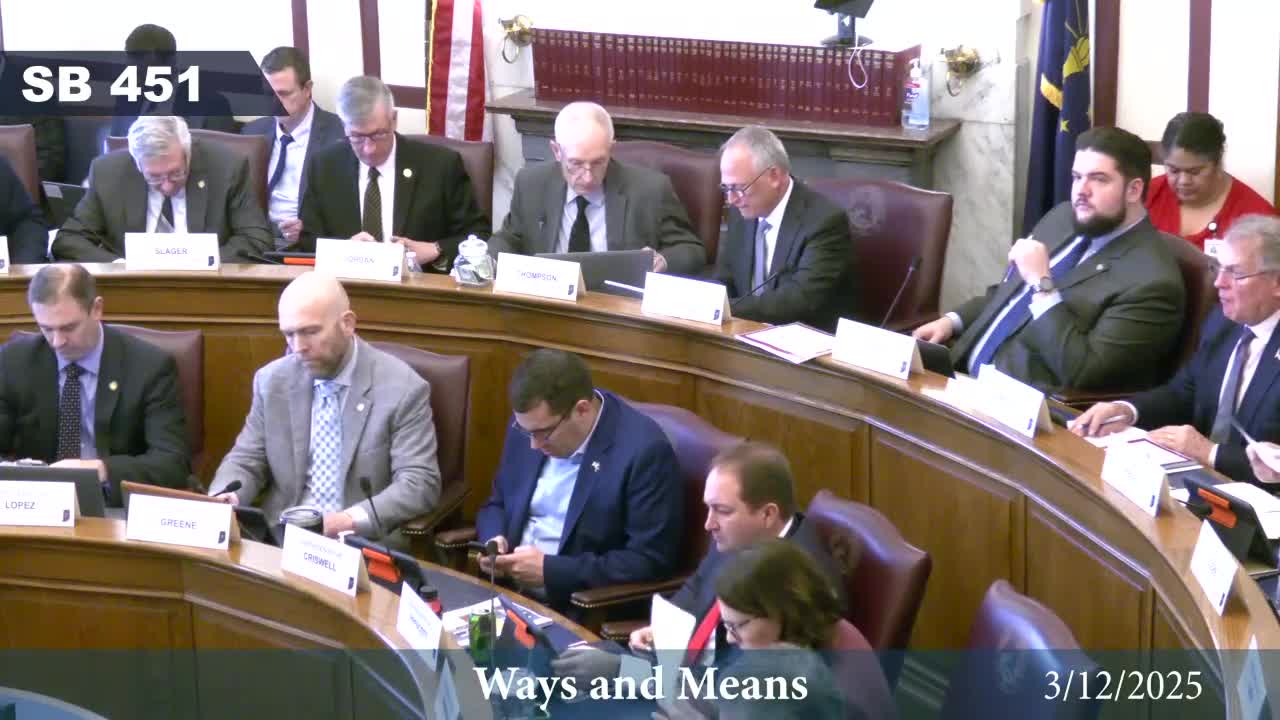
Senate Bill 451, presented to the Ways and Means Committee, would reduce Indiana's individual income-tax rate by 0.5 percentage points beginning in 2030 and every even-numbered year thereafter if state revenues exceed a 3% year-over-year growth threshold.
Senator Tim Holman presented Senate Bill 451, which would set a conditional plan to reduce Indiana's individual income tax rate by 0.5 percentage points beginning in calendar year 2030 and again in subsequent even-numbered years if state revenues meet a specified growth threshold.
Holman described the bill as an effort to "keep Indiana in the game," saying the change is intended to maintain the state's competitiveness with peer states that have been cutting income-tax rates. He told the committee the bill calls for a 0.5% reduction that would begin in 2030 and recur each even-numbered year "unless suspended by the general assembly in the odd numbered years."
The rate reduction would trigger only if revenues exceed a pre-set growth threshold; sponsors described the threshold as 3% year-over-year growth in state revenues. Holman and several supporters said the contingency protects fiscal stability by making the cut automatic only when revenues grow sufficiently.
Supporters from business and taxpayer groups urged the committee to advance the bill. Natalie Robinson, state director of the National Federation of Independent Business, said lowering the individual income-tax rate helps small businesses that are organized as pass-throughs and pay taxes through the individual code. Graham Renbarger of Americans for Prosperity characterized the measure as a "measured approach" that rewards taxpayers while preserving fiscal stability.
Several other business groups echoed support. David Ober of the Indiana Chamber told the committee that tax competitiveness matters and urged an environment that encourages investment.
Legislators including Representative Delaney raised questions and voiced concerns about binding a future legislature to a tax change that depends on economic conditions a half-decade away. Delaney asked, "What's the economic circumstances gonna be here in 2030? We don't know that," and said he would oppose bills that "puts anticipatory tax increases" on future lawmakers.
Others pushed back that the measure contains safeguards. Holman said the default is to return growth above 3% to taxpayers and that the general assembly can still act in future years to suspend the reduction if circumstances warrant.
Why it matters: Proponents say the bill would help keep Indiana competitive for workers and businesses by reducing income-tax burden when state revenue allows; opponents warned it may constrain future legislatures or force trade-offs if revenue projections are wrong.
What the committee heard: testimony included advocacy from NFIB and Americans for Prosperity and supportive remarks from the Indiana Chamber. Questions focused on the choice of a 3% trigger, the role of federal pandemic-era receipts in recent growth, and who decides whether conditions are met in 2030.
No committee vote on SB 451 is recorded in the transcript for this hearing.