Get Full Government Meeting Transcripts, Videos, & Alerts Forever!
Get email alerts on the Healthy Indiana Plan topic
No spam. Unsubscribe anytime.
Lawmakers, providers and patients spar over proposed changes to Healthy Indiana Plan; committee moves bill
Summary
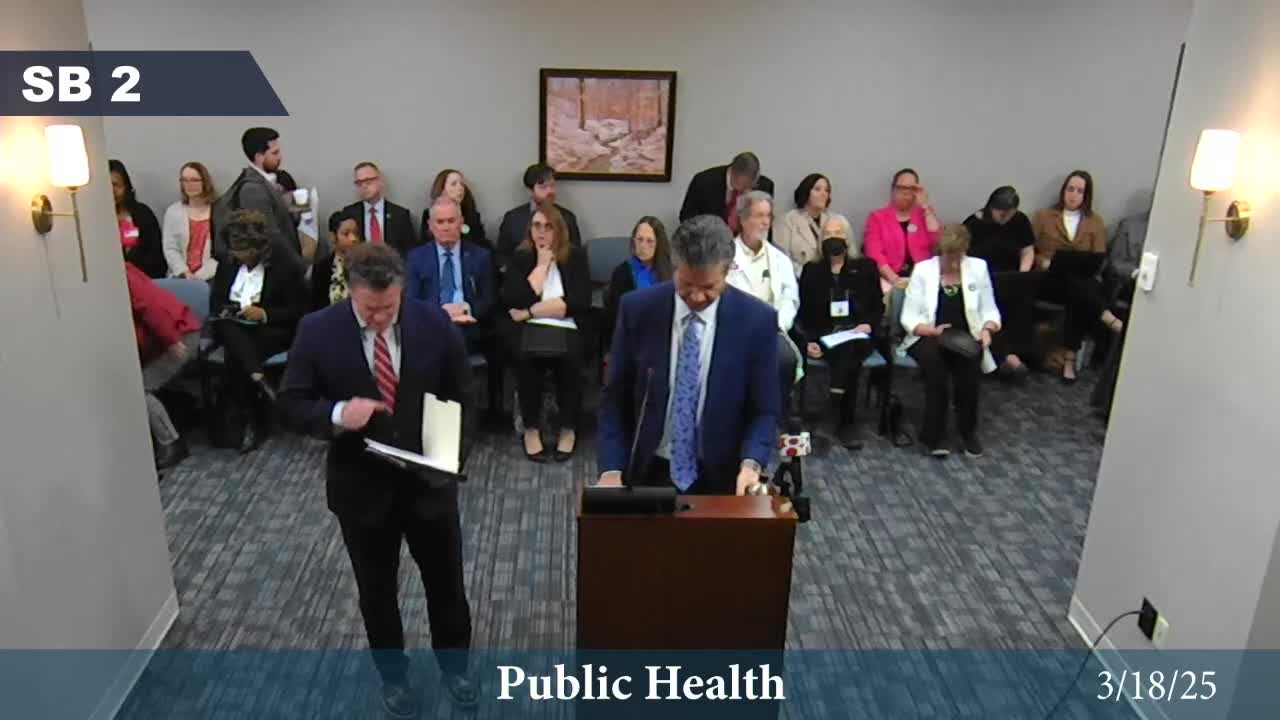
The House Public Health Committee on Feb. 16 advanced Senate Bill 2, a bill that would shift Healthy Indiana Plan expansion to a waiver, add verification and reporting requirements, and introduce limited work requirements and advertising restrictions for some Medicaid enrollees.
The House Public Health Committee on Feb. 16 advanced Senate Bill 2, a wide-ranging bill that would move the state's Healthy Indiana Plan (HIP) expansion out of a state-plan amendment and into a waiver, add verification and reporting requirements for eligibility, create limited work or community-engagement requirements for some able-bodied adults, and restrict marketing of Medicaid enrollment by entities that financially benefit from the program.
Senator Brent Mischer, the bill sponsor, told the committee that the change to a waiver is intended to give the state more flexibility if federal matching rates change. "The plan was originally set up as a state-plan amendment," he said, noting HIP's growth from roughly 40,000 people in 2006 to more than 700,000 today. He said the goal is "right-sizing" the program so people are in the most appropriate coverage and to address fiscal pressures as Medicaid spending has grown.
The bill would require more routine cross-checks of enrollee information to detect eligibility changes, authorize FSSA to share data with other agencies for redeterminations, and require reporting on improper payments and fund recovery. It would also authorize performance standards for hospitals that use presumptive eligibility and would create a three-strikes enforcement rule for hospitals that repeatedly enroll people who are subsequently found ineligible through presumptive eligibility.
Senator Mark Garten, co-author, said the bill targets resources to people "who need them the most" and asked for committee support. The FSSA's Mitch Roe said the administration supports the amended bill and that the agency already conducts quarterly electronic redeterminations for about 47% of people it reviews; he told lawmakers the agency may not need additional full-time staff but could require vendor contracts to implement enhanced verification.
Hospitals and health-care providers urged caution. Luke McNamee of the Indiana Hospital Association and Jay Hopkins, who works on hospital enrollment systems, said presumptive eligibility is an important on-ramp to coverage but warned that a strict three-strikes rule could discourage hospitals from using the tool. The Hospital Association proposed performance-based thresholds rather than an automatic out rule.
Public comment lasted for hours and included physicians, patient advocates, community organizations and individuals who said HIP provided essential care. Common concerns included quarterly re-determinations, which many witnesses described as burdensome and error-prone; the risk of increased uncompensated care and emergency visits if people lose coverage; a prohibition on advertising that could be interpreted to restrict nonprofit outreach; and potential harms to people who are medically frail or in the waiver population.
Key clarifications and amendments emerged in committee debate. Chair Barrett said amendment 13, accepted by the committee, removed a previously proposed 500,000-person enrollment cap. Amendment 15 was described as a likely carve-out for full-time post-secondary students; amendment 14 (advertising/marketing restrictions) was flagged as unresolved and subject to further drafting because of concerns it could unintentionally bar informational outreach by nonprofits and providers.
Supporters of the bill, including the Foundation for Government Accountability, argued the measures would reduce improper payments, allow the state to respond if federal match rates change, and legally preserve HIP under a waiver baseline. Opponents, including the Indiana Hospital Association, the American Heart Association, cancer and patient advocacy groups, and community providers, warned of increased administrative costs, potential coverage churn and harms to patients with chronic conditions.
A wide range of numbers and policy details were discussed during testimony: speakers cited a 90/10 federal/state match in the current structure, noted a recent state Medicaid shortfall of roughly $233 million in the current fiscal year, and debated per-enrollee spending figures; Representative Garcia Wilburn referenced a figure of about $667 per HIP enrollee put forward in committee testimony. Committee members sought greater detail from FSSA, hospital groups and the fiscal agency as the bill moves on.
After debate the committee recorded a roll call on the motion to pass as amended. The clerk announced an 8-4 vote in favor; the chair said the committee would continue work on remaining open issues, including advertising language and some carve-outs, as the bill proceeds to Ways and Means for fiscal review.