Get Full Government Meeting Transcripts, Videos, & Alerts Forever!
Get email alerts on the Consumer Credit topic
No spam. Unsubscribe anytime.
Committee advances bill to align Indiana consumer credit code, raises cap on nonrefundable prepaid finance charges
Summary
A legislative committee advanced Senate Bill 464, which updates the Indiana Uniform Consumer Credit Code to align with federal law, clarifies the definition of loan principal, updates credit-union audit and bylaw rules, and — after an amendment — raises the nonrefundable prepaid finance charge cap on subordinate-lien loans from 2% to 3%.
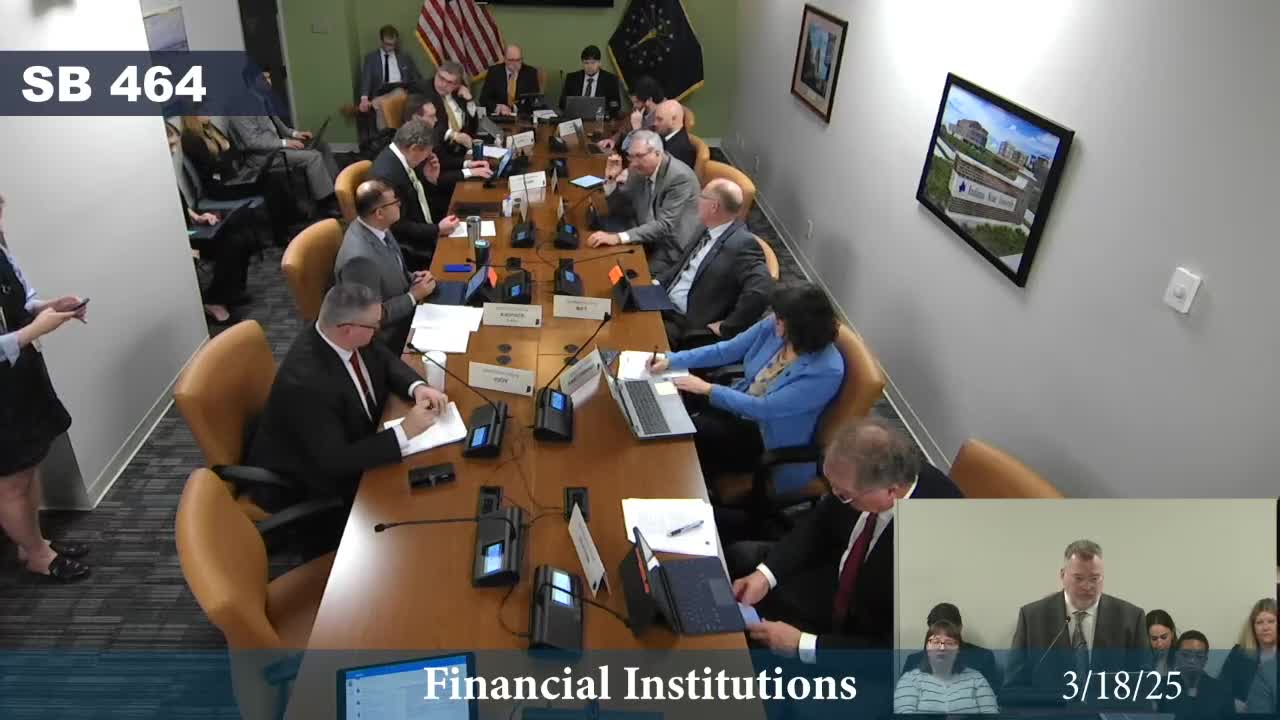
A House committee advanced Senate Bill 464, a Department of Financial Institutions (DFI) annual bill that updates Indiana's Uniform Consumer Credit Code, clarifies several definitions and procedures for lenders and credit unions, and — after an amendment — raises the cap on nonrefundable prepaid finance charges for subordinate-lien consumer loans from 2% to 3%. The committee voted 12-1 to pass the bill after adopting amendments by roll call and by consent.
Senator Greg Bassler, the bill's sponsor in the Senate, told the committee the measure makes four main changes: several statutory date alignments with federal law, updated credit union audit requirements, a technical correction to language from a 2020 UCCC update, and an amendment to the UCCC definition of "principal" clarifying that proceeds held solely as security for a loan are not considered principal. "There are essentially four things that are taking place with this bill," Bassler said as he summarized the measure for the panel.
The clarification of "principal," Bassler said, is intended to prevent confusion about how interest is calculated when a financial institution holds part of a loan's proceeds as security. He offered an example in which a lender makes a $2,000 loan but holds $1,000 on deposit as security: the bill text is intended to ensure interest is assessed only on the borrower's actual principal, not on amounts held as security.
A key floor amendment (amendment number 3) drew extended testimony. The amendment would raise the statutory maximum nonrefundable prepaid finance charge for nonrevolving subordinate-lien loans (commonly second mortgages or home equity loans) from 2% to 3%, aligning Indiana more closely with the federal Qualified Mortgage (QM) standard used by many states. Michael Stidham of Rocket Mortgage testified in favor, saying the change would "expand the opportunity for Indiana consumers to tap into the accumulated equity in their homes without disturbing the low interest rates they may have on their first liens." Stidham said inclusion of broker compensation and origination fees in the 2% calculation has in some cases limited lenders' ability to offer points or discount points that help borrowers lower monthly payments.
Erin Macy of the Indiana Community Action Poverty Institute, speaking for a coalition that included Habitat for Humanity, Citizens Action Coalition and others, urged caution. Macy noted state law already caps a maximum rate of finance charges for consumer loans (25% annually under the code section cited in testimony) and said the 2% nonrefundable portion is not a "hard cap" for all prepaid finance charges. "That 2% is not a hard cap on prepaid finance charges or points," Macy said, and she urged the committee to consider the amendment in the context of other bills that would change allowable maximum rates.
A DFI staff member read existing department guidance clarifying how the current 2% limit functions in practice: "Subordinate lien consumer loans are not subject to a hard cap, and lenders retain the ability to charge a prepaid finance charge above the maximum nonrefundable percentage amount permitted by law," the guidance states, while noting amounts above the nonrefundable percentage must be refundable and tested against the statutory maximum at consummation. The DFI staff member said the guidance would simply substitute 3% for 2% if the amendment is adopted.
Committee members asked industry witnesses and DFI staff questions about the federal QM thresholds (witnesses described that loans above a federal dollar threshold are held to a 3% limit while smaller-balance loans may allow higher percentages), product types covered (witnesses said the change would apply to closed-end home equity loans and lines of credit as well as HELOCs), and the typical origination fees lenders charge (one witness cited a $795 origination fee for many loan sizes). Representative Judy moved the amendment; the committee adopted amendment 3 by roll call (10-2).
Two other amendments were adopted by consent. Amendment number 2 reconciles conflicting statutory language so credit union bylaws can allow absentee voting on merger approvals (it aligns provisions at Indiana Code 28-7-1-4 and 28-7-1-33). Another amendment would add state and local law enforcement agencies to the definition of protected "consumer" transactions under the Deceptive Consumer Sales Act for the purpose of allowing the attorney general's office to pursue enforcement on their behalf; supporters said the change was prompted by failures in certain police pursuit vehicles that forced small departments to pay substantial repair costs. Steve Toterica, deputy director of the Consumer Protection Division in the Attorney General's Office, told the committee the existing Deceptive Consumer Sales Act historically applied to personal, family, household, charitable or agricultural purchases and did not clearly reach purchases by law enforcement agencies.
Votes at a glance: amendment 3 (raise nonrefundable prepaid finance charge from 2% to 3%) passed by roll call 10-2; amendment 2 (credit-union absentee voting for mergers) was adopted by consent; the amendment to add law enforcement agencies for DCSA enforcement was adopted by consent; final passage of Senate Bill 464 in committee was 12-1.
Support came from lenders and industry groups including Rocket Mortgage and the Indiana Bankers Association; the Indiana Credit Union League and the Department of Financial Institutions supported technical changes affecting credit unions and audits. Opposition or caution on the cap increase came from community organizations represented by Macy, who recommended broader consideration of related rate changes. DFI staff noted existing guidance that subordinate-lien loans can involve refundable prepaid charges above the statutory nonrefundable percentage, subject to refund and statutory-rate testing.
The committee record includes several examples lawmakers cited as motivating the law-enforcement amendment, including testimony that a Lake County department spent about $16,146 to repair camshaft failures on seven pursuit vehicles and citations to a procurement of 219 Dodge Durango pursuit vehicles of which 40 experienced mechanical issues. Those figures were supplied in committee testimony and were cited as the practical problem the amendment seeks to address.
The bill now moves forward after the committee's vote. Committee debate focused on consumer protections for subordinate-lien borrowers, the interaction between nonrefundable charges and total statutory rate limits, and a narrow, targeted addition to the Deceptive Consumer Sales Act to permit attorney-general enforcement on behalf of state and local law enforcement agencies.