Get Full Government Meeting Transcripts, Videos, & Alerts Forever!
Get email alerts on the Designer Interview topic
No spam. Unsubscribe anytime.
State Designer Selection Board interviews Collaborative Design Group for Badura Nursery expansion
Summary
The State Designer Selection Board interviewed Collaborative Design Group and Wunderlich Malek on March 18, 2025, for project 2,501, the Badura Nursery Expansion Project, focusing on process flow, season-driven phasing and sustainability goals.
The State Designer Selection Board interviewed Collaborative Design Group and mechanical/electrical partner Wunderlich Malek on March 18, 2025, for project 2,501, the Badura Nursery Expansion Project, focusing on process flow, construction phasing tied to seasonal operations, and sustainability goals.
The interview began with Bill Beyer, board chair, introducing the three competing teams and asking board members and agency staff to identify themselves. Brian Ritzinger, project manager with the Minnesota Department of Natural Resources, and Sarah Ebert, nursery supervisor at Badura, joined board members for the 40‑minute presentation and question-and-answer session.
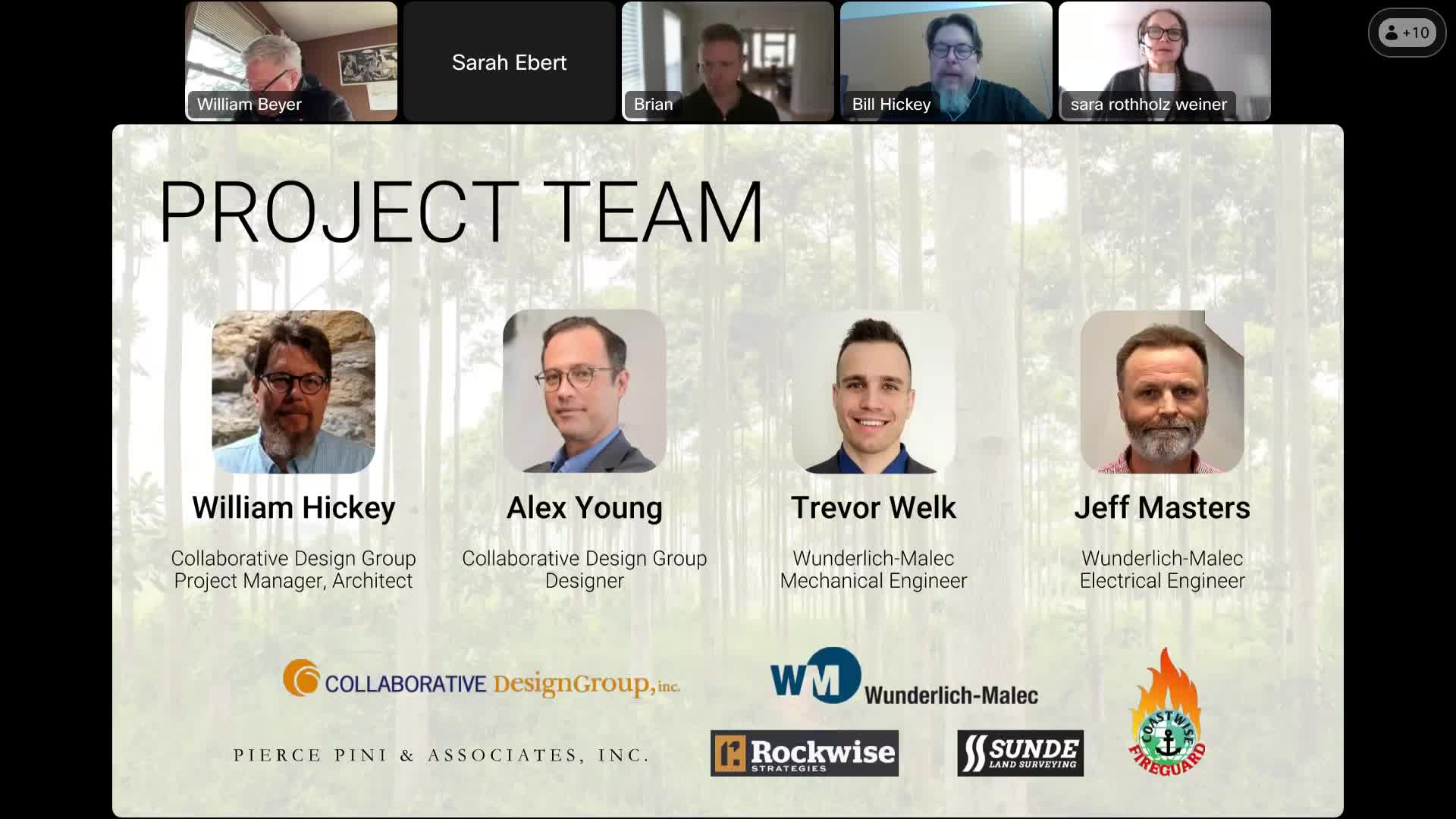
Collaborative Design Group principal Bill Hickey outlined the team’s approach, saying the firm would lead architecture and planning while Wunderlich Malek would handle mechanical and electrical engineering and process-flow planning. Hickey said the team emphasizes early process-flow analysis and frequent energy modeling, adding, "we run through [B3] early and often to see where we can leverage aspects of the project where we can gain advantage." Trevor Welk, Wunderlich Malek mechanical lead, described steps to map raw materials, equipment footprints and internal transportation to avoid bottlenecks.
The team discussed compliance and goals under the B3 standard, noting recent changes to the standard ("jumped up a level to 90% of SP 20 30," in the presentation) and asking whether the agency would consider pursuing net-zero performance. Hickey said the team would engage the state reviewer identified as CSBR early and review whether the site can be treated as a campus for averaging across buildings. He added that biomass energy could be an option if a stable fuel supply can be secured.
Agency staff pressed the team on phasing and cost estimating. Brian Ritzinger asked about combining schematic design (SD) and design development (DD). Hickey said the team would produce midphase cost estimates with their cost partner, Rockwise, to provide course corrections before construction documents. Ritzinger also raised the age and size of existing equipment; the team acknowledged equipment replacement drives space and utility needs and said they would rely on both in‑house and outside resources to specify extraction and other specialized machinery.
Seasonality and phasing were central concerns. Sarah Ebert, nursery supervisor, emphasized the tight seasonal windows that govern operations and asked how the firm would maintain schedules if construction overlapped critical periods. Hickey said the project’s most critical risk is construction timing and that the team would focus on predictive scheduling, site layout decisions and contracting forms to avoid being "halfway through a building when the season turns." He said demolition-and-rebuild approaches carry high schedule risk.
Presenters identified specific design opportunities for public engagement and education. Alex Young, a designer with Collaborative Design Group, described the site as a place that "changes so much by the week, by the season," and recommended master-planning visitor routes, gathering spaces and interpretive paths so tours and educational groups could visit without disrupting operations.
On sustainability, Trevor Welk and Bill Hickey described tradeoffs between achieving B3 targets and moving to net-zero. Hickey noted mechanical and electrical systems drive the cost of higher targets and that operational practices and staff attention are part of the performance equation. The team described prior work with a biomass energy company, Nature Energy, and with Itasca Community College’s wood biomass program while cautioning that stable fuel supply and contract logistics are essential for a viable biomass strategy.
The board and agency asked several technical clarifying questions (utilities and backup power sizing, dust collection, dust mitigation and electrical service capacity). Jeff Masters, Wunderlich Malek’s electrical engineer, said the team would coordinate with the utility to determine required service upgrades and would evaluate ground-mounted versus rooftop solar to maximize capacity and maintenance access.
No formal decision or vote occurred during the interview. The chair said teams would be notified of the board’s decision by the executive secretary the same day or the next day.
Ending: The interview closed after the allotted time; the board thanked the team and moved to a break and the next scheduled interview.