Get Full Government Meeting Transcripts, Videos, & Alerts Forever!
Get email alerts on the American Indian Education topic
No spam. Unsubscribe anytime.
American Indian Education liaison outlines programming and college-pathway events for MAPS students
Summary
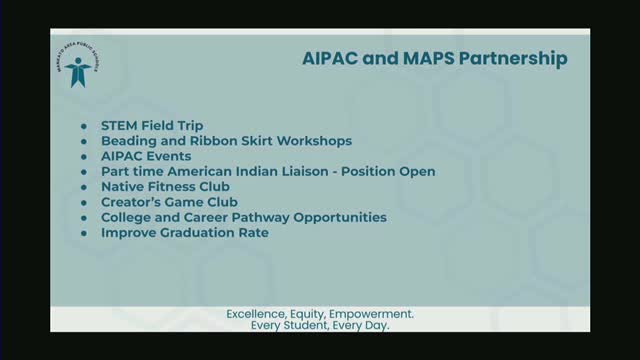
The district’s American Indian education liaison reported recent programming including Natives in STEM day, beading and ribbon-skirt workshops, fitness and creators clubs, and plans for a MSU college tour; funding is based on district American Indian enrollment (about 100–130 K–12 students).
Amina Haynes, the district’s American Indian education liaison, presented the annual American Indian Education compliance report on March 3 and described programming intended to support Native students and families.
Haynes said funding for the American Indian State Aid grant is based on the district’s count of American Indian students — she estimated roughly 100 to 130 K–12 students districtwide, which equates to about 5–15 students per grade. The grant has supported programs including a visit to the Science Museum of Minnesota’s Natives in STEM day, beading and ribbon-skirt workshops where students produced and took home traditional items, and continuing clubs such as a fitness club and a creators game club.
Haynes said the program maintains family events run by the American Indian Parent Advisory Committee (APAC), and the district recently hired or designated liaisons to help American Indian students and families access services. She said the program is planning a Minnesota State University college tour in April for grades 6–12 and that an assistant position supported by the grant is currently open to help with transportation and event attendance.
John Lustig said APAC held its annual vote of concurrence, as required by statute, and parents in attendance voted to concur.
The report was informational; board members asked no substantive follow-up questions at the March 3 meeting.