Get Full Government Meeting Transcripts, Videos, & Alerts Forever!
Get email alerts on the Municipal Law Training topic
No spam. Unsubscribe anytime.
City attorney reviews Arizona municipal law and procurement; council requests follow-up training
Summary
During the March 4 work session attorney Alan Quist (Pierce Coleman) gave a wide-ranging, high-level briefing on municipal law (ARS Title 9, ordinances, charter vs general law cities, preemption, gift clause, procurement thresholds). Councilmembers asked for deeper follow-up sessions on key topics.
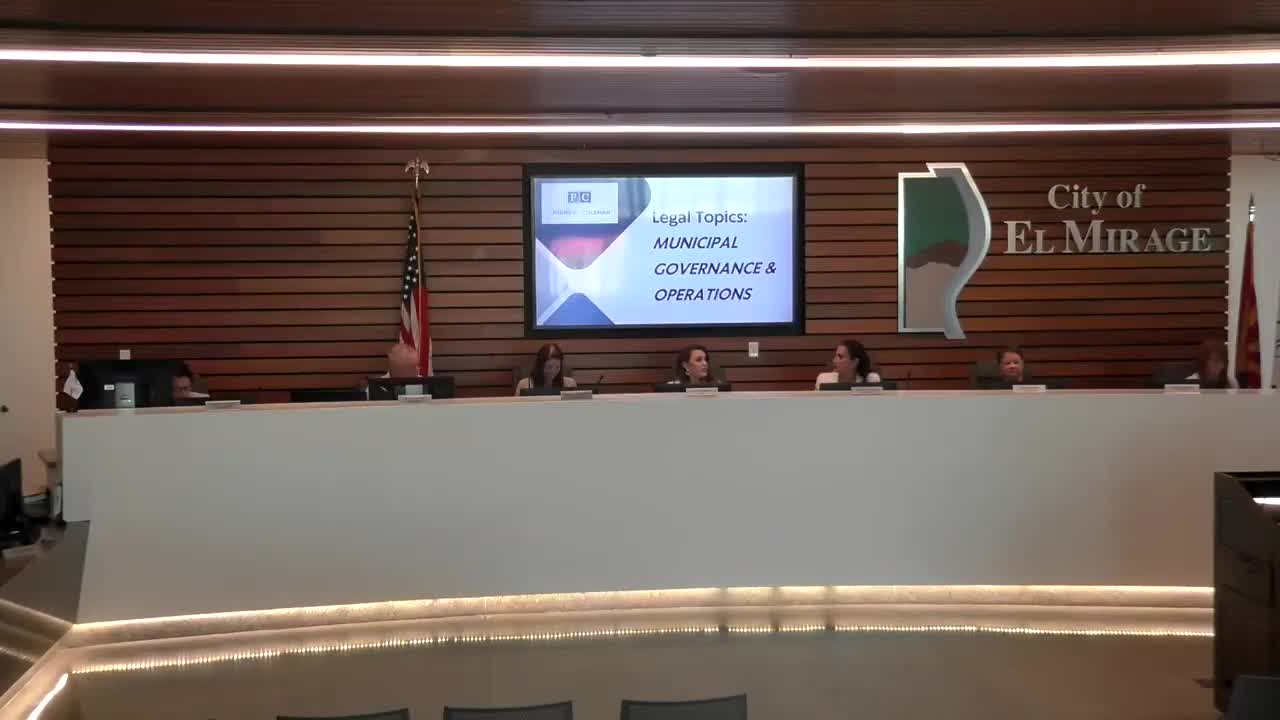
Alan Quist, an attorney with Pierce Coleman, presented an overview of municipal law and governance during the March 4 El Mirage Common Council work session and advised the council to seek further training on several technical topics, including open meeting law, procurement rules and gift-clause limits.
Quist reviewed sources of municipal authority in Arizona, noting that much city power derives from Arizona Revised Statutes (ARS), particularly Title 9 for municipal matters. He summarized how ordinances and resolutions operate, warned about state preemption (where the state removes municipal authority in specific areas), and explained potential consequences if a city adopts an ordinance that conflicts with state law, including unenforceability and an ARS 14 87 complaint to the attorney general.
Quist outlined two practical procurement thresholds used by the city: purchases up to $5,000 do not require quotations; purchases between $5,000 and $30,000 require a minimum of three telephone quotations; purchases greater than $30,000 require competitive procurement unless an exception applies (sole source, professional services, emergency or cooperative procurement). He also summarized the "gift clause" test under Arizona law: (1) public purpose for the expenditure, and (2) consideration (whether the city receives something roughly equivalent in return). Quist recommended issue-spotting (seek counsel when a potential conflict appears) and advised councilmembers to leave administrative personnel decisions to the city manager to preserve immunity protections.
Councilmembers asked procedural and practical follow-up questions. One member asked whether an executed grant agreement can create binding obligations; Quist said it can be binding depending on the underlying document and facts and offered to follow up on specific items. The discussion closed with the council asking for additional meetings to dive deeper into topical areas such as open meeting law, procurement and the gift clause. Finance and legal staff were invited to provide more detailed, later sessions.
No formal action was taken; the council asked staff and outside counsel to return with more detailed training and to make guidance available on issues the council should refer to staff or legal counsel rather than handling individually.