Get Full Government Meeting Transcripts, Videos, & Alerts Forever!
Get email alerts on the Local Taxes topic
No spam. Unsubscribe anytime.
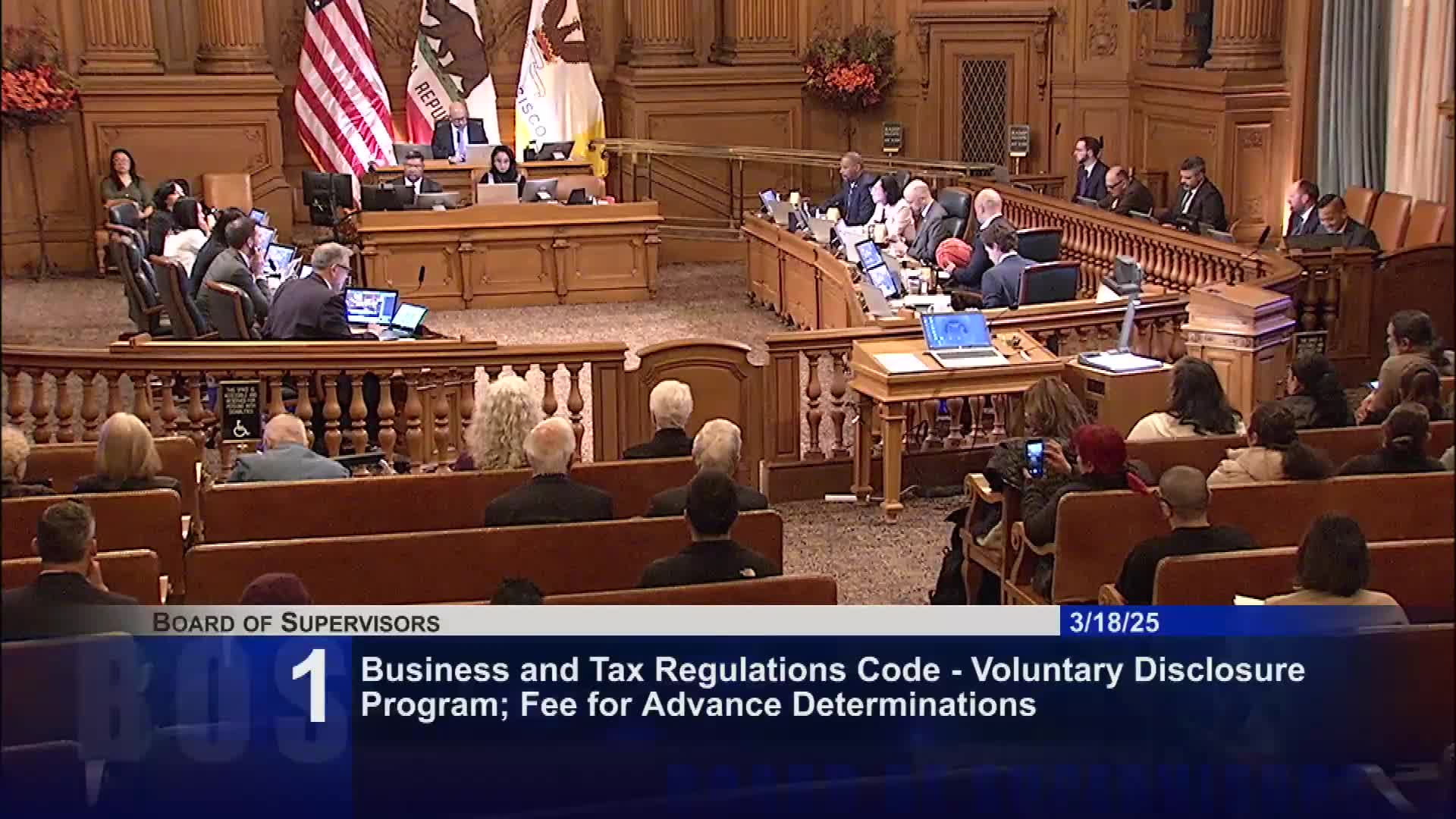
Board approves suspension of San Francisco's empty homes tax pending court decision, 9-2 on first reading
Summary
The Board of Supervisors voted 9-2 on March 18 to pass on first reading an ordinance that suspends the city's voter-approved empty homes tax until a final decision in ongoing litigation; supervisors raised concerns about administrative costs and revenue estimates during debate.
The San Francisco Board of Supervisors voted 9-2 on March 18 to pass on first reading an ordinance that suspends the city's voter-approved empty homes tax until a final court decision in ongoing litigation.
The ordinance, read into the record by the clerk, would suspend the empty homes tax pending a final decision in the lawsuit challenging the measure and would reinstate the tax to first apply in the tax year immediately following the calendar year of that final decision. The clerk said the measure requires a two-thirds vote to pass under the Business and Tax Regulations Code (Article 29A, section 29.61).
Why it matters: Supervisors and city fiscal staff said the legal uncertainty makes implementing the tax administratively difficult and could reduce near-term revenue, while opponents said suspension risks leaving significant revenue on the table during a budget shortfall.
Supervisor Joel Fielder, who opposed the suspension, said the tax is one of the tools in the city's housing affordability strategy and that he would "be voting no on today's ordinance." He added that he was "grateful for our city attorney's efforts to overturn the trial court's decision" and that he planned to follow the litigation closely.
Amanda Fried of the Treasurer and Tax Collector's Office told the board that the empty homes tax would apply to a large population of parcels and that collection would require an extensive outreach and filing effort. Fried said, "It was approximately, estimated at approximately $50,000,000," when asked about earlier yield estimates. A city official later clarified that the Budget and Legislative Analyst's revised estimate shows a lower annualized revenue impact (the BLA cited roughly $9 million in 2024 rising to about $15.4 million by 2026 in its report), reflecting market responses and other assumptions.
Fried and other staff described significant upfront administrative work for a novel filing population of roughly 80,000 parcels, saying many property owners would need education and multiple outreach mailings. Fried told the board the office would likely need to "triple our communications" and maintain a specially trained unit supported by the city attorney's office during periods of legal uncertainty.
Supervisor Connie Chan said she supported the suspension because the treasurer's office had warned that, while collection might be possible if an injunction were lifted, the administrative cost and confusion could exceed early revenue projections. Chan said that, "the administrative cost is greater than potentially projected, tax collected," and that uncertainty about retroactive collection contributed to her vote.
On the final roll call for the ordinance (item 2), the clerk recorded nine ayes and two noes; Supervisors Walton and Fielder voted no. The clerk announced, "There are 9 ayes and 2 no's with supervisors Walton and Fielder voting no." The ordinance passed on first reading.
The board did not adopt an immediate implementation plan in council that would begin collection while litigation proceeds; instead the ordinance delays collection until the tax year after final judicial resolution. The treasury and controller advised the board that the ramp-up period for a new filing population typically produces lower revenue in early years and higher administrative costs when litigation is pending.
The item will return for further consideration under the city's ordinance process as required for final passage and implementation.