Get Full Government Meeting Transcripts, Videos, & Alerts Forever!
Get email alerts on the Clean Power topic
No spam. Unsubscribe anytime.
SFPUC will not carry forward $593,152 for LAFCO projects; commissioners warned studies could be delayed
Summary
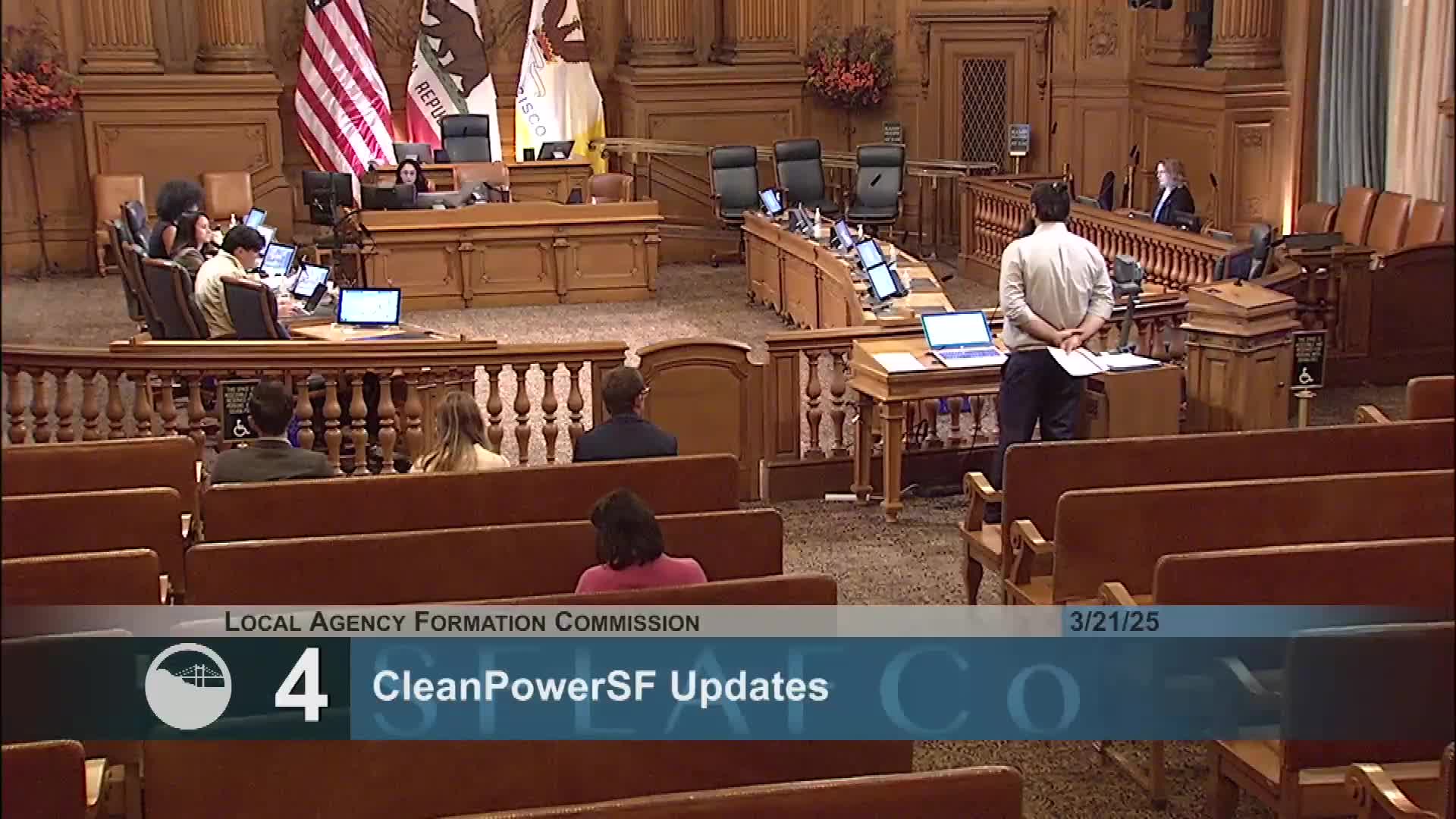
On March 21, 2025, Anna Dunning, budget director for the San Francisco Public Utilities Commission, told the San Francisco Local Agency Formation Commission (LAFCO) that the PUC does not intend to carry forward $593,152 in Clean Power SF funding identified in a February 21 memo, and asked LAFCO not to start any new projects not already underway.
On March 21, 2025, Anna Dunning, budget director for the San Francisco Public Utilities Commission, told the San Francisco Local Agency Formation Commission (LAFCO) that the PUC does not intend to carry forward $593,152 in Clean Power SF funding identified in a February 21 memo, and asked LAFCO not to start any new projects not already underway.
The announcement affects a memorandum of understanding between LAFCO and the PUC that had funded a series of studies, including a green bank financing study and a study of natural gas decommissioning. "There’s around $600,000 of SFPUC funding that has been set aside for the implementation of the MOU between Clean Power SF and SF LAFCO," Dunning said, adding that the PUC must prioritize reserves and core operations amid citywide fiscal constraints. "We are examining our spending across all our operations to ensure that every dollar ultimately benefits our rate payers."
LAFCO acting executive officer Khalid Somerai told commissioners the change will “obviously have an impact on LAFCO's budget and work plan,” and that commissioners are engaged with PUC commissioners to seek restoration of the funds. Somerai said if the funding is restored LAFCO would amend its work plan and add the studies back in.
Why it matters: LAFCO had expected PUC funding to support feasibility work tied to local climate and energy policy. Commissioners and staff said those studies would inform possible local tools — including a green bank and a plan for decommissioning parts of the city’s natural-gas infrastructure — that could affect long‑term costs and the city’s climate goals.
Clean Power SF staff explained near-term program metrics and how financial planning informed the decision. Mike Himes, deputy assistant general manager for power at SFPUC, said program participation remains above 95% and that Super Green — the highest-renewables subscription tier — now represents more than 16% of annual retail sales. Matthew Freiberg, Clean Power SF rates manager, said the utility has set a 150-day minimum cash-on-hand reserve target and a 180-day target as its long-term goal.
Freiberg said Clean Power SF is proposing no rate changes for fiscal year 2026, but warned of continued volatility in wholesale power and regulatory costs. He noted a short-term market effect: a currently negative PCIA for PG&E customers that, in the near term, can make some PG&E bills lower than comparable Clean Power SF residential bills by roughly $3 per month on average. "We are not in control of the PCIA and we are not in control of PG&E’s rates," Freiberg said, adding that Clean Power SF aims to maintain competitiveness while meeting reserve targets.
Commissioners pressed for more context. Commissioner Sevier and Vice Chair Williams both asked staff how the PUC’s reserve targets and broader city fiscal directives led to the decision, and whether the PUC considered alternative reductions. Dunning said the decision responded to mayoral direction for departments to reduce budgets and to agency-specific financial pressures, including capital and regulatory costs. She emphasized the PUC is "just barely meeting the minimum" reserve requirement and is prioritizing rate stability for ratepayers.
Clean Power SF staff outlined the program's schedule for its next integrated resource plan (IRP), which is due to the California Public Utilities Commission on Nov. 1, 2025, and described an outreach timeline that includes consultant procurement, modeling and community engagement in summer 2025.
What’s next: LAFCO and PUC commissioners are speaking outside the meeting about restoring the MOU funding. Somerai said LAFCO will amend its work plan if funding is returned.