Get Full Government Meeting Transcripts, Videos, & Alerts Forever!
Get email alerts on the Infectious Disease Avian Influenza topic
No spam. Unsubscribe anytime.
Health officer reports San Francisco's single H5N1 case; department steps up enhanced surveillance
Summary
San Francisco public-health officials reported one confirmed H5N1 infection in a city resident and said intensive contact tracing and serology found no evidence of person-to-person spread; the department described ongoing enhanced surveillance and preparedness planning.
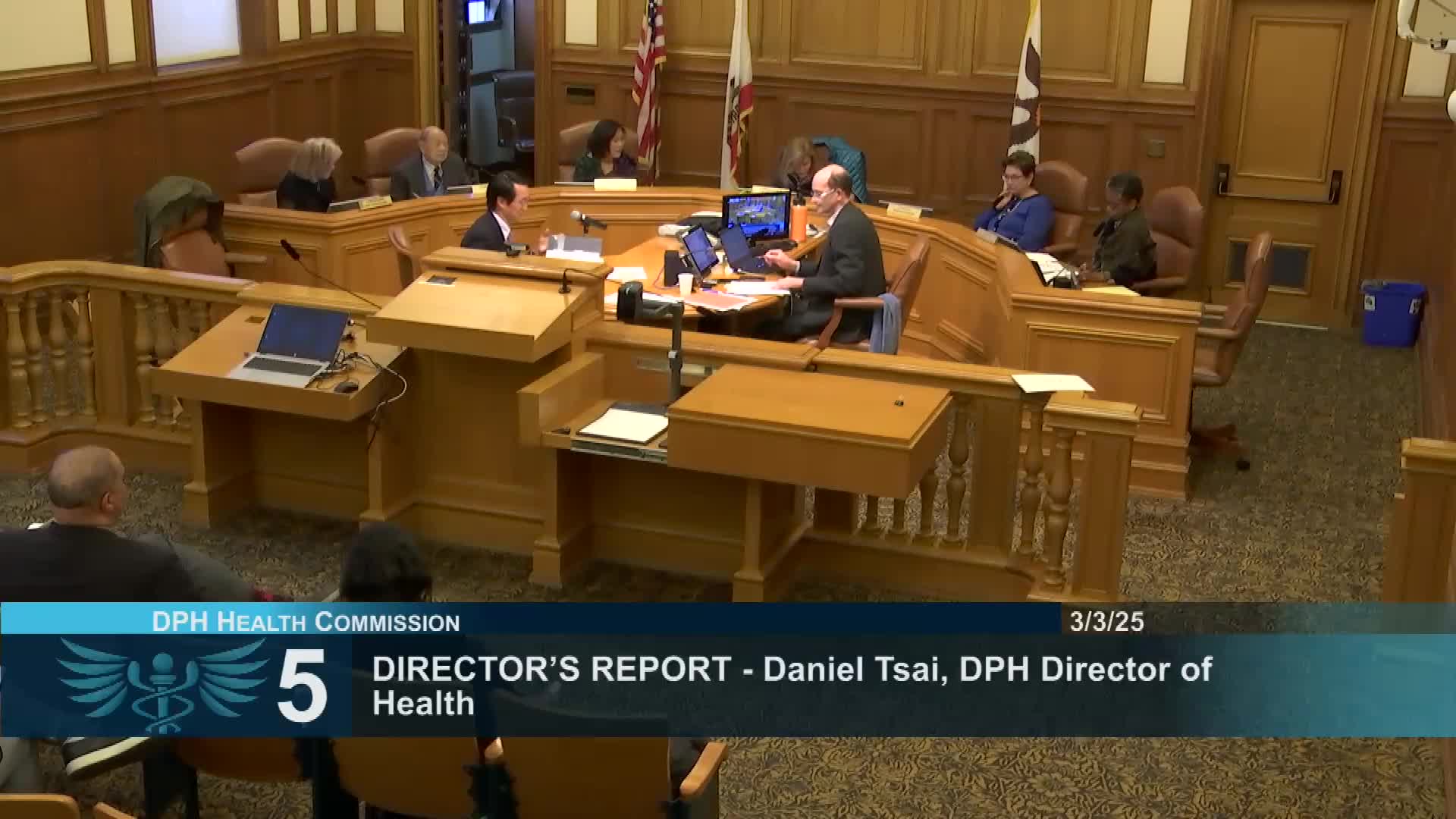
San Francisco's health officer briefed the Health Commission on the local and national status of avian influenza (H5N1), including one San Francisco case confirmed by the Centers for Disease Control and Prevention and no evidence of onward person-to-person transmission following an extensive investigation.
The case: On Jan. 9, 2025, the SFDPH Public Health Laboratory identified an influenza A specimen that CDC subsequently confirmed as H5N1. The specimen came from enhanced surveillance testing of respiratory samples that had tested positive for influenza A. Health Officer Dr. Susan Phillip told the commission the case was a child who lives in the city, experienced a short febrile illness with conjunctivitis and recovered within about a week. Genetic sequencing at CDC linked the virus to genotype B3 associated with the California dairy-cow outbreak.
Why this matters: Most U.S. H5N1 infections have been associated with agricultural exposure or consumption of unpasteurized milk; the absence of detected person-to-person transmission, limited clinical severity to date in most U.S. cases and the extensive negative testing and serology among close contacts suggest the immediate risk to the general public is low. At the same time, influenza viruses can mutate, so the department said it is preparing for multiple scenarios.
DPH findings and response
Dr. Phillip described a detailed contact investigation and testing effort coordinated with the California Department of Public Health and the CDC. Household members, school contacts and healthcare-worker contacts were interviewed and many submitted respiratory specimens and serology; all tested negative in those samples. The department noted that serology is voluntary and that not all close contacts provided specimens.
DPH officials described three surveillance and planning elements they are using now: - Enhanced laboratory surveillance: SFDPH subtypes influenza A specimens and sends specimens that cannot be subtyped to the public-health lab to look specifically for H5N1. Since June 2024, the lab has subtyped more than 900 influenza A specimens as part of this enhanced surveillance effort. - Provider outreach: DPH is alerting clinicians to consider testing and to consult the department for patients with compatible illness and risk factors (including exposure to dairy cows, poultry or consumption of raw milk products). - Wastewater monitoring: SFDPH is tracking influenza signals in wastewater (two watershed catchments cover the city). H5-level signals remain low in wastewater and are consistent with Bay Area trends; wild-bird detections can affect combined-sewer samples.
Planning and scenarios
DPH said it has an incident-management team (IMT) in place and has run tabletop exercises. The IMT is preparing for three possible scenarios: (1) isolated cases such as the one detected in January; (2) a virus that acquires sustained person-to-person transmissibility (moderate public-health threat); and (3) widespread person-to-person transmission with high severity (major public-health threat). Officials said work on mitigation strategies and a draft after-action report from the tabletop are under review and that plans for scenarios involving person-to-person transmission will be finalized shortly.
Vaccines and therapeutics
Dr. Seema Jain, the department's deputy health officer, told commissioners that the federal stockpile contains an estimated 5 million doses of H5 vaccine that have not been released for broad use; industry is also developing updated vaccines that may yield better immune responses. She said antiviral medications (e.g., oseltamivir and related agents) have been effective in reported cases to date and that DPH is including drug-allocation planning in its preparedness work in case supplies become limited.
Commissioners asked about the completeness of national and state reporting, wastewater signals, veterinary detections (including reports of H5 detection in rats in Riverside County) and the department's communications to clinicians and the public. Dr. Phillip said DPH maintains close informal and formal lines with CDC and the California Department of Public Health and is also working with national municipal public-health networks to track developments elsewhere.
Ending
DPH advised the public to avoid direct contact with sick or dead birds, not to consume raw milk or raw-milk products and to seek clinical evaluation for respiratory illness when appropriate. The commission requested updates as surveillance and planning evolve.