
Shorewood board hears 2025 budget assumptions; faces enrollment decline, possible referendum
Get AI-powered insights, summaries, and transcripts
Subscribe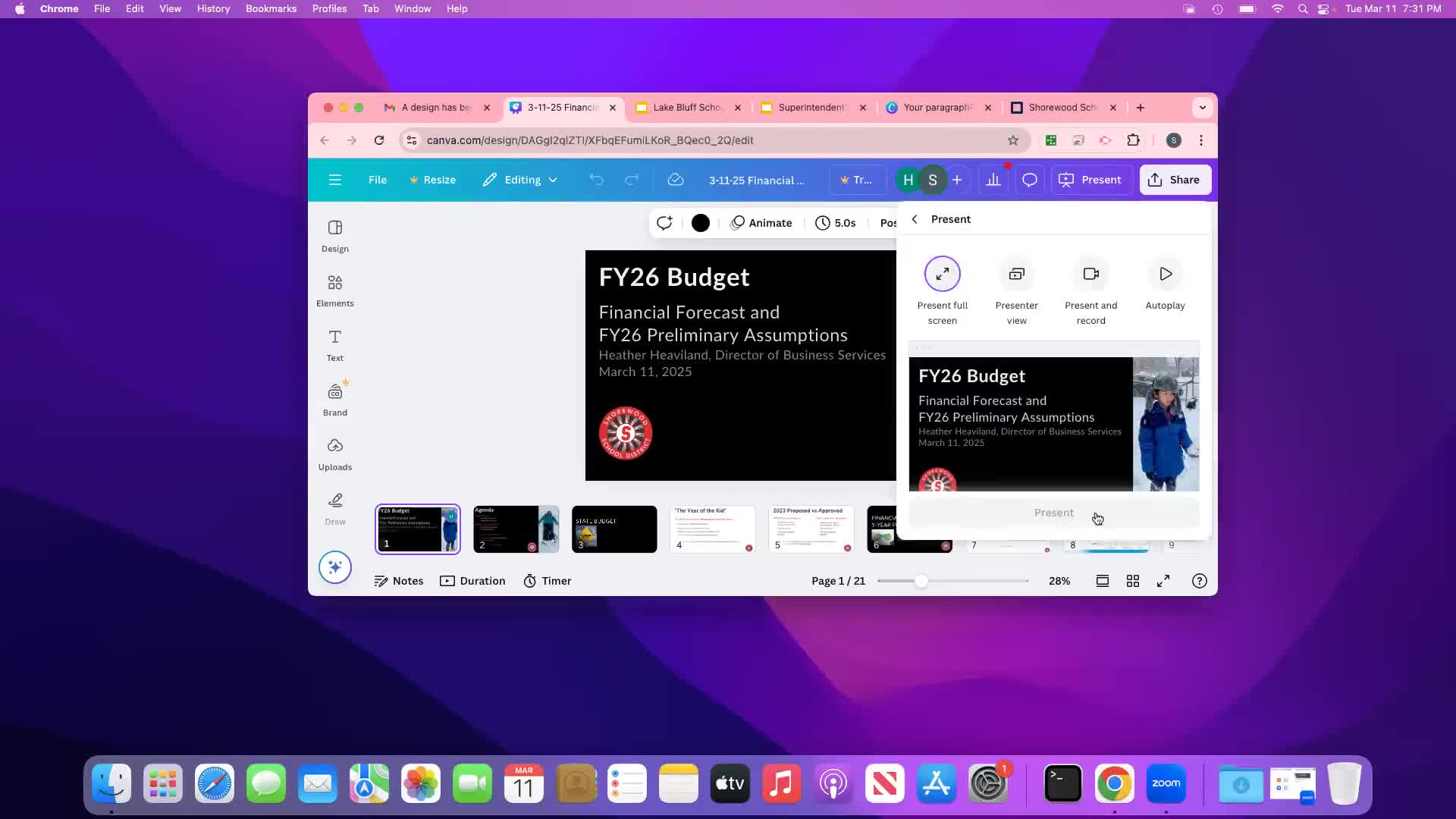
Summary
District finance staff presented a five-year forecast showing declining enrollment and rising per-student costs. Board members debated options including open enrollment, school consolidation/grade‑span changes and a likely operating referendum.
Shorewood School Board members heard a detailed presentation on March 11 about the district's 2025 budget assumptions and a five-year financial forecast that projects falling enrollment and rising per-student costs.
The presentation, led by district finance staffer Heather, said the district is projecting about a 2.5% enrollment decline for next year and warned that, if current assumptions hold, the district could face an operating shortfall in later years. Heather said the district will assume the $325 per-pupil revenue limit increase that has already been enacted will remain but is not counting on other proposed state increases such as additional per-pupil aid or increased special education reimbursement.
Those assumptions informed a model showing expenses rising about 3% annually while per-student costs could increase 4%–5% a year as enrollment falls. Heather said the district's preliminary five-year forecast shows surpluses tightening through 2028 and a possible net fund-balance decline in later years if no additional actions are taken.
Board and staff discussed three broad responses being evaluated: increasing open enrollment to attract more students; studying school reconfigurations or consolidations (grade-span changes) to realize staffing efficiencies; and pursuing another operating referendum to secure community funding. Several board members said the district will likely need one of those responses, with different trade-offs for programs, facilities and community expectations.
"We're going to assume that the $325 per year that was already put in place isn't removed," Heather said, summarizing the conservative revenue assumptions the budget team is using. She added that other proposed state items "aren't going to happen" for planning purposes given the uncertainty in the legislative process.
Superintendent Dr. Burgos framed the state-policy context that complicates forecasting. She noted recent federal and state actions, including shifts in Department of Education staffing and new reporting mechanisms related to DEI, and said district staff are monitoring guidance from NEOLA and the Wisconsin Department of Public Instruction. "We don't consider DEI to be a threatening term here. It is part and parcel to who we are in Shorewood," she said, describing the district's approach to continuing that work despite external scrutiny.
Board members asked for detailed studies and outside analyses before making major structural changes. Board member Abby said she favors a proactive approach to enrollment: "I'm leaning towards open enrollment as the answer as sort of the baseline," she said, urging maximizing the number of students in district schools to sustain staff and programming. Other board members expressed openness to studying grade-span reconfiguration but said the community would expect a careful, evidence-based analysis showing educational and operational impacts before any change.
On special education funding, Heather and other staff warned that any increase in state matching would likely be based on prior-year spending and could arrive with a lag, limiting how the district could immediately rely on such funds to cover new, recurring personnel costs.
Next steps described by staff include an external enrollment study due to start next month, continued refinement of the FY26 budget assumptions, and a deeper analysis of school-configuration scenarios and their programmatic consequences. Heather said the district will bring more refined options and budget trade-offs back to the board this spring and into the summer.
The presentation did not include a formal board vote. Trustees signaled they expect continued, detailed discussion and more data before any formal decision. The board asked administration to return with the external enrollment study results and clearer fiscal scenarios for each policy option.
For context, the district's finance presentation included these illustrative figures noted by staff: a $58 increase in per-pupil aid proposed in the governor's budget (treated as uncertain), a potential revenue-limit increase (reported in other proposals as $334 per member but not counted in the district's baseline), an assumed $325-per-pupil increase the district will treat as enacted, and a projected multi-year fund-balance tightening if no further revenue or structural changes occur.
Board members and administrators agreed the next several months' work will focus on three things: (1) confirm assumptions after the state budget process becomes clearer, (2) complete the outside enrollment analysis, and (3) present concrete fiscal scenarios (including estimated tax impacts) the public can evaluate ahead of any referendum discussion.
Ending: The board did not take any formal action on the budget assumptions at the March 11 meeting. Staff will return to the board with updated revenue numbers, the enrollment study findings and cost/savings estimates for proposed structural options before the district finalizes the FY26 budget.