Get Full Government Meeting Transcripts, Videos, & Alerts Forever!
Get email alerts on the K 12 Education Extracurriculars topic
No spam. Unsubscribe anytime.
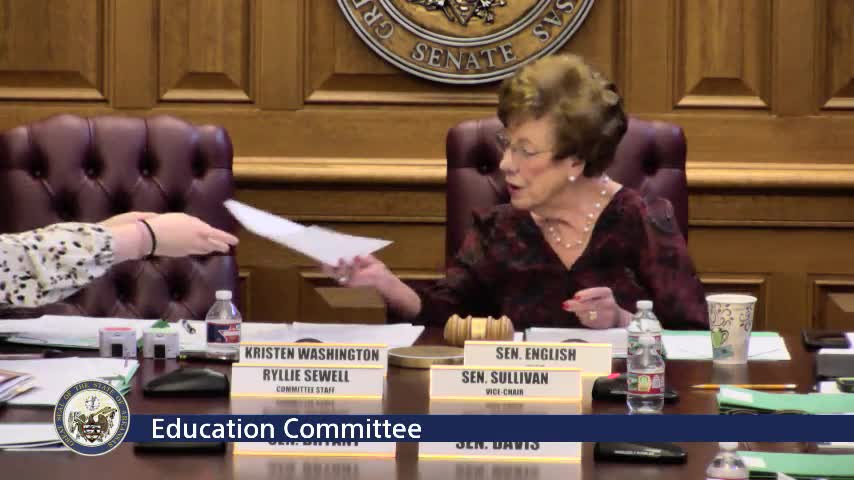
Senate panel approves amendment to let private and microschool students join public-school activities, with funding to follow
Summary
A Senate committee approved an amendment that would allow students enrolled in private micro schools or similar small programs to participate in extracurricular activities at their resident public schools, with a portion of state foundation funding following the student to the public district.
A Senate committee approved an amendment that would allow students enrolled in private micro schools or similar small programs to participate in extracurricular activities at their resident public schools, with a portion of state foundation funding following the student to the public district.
The amendment, introduced by State Senator Tyler Deese, clarifies “and adds the funding stream that would follow the student, to the public school,” Deese told the Education Committee. He said the amendment adds “the 1/6 foundational funding, that would follow to the resident school district.”
The change was adopted by voice vote after committee members asked how it would affect district budgets and which entities would bear costs such as transportation.
Why it matters: Committee members said the amendment seeks to address a narrow, growing problem they described as arising after new rules changed how some homeschool and microschool students participate in activities. Under current Arkansas Activities Association (AAA) rules, Deese said, students enrolled in some newly accredited micro schools could lose the ability to take part in band, choir or sports at the public school; the amendment is intended to preserve existing access in similar fashion to current homeschool provisions while ensuring districts receive funding for participating students.
Deese said the proposal is permissive: public schools may decline participation if they determine a capacity or other issue exists. "It's permissive. If...the public school sees any issues, they can decline," Deese said. He added that the amendment was written to match language used for homeschool participation and to ensure proper funding flows to public districts.
Committee members pressed for clarity on cost. Senator King asked whether any fiscal estimate was available; Deese said there was no official cost estimate and that the total would depend on how many students participated. Deese and others noted the amendment ties to the existing foundation funding mechanism and to the state’s education funding formulas; Deese said the current foundation funding figure is “around that $7,700 range,” and framed the amendment as aligning with that metric.
Courtney Salas Ford of the Department of Education told the committee there is no legal or regulatory definition for a "micro school" or "microschool" in current state law; she described the term as commonly referring to a group of homeschool students organized like a cooperative.
Scott Smith with the Arkansas Public School Resource Center asked the committee to clarify whether charter schools would be treated the same as traditional districts for this provision. Smith said the bill’s wording appeared to limit transfers to the resident school district and recommended that charter schools be included as possible receiving public schools. Senator Deese agreed to seek clarity and to revise the language.
Dr. Hernandez, representing the Administrative Association, explained how funding reporting typically works for homeschool students enrolled in a course at a public school. He said funding is reported based on attendance and that districts do not necessarily receive a full-year full-time-equivalent (FTE) if a student leaves midyear: "If that student enrolls for a period of time...if they were to leave, they would fall off that reporting," Hernandez said.
On transportation, Deese said families would be responsible: "That would be the student and the family," he said when asked who would bear the cost.
Concerns raised included the potential for long-term abuse by providers creating small programs that send students to public schools for activities while avoiding offering extracurriculars themselves. Senator Fable warned that the change could encourage creation of microschools that rely on public schools for extracurriculars and cautioned about protecting the integrity of Education Finance Accounts (EFA) funding.
The sponsor agreed to pull the bill down to revise language and return with clarifications, including whether charter schools are explicitly covered and with additional data on how many students now participate under current homeschool rules.
Ending: Deese told the committee he would return with revised language and more information. "I'll go back and do my homework and get back to this," he said.