Get Full Government Meeting Transcripts, Videos, & Alerts Forever!
Get email alerts on the Fetal Development Education topic
No spam. Unsubscribe anytime.
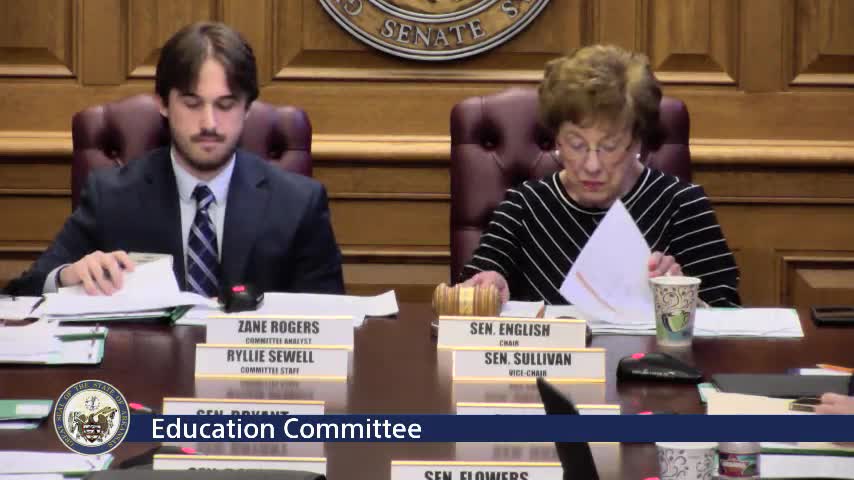
Arkansas committee hears hours of testimony on ‘Baby Olivia’ bill; action deferred
Summary
The Senate Education Committee heard extensive testimony for and against House Bill 1180, which would add a short fetal-development video to health curricula beginning in sixth grade. Lawmakers and witnesses debated medical accuracy, emotional impact, and curriculum control; the committee moved the bill to be deferred for later consideration.
Representative Mary Bentley, sponsor of House Bill 1180, told the Senate Education Committee that the proposal — dubbed the Baby Olivia Act — would require school districts and open-enrollment charter schools to include six minutes of fetal-development instruction in existing health and safety classes beginning in sixth grade. "This bill is about teaching children the basic facts about human development in an approachable way," Representative Mary Bentley said.
The bill would direct the Department of Education to promulgate a list of approved videos and explicitly lists the three-minute Meet Baby Olivia video produced by Live Action as the first approved resource. "That is the first video that we want to add to the list," Bentley said.
Supporters described the video as medically accurate and age-appropriate. Arkansas Surgeon General Dr. Kaye Chandler, a practicing obstetrician-gynecologist, told the committee that the video is grounded in research and uses embryology standards that measure development from fertilization. "This education involves weeks from fertilization," Dr. Kaye Chandler said, adding that the Endowment for Human Development provides extensive sourced research used in materials like the video.
Witnesses testifying in favor said the lesson fits existing sixth-grade life-science standards and could counter misinformation young people encounter online or in peer settings. Vicky Parker of the Arkansas Pregnancy Network said, "A picture is worth a thousand words" and argued that showing fetal development would correct what she called misleading views that an embryo is "a blob of tissue." Elizabeth Bryant, executive director of Reality Check Incorporated, told the committee she uses puberty curricula for sixth graders and called the video "age appropriate" and medically accurate.
Opponents raised concerns about medical accuracy, emotional harm, and the absence of broader reproductive-health context. Nicole Carey, education policy director at Arkansas Advocates for Children and Families, said the American College of Obstetricians and Gynecologists (ACOG) has described the Live Action video as "emotionally manipulative" and warned that presenting fetal development without comprehensive instruction on consent, healthy relationships and contraception could have unintended consequences for students who have experienced trauma. "We agree that medically accurate fetal development should be taught in schools, but it cannot be taught in a vacuum," Carey said.
Medical witnesses were split. Dr. Chad Taylor, a Little Rock obstetrician-gynecologist, testified that parts of the video contain medical inaccuracies and urged that local clinicians, educators and medical schools help develop materials. "If you really want to teach embryology and physiology, there are textbooks on this," Dr. Chad Taylor said. By contrast, Dr. Sherry Amaya, a fellow of ACOG and practicing OB-GYN, said she had reviewed the video and considered it "a good resource," noting it uses weeks-from-fertilization terminology commonly used in embryology.
Several speakers urged adding context and accompanying curricula: Britney Stockton, a parent testifying in opposition, said the state must teach children how to recognize abuse and seek help, arguing a single fetal-development video could retraumatize victims. "We need to teach them about consent, how to recognize inappropriate conduct, and how to seek help when they are in danger," Stockton said.
Representative Bentley closed by emphasizing support in the House and framing the measure as a short, science-based addition to existing instruction. After public testimony and committee discussion, a procedural motion was made to defer the bill for later consideration. The committee recorded that motion as moved to defer; specific roll-call tallies for the final procedural action were not specified in the transcript.
The committee earlier approved a separate procedural motion to limit debate to five minutes per side during the hearing.
What’s next: The committee deferred HB 1180 for later action; no final enactment or statutory change occurred during this meeting. The Department of Education and the governor’s office were described in testimony as neutral on the bill.