Prescott Valley police present data-driven traffic safety plan; department highlights enforcement, education and engineering
Loading...
Summary
Chief Bob Teyser told the council on March 6 that the Prescott Valley Police Department is increasing targeted enforcement and community education while partnering with engineering to reduce crashes and injuries.
PRESCOTT VALLEY, Ariz. — The Prescott Valley Police Department on March 6 outlined a traffic safety program that pairs data-driven enforcement with community education and engineering changes to reduce crashes and injuries on local roads.
Chief Bob Teyser briefed the Town Council on enforcement priorities, outreach programs and partnerships with the town’s engineering team and regional agencies. The department described enforcement targeted to high-crash locations, ongoing DUI enforcement, bicycle safety outreach and school-based education programs.
“Traffic safety is one of our key goals,” Chief Bob Teyser said. “Every day in our community, that's the most dangerous thing, that anybody does in our community, whether they're driving, riding, or walking along our roadways.”
Teyser presented department data comparing 2024 to 2023: 217 impaired-driver arrests in 2024 (alcohol, drugs or combination), more than 5,500 citations issued, an increase in overall traffic stops and a reported 13.09 crashes per 1,000 residents (a metric staff uses to account for population growth). The department reported 159 injury-related crashes in the last year and three fatalities; DUI-related crashes were down 18%.
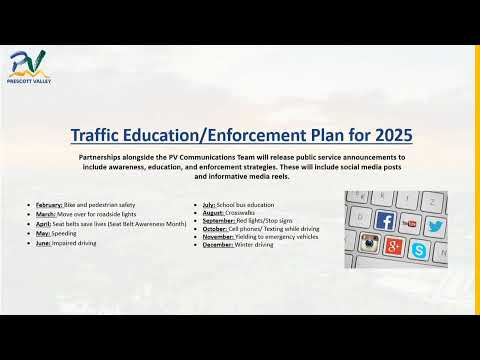
The chief described a three-pronged strategy of enforcement, education and engineering. Enforcement includes selective, directed patrols using unmarked traffic cars and motorcycle units — assets the department said were acquired through grants from the Arizona Governor's Office of Highway Safety. Education work includes school outreach, bicycle rodeos, car-seat safety clinics and public information campaigns on social media. Engineering tools cited were speed trailers, data-driven identification of collision hotspots, and coordination with the town’s traffic engineers to evaluate roadway changes.
Teyser singled out partnerships and grant funding: the department receives competitive grants for impaired-driving enforcement, occupant protection, bicycle/pedestrian safety and other programs. “We get some significant grants from the Arizona governor's office of highway safety,” he said, adding that recent grants funded unmarked traffic vehicles and new motorcycles used in enforcement.
Council members and staff offered suggestions and raised concerns. Councilman Freund proposed an expanded bicycle-safety campaign timed to the school calendar that would include in-school training, printed handouts, a student essay contest and community safety booths. “I have ideas for motorcycles and cars and pedestrians too,” Freund said, urging action before schools let out for the season to reach students.
Council members also asked about jurisdictional responsibility on state highways. Teyser replied that municipal police enforce collisions on state roads that traverse the town (for example stretches of State Route 69 and 89A) and that the department frequently coordinates multi-agency saturation patrols with the Arizona Department of Public Safety and Yavapai County sheriff’s deputies.
Teyser concluded by noting ongoing public outreach and community requests drive enforcement decisions: speed trailer deployments and targeted patrols often follow resident complaints, and the department expects to continue education and enforcement highlights throughout the year.
Council members thanked the department for proactive engagement and urged continued attention to speeding, bicycle safety and school‑age outreach.