Get Full Government Meeting Transcripts, Videos, & Alerts Forever!
Get email alerts on the Bond Refunding And Opioid Policy topic
No spam. Unsubscribe anytime.
School board approves bond refunding delegations and adopts opioid overdose reversal policy
Summary
At its March 13 meeting the Snoqualmie Valley School Board unanimously approved two resolutions authorizing steps to pursue a bond refunding and delegated authority to execute the sale, and unanimously approved an amended district policy on opioid overdose reversal.
The Snoqualmie Valley School Board on March 13 unanimously approved two resolutions to enable a planned bond refunding and adopted an amended policy on opioid overdose reversal.
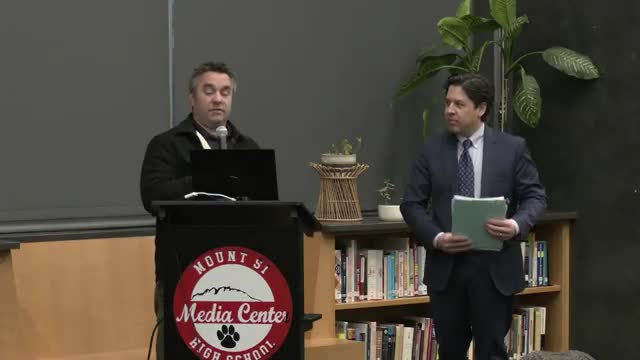
The first resolution (No. 889) authorized the district to request a certificate of eligibility from the state treasurer under chapter 39.98 RCW as part of the district's plan to refinance outstanding bonds; the board then approved a delegation resolution (No. 890) authorizing district staff to finalize and execute the bond sale if refinancing savings meet the district's target. Bond counsel Lee Marchezio of Foster Garvey, who attended the meeting, described the two draft resolutions as "necessary to delegate authority to district administration to approve the bond sale when it happens, when we get to the pricing date." The motions to approve were made and seconded on the floor and passed unanimously.
In a separate vote, the board approved an amended policy 3424 on opioid-related overdose reversal after a third reading. Board members discussed edits to the policy's cross-references and to procedural language addressing training; the motion adopted the suggested amendment to refer to the accompanying procedure. Selena Faso, present to answer questions, confirmed that the procedure would address training and implementation details.
Why this matters: the bond resolutions set the administrative authority and procedural steps needed to move forward quickly with a refunding if market conditions yield the district's minimum savings target, while the opioid policy sets district-wide guidance for responding to overdoses on school property.
Votes at a glance
Resolution 889 — Certificate of eligibility Motion: Approve Resolution No. 889 authorizing the district to request a certificate of eligibility from the state treasurer pursuant to chapter 39.98 RCW and related delegation of authority for filing the request. Mover/Second: not specified in the record Outcome: approved (unanimous) Notes: Board approved the resolution and directed staff to proceed with required filings.
Resolution 890 — Delegation resolution Motion: Approve the delegation resolution authorizing district administration to finalize bond pricing and execute refunding if minimum savings target (set at 5%) is met. Mover/Second: not specified in the record Outcome: approved (unanimous) Notes: Delegation permits staff to act on pricing date without returning for a separate board authorization if conditions meet the resolution's thresholds.
Policy 3424 — Opioid-related overdose reversal (amended) Motion: Approve amended policy 3424 with suggested edits to cross-reference the accompanying procedure (procedure 3424p) and clarify training responsibilities. Mover/Second: not specified in the record Outcome: approved (unanimous) Notes: The board voted to replace a reference to policy 3416 with procedure 3424p and to rely on the procedure to document training steps and responsibilities.
Procedural context and next steps Bond counsel Lee Marchezio remained available after the votes to collect required signatures and to prepare documents for processing the next day. District staff and counsel will proceed with the statutory filings and with the administrative steps the resolutions delegate to them. The amended opioid policy will be implemented according to the accompanying procedure, which staff indicated contains the detailed steps for training and operationalization.
All motions passed with no recorded opposition; roll-call vote tallies by name were not provided in the meeting record.