Get Full Government Meeting Transcripts, Videos, & Alerts Forever!
Get email alerts on the School Sports Transfers topic
No spam. Unsubscribe anytime.
Heated hearing on student transfer rules: subcommittee advances bill codifying broader first-time transfer eligibility for athletics
Summary
House Bill 25, which incorporates a recent change by the Tennessee Secondary School Athletic Association (TSSAA) to broaden immediate athletic eligibility for certain first-time transfers, moved out of subcommittee despite opposition from TSSAA leadership about legal consequences.
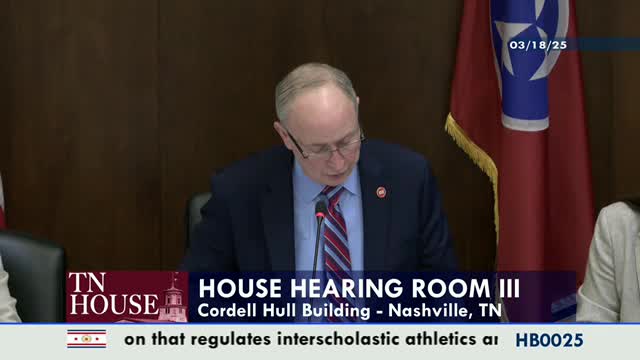
The House Education Administration Subcommittee advanced House Bill 25 to the full Education Committee after an extended discussion and public testimony about transfer eligibility and TSSAA governance.
Chairman Cipicchi (sponsor of HB 25) framed the bill as a technical clean-up and a codification of a transfer-eligibility rule the Tennessee Secondary School Athletic Association’s legislative council adopted March 3. The language included in an amendment added in subcommittee would allow a student’s first transfer to another member school to be immediately eligible for interscholastic athletics if the transfer occurs for a significant academic, social, emotional, environmental or mental health need — provided the sending school does not, within seven days, attest that the transfer was for athletic or disciplinary reasons. The amendment also limits the special eligibility to transfers made before the first day of the school year to guard against midseason roster changes.
Mark Reeves, executive director of the Tennessee Secondary School Athletic Association, told the committee TSSAA’s legislative council approved similar language but asked the legislature not to codify it into state law. Reeves and TSSAA counsel Richard Colbert warned that placing eligibility rules into state statute would remove a jurisdictional barrier that now limits lawsuits challenging TSSAA decisions. Colbert explained that, under Tennessee precedent, courts generally decline to intervene in the internal affairs of voluntary associations except where constitutional rights are implicated or actions are arbitrary and capricious; codifying eligibility rules in state law would invite broader judicial review and a likely wave of litigation that could be costly to member schools and the association.
Parent Jason Cooper testified in support of HB 25, describing a case he said showed inconsistent TSSAA application of transfer rules and the emotional toll on his son when the association denied eligibility after the family moved for documented academic, medical and family reasons.
Committee members split along enforcement and institutional-responsibility lines. Representative Hurt said she shared TSSAA’s concerns about potential litigation but urged the association to increase consistency in applying rules. Representative Glenn and others said they feared codifying the rules would insert government into a voluntary association’s internal operations. Chairman Supicki said he had asked for an attorney general opinion about whether the AG’s office would defend statutory language if codified; he also flagged that several other states have taken varied approaches and suggested further legal vetting.
The record shows a roll-call result of four ayes and two nays; the bill moved to full Education. Sponsors and TSSAA indicated continued discussions would continue as the measure proceeds.