Get Full Government Meeting Transcripts, Videos, & Alerts Forever!
Get email alerts on the Right Of Way topic
No spam. Unsubscribe anytime.
Council approves updated right-of-way permitting rules after industry talks
Summary
After months of negotiations with utilities, the committee approved a substituted version of ordinance 2024-950 that sets new notice and bonding rules for work in city rights of way and leaves technical inspection details to permitting staff.
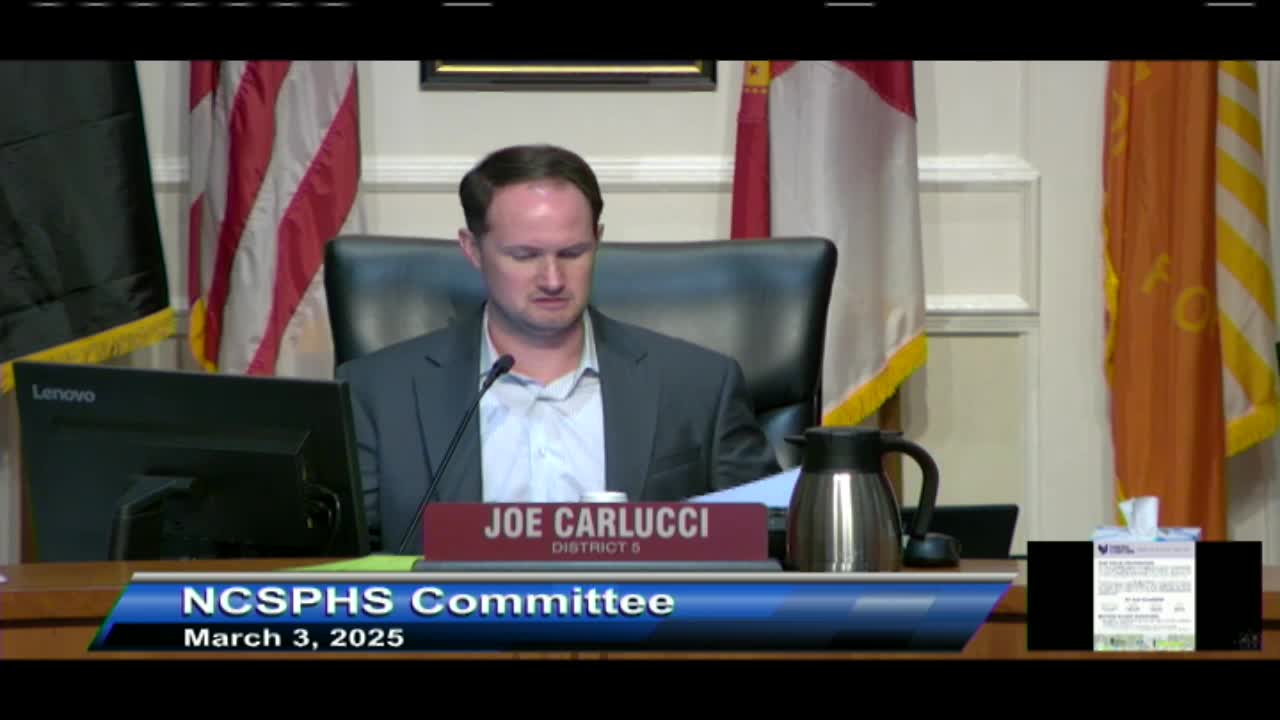
The Jacksonville Neighborhoods, Community Services, Public Health and Safety Committee on March 3 approved a substituted version of ordinance 2024-950 to change notice, bonding and inspection requirements for companies doing work in the city's rights of way.
The substitute adopted Wednesday was the industry's revision of a measure introduced by Councilmember Mike Gay. The committee approved the industry substitute by voice and then by recorded ballot, 7-0.
The adopted substitute establishes a new annual surety approach for utilities and other permittees, narrows residential driveway work to a lower bonding threshold, and reduces advance public-notice requirements while leaving the technical structure of construction engineering inspections to city permitting processes.
Councilmember Mike Gay, the bill sponsor, told the committee he introduced the issue to protect neighborhood road and sidewalk restorations and to improve public notice for affected properties. "This was created to protect our right of ways and our roads to make sure they get restored correctly but also notifying the public of when projects are gonna take place," Gay said.
Jason Teal, an attorney in the Office of General Counsel who helped draft the substitute language, described the compromise: smaller, routine residential driveway work will be subject to a lower letter-of-credit requirement while larger or multi-project contractors may opt for the annual surety model. Teal said public-works staff will set project milestones for inspections and that permitting staff can handle the CEI (construction engineering inspector) checkpoints rather than the ordinance prescribing continuous on-site CEI coverage.
Industry representatives said their two main concerns were (1) not requiring a per-project bond equal to a percentage of each project's cost and (2) the cost of requiring a dedicated CEI inspector on-site for many utility jobs. Carlo Fassi of TECO Peoples Gas told the committee that an industry-wide per-project bond at a percent of project cost would be an unprecedented and substantial administrative and financial burden. "A new bond at that cost is provides a significant cost, not financial not just financially, but also administratively," Fassi said. He said the industry proposed a $50,000 annual bond for larger contractors and a $10,000 letter-of-credit for most residential driveway permits.
Public-works staff reported the city currently receives roughly 500 right-of-way permit applications per month and about 10 complaints a month related to right-of-way work. Nina Sickler, who recently took responsibility for Development Services, told the panel the complaints can represent significant potential liability if a repair is large. "When you think about the bonding, it's just like insurance," Sickler said, adding project scale guides how the city evaluates risk.
The substitute reduces the public-notice period to 5 business days for projects estimated to last longer than two days and includes an explicit exemption for telecommunications service providers where state law preempts local notice requirements.
Council President Randy White and other members said they supported compromise language that reduced the potential financial burden on customers. "If I were in their shoes, I wouldn't like that," White said of large new bond demands. After adoption, the committee instructed OGC and staff to finalize technical drafting with industry and the auditor's office before the measure moves to additional committees.
The final committee ballot was 7-0 in favor of approving 2024-950 as substituted; the committee also agreed to require that any annual surety bond, if drawn on, be replenished back to the required level (language to be finalized by OGC with industry). The ordinance now proceeds to other reference committees for final readings.
The committee recorded substantial back-and-forth over three items: bonding thresholds, notice timing and the practical structure and cost of CEI inspectors. Members said they expected more implementation details to be refined by Development Services and the Office of General Counsel.