Get Full Government Meeting Transcripts, Videos, & Alerts Forever!
Get email alerts on the Budget And Efficiency topic
No spam. Unsubscribe anytime.
Jacksonville council auditors outline efficiency review as city faces multi‑year shortfalls
Summary
Council auditors presented a plan modeled on a 2007–08 “lapse” review to identify potential efficiencies and short‑term savings as Jacksonville faces projected deficits; council members raised concerns about service impacts and asked for greater public engagement and details on incentives and capital spending.
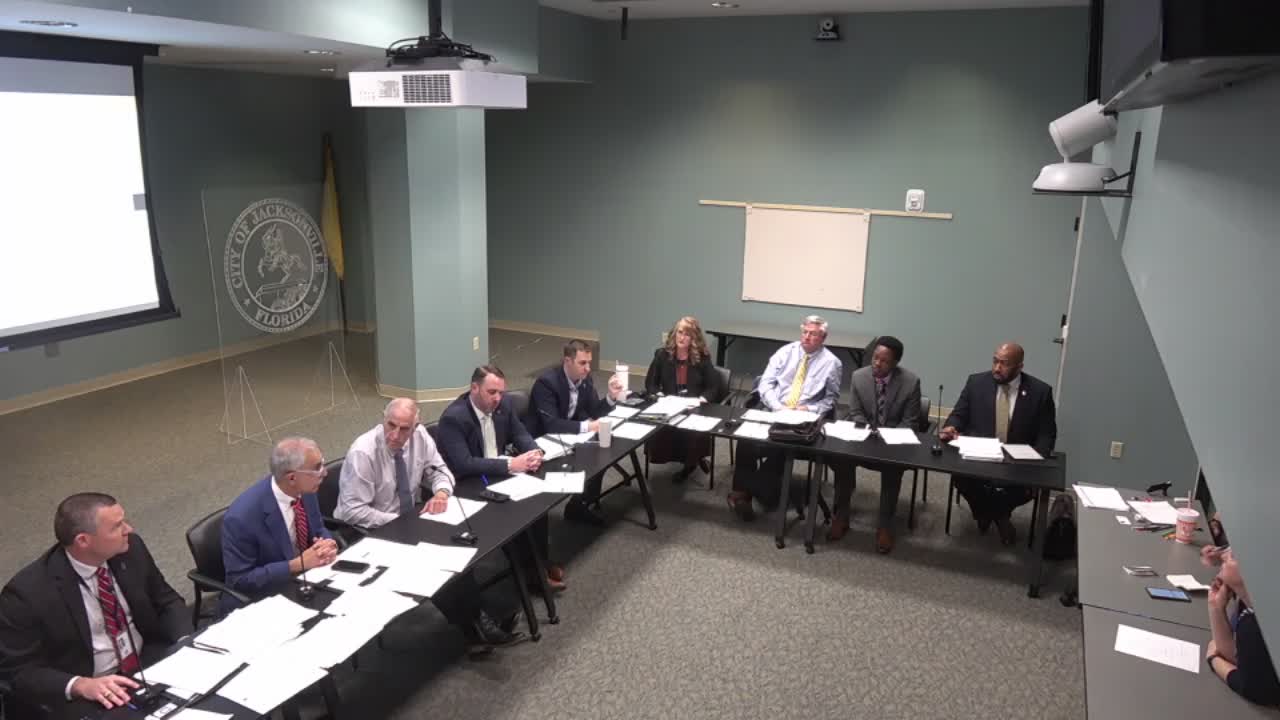
Councilmember Salem convened a special meeting of the Jacksonville City Council to hear a presentation from the council auditor on the city’s financial outlook and a proposed efficiency review aimed at addressing projected multi‑year revenue shortfalls.
The presentation by Kim Taylor, council auditor, described short‑ and long‑term approaches the audit office can take — including revisiting a 2007–08 process that placed a small “lapse” across general fund departments and directed detailed efficiency reviews — and recommended immediate steps the council could begin before the July budget process.
Taylor told the council the audit office had identified a set of short‑term items to examine, including potential overlaps in program and nonprofit funding across departments, rental and utility assistance programs funded through multiple sources (including American Rescue Plan funds), children’s programming run by multiple city entities, utilization of city facilities post‑COVID, banking and credit card processing fee consolidation, and oversight of economic incentives administered by the Downtown Investment Authority (DIA) and the Office of Economic Development (OED). Taylor said such reviews could reveal duplications or streamlining opportunities but emphasized that policy decisions about service levels would remain with the council.
The audit office also outlined what it calls the post‑budget option used in 2007–08: a citywide below‑the‑line lapse (the previous review used a 2% lapse on general fund departments, excluding sheriff and fire) and detailed “0‑based” reviews of departments. Taylor said the 2007–08 process convened seven meetings, produced an operating lapse that generated roughly $5,000,000 at the time, and ultimately restored $3,900,000 of an original $4,800,000 lapse (about 82%), with about $885,000 not restored.
Councilmembers raised a series of concerns and requests for more detail. Council Member Howland and others pressed for attention to the timing of any decisions, noting the property tax roll and other revenue figures that will affect the budget. Council Member Layman and others asked that the review also address whether the city has sufficient staffing to execute core public works and permitting tasks if cuts or reorganizations are considered.
Several council members urged that the review include a closer look at capital projects and incentives. Council Member Layman said the city is carrying significant debt service — which Taylor and Layman described as about $125,000,000 of debt expense in the current budget year — and Council Member Layman and Council Member Arias urged review of roughly $80,000,000 in cash incentive commitments concentrated downtown. Arias and others also noted recent cuts: Taylor and councilmembers referenced about $47,000,000 removed from the prior year’s budget to balance that cycle.
Some council members voiced skepticism of the process and of how the term used for the review — referenced in public discussion as “DOGE” — has been perceived. Council Member Peluso distributed a comparative handout of peer cities and cautioned that Jacksonville’s combined city‑county structure already operates efficiently in some departments; Peluso and others said residents had expressed concern that the review could lead to cuts in services for vulnerable residents. Council Member Gaffney said constituents asked “what prompted this meeting and why now,” and Salem said the timing reflected projected multi‑year deficits and a desire to present the council with options before broader public release.
Several procedural directions emerged during the meeting. Councilmember Salem said he would schedule a follow‑up meeting next Tuesday at 12:30 p.m. to receive public comment and additional council questions. He also indicated the council president would determine whether to form an ad hoc special committee to pursue the short‑term items identified by the auditors and to consider a deeper fall review modeled on the 2007–08 process. Taylor said the audit office and staff (including Brian Parks and Philip Peterson, present at the meeting) have capacity to facilitate that work and to pull relevant financial data on capital projects and other items for council review.
Taylor and several council members emphasized that a lapse differs from an outright cut: a lapse establishes a lower net budget but permits departments to manage operations within the net, and prior lapses were followed by periodic legislation to restore funds where necessary. Taylor said the prior process used multiple follow‑up bills to restore funds as needed and that departments were involved in vetting potential impacts on services.
The meeting closed with the chair moving to the council meeting, noting the council meeting would include a 90‑minute public comment period and reminding members that the follow‑up session would be scheduled in the council chambers to accommodate more people.
Ending: The audit office recommended a two‑track approach: short‑term reviews council can begin immediately and a deeper post‑budget departmental review if the council directs it. Council members requested additional data on capital projects, incentive commitments, debt service, and where proposed short‑term savings would be applied; a timetable for an ad hoc committee and public engagement was left to the council president and a follow‑up meeting scheduled by Salem.