Get Full Government Meeting Transcripts, Videos, & Alerts Forever!
Get email alerts on the Land Use topic
No spam. Unsubscribe anytime.
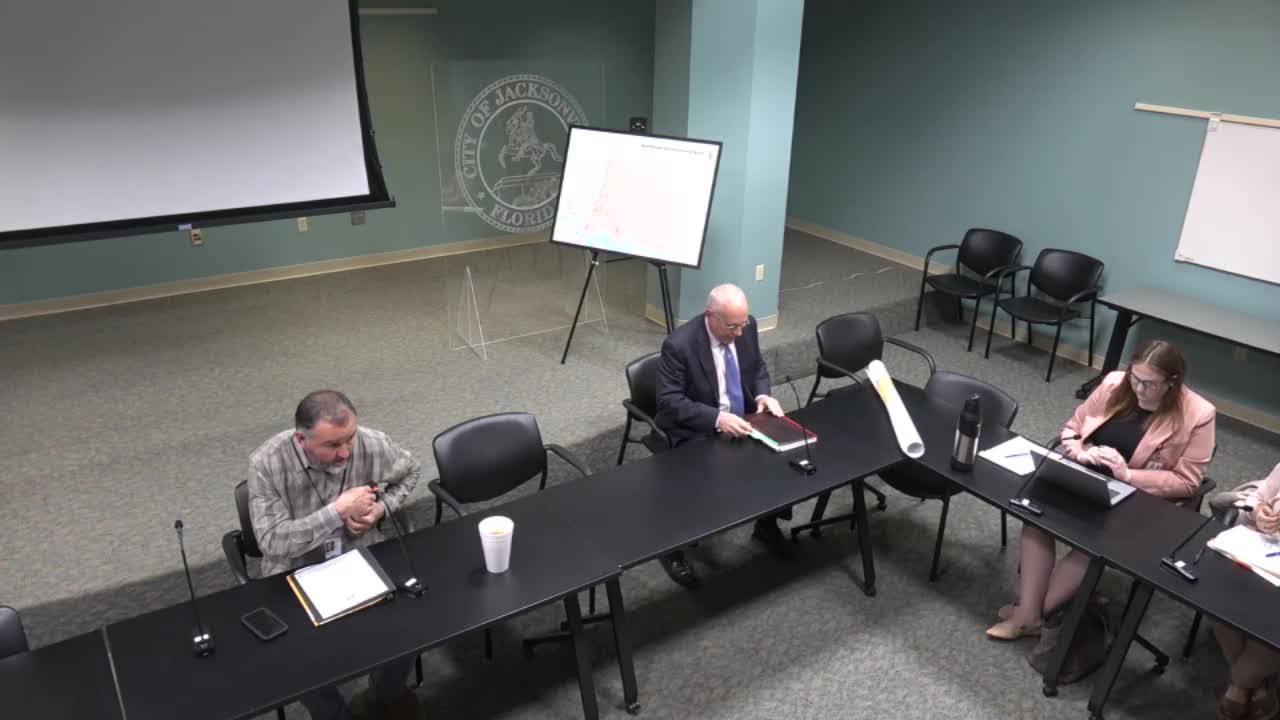
Councilman outlines Northeast Review Board proposal as residents press for development limits
Summary
At a City Council notice meeting, Councilman Mike Gay described an ordinance to create a Northeast Review Board for northeastern Jacksonville; planning staff outlined options including a $200,000–$500,000 study and a two-year land‑development code rewrite, and residents urged stricter limits on denser housing and protection of natural areas.
Councilman Mike Gay opened a notice meeting to discuss an ordinance to create a Northeast Review Board covering the area “from the north bank of the St. Johns River to the county line, east of Main Street to the county line,” saying the proposal is intended to “get development right” in a part of Jacksonville he described as unique.
The proposal would add a Northeast‑focused panel that, as presented, keeps the existing nine planning‑commission seats and adds five members drawn from the Northeast area to form a segmented second commission for applications in that geography. “This ordinance ... is to establish ... the Northeast Review Board,” Gay said as he outlined the boundaries and the membership idea.
Why it matters: meeting participants and speakers said the Northeast area faces heavy development pressure and contains environmentally sensitive features — including about 15 named islands and Huguenot Park, which the meeting record says attracts roughly 400,000 visitors annually — that speakers say could be damaged by high‑density development. Residents at the meeting emphasized traffic, limited road access, flood and drainage concerns, and compatibility of new housing with existing single‑family neighborhoods.
Planning department overview
Fred James, identified in the meeting as Director of the Planning Department, told the group the city cannot easily “take away entitlements,” meaning that current land uses and zoning remain in force until changed through established processes. “We can’t normally easily take away entitlements, that is the land uses and the zonings, the things that developers and others can do by right right now,” James said, explaining that a plan or study would guide future recommendations but would not automatically remove existing entitlements.
James and other planning staff described options for guiding development in the Northeast, including commissioning a focused plan. He cited the Durkeeville study as a comparator: that study was procured under council direction, cost about $200,000, began in May and is “about halfway through,” James said, and a comparable Northeast study could take roughly a year depending on scope. The planning director said the Department is understaffed and would likely use an outside contractor for a major study.
Helena Parola, Chief of the Community Planning Division, said the Durkeeville consultant is working through a sequence of tasks and has been meeting with the neighborhood and collecting data; she gave a status that the consultant is “only, I think, on about task 3 right now.” Parola and James also noted a broader land development code rewrite is planned and described as a two‑year effort that would be a separate, public process.
Proposal details and logistics
Under the version discussed at the meeting, the planning commission would remain a nine‑member body, and a second, geographically segmented panel (described at the meeting as a “planning commission B”) would convene after the regular planning commission meeting to hear applications within the Northeast area. The segmented panel would include four existing planning commissioners plus five members appointed from the Northeast who meet the same residency criteria described in the draft legislation.
Staff provided preliminary implementation estimates: an approximate additional annual support cost of $65,000 and roughly 715 additional staff hours were cited in discussion as the incremental burden of supporting a separate Northeast panel; those figures were offered during the meeting as staff estimates and should be considered approximate. The meeting record also referenced a possible cost range for a tailored area study of about $200,000 to $500,000, depending on scope.
Public comment and community concerns
More than a half‑dozen residents spoke during the public‑comment period. Several residents said they support targeted oversight for the Northeast but do not oppose development in principle.
Ruth Nelson Peoples, a resident who said she lives at Nassau Sound Drive, told the panel: “I moved to Jacksonville ... because of the beautiful natural areas up there,” and asked council members to support “controlled considerate growth.”
John Peavey, who said he has lived on the North Side his whole life, warned of limited access and constrained roads: “To get in and out of that neighborhood is very limited,” and urged decision‑makers to consider traffic and emergency access when evaluating new development.
James Matchett framed his support in environmental terms, saying the area’s tributaries and island features return water to the aquifer and warning that paving and filling could cause flooding and structural damage over time: “We’re talking about protecting the ecosystem that is very fragile.” Other commenters raised concerns about compatibility of townhomes or apartment complexes with established single‑family areas, fire‑safety and construction quality in denser projects, and accelerating warehouse and port‑related truck traffic.
Next steps
At the meeting Councilman Gay said he expected to work with staff and Council counsel on potential amendments; he also said the item will move through committee (the transcript references Neighborhoods, Rules, TEU and LUZ as likely stops) before any council vote. Council staff and members repeatedly noted the ordinance and any amendment must still be taken up and approved by the relevant committees and by council before becoming effective.
There was no formal action taken and no vote at the notice meeting. Council staff and speakers described the discussion as preparatory and asked residents to return to upcoming committee meetings if they want to provide additional input.