Get Full Government Meeting Transcripts, Videos, & Alerts Forever!
Get email alerts on the Infrastructure Port Powerlines topic
No spam. Unsubscribe anytime.
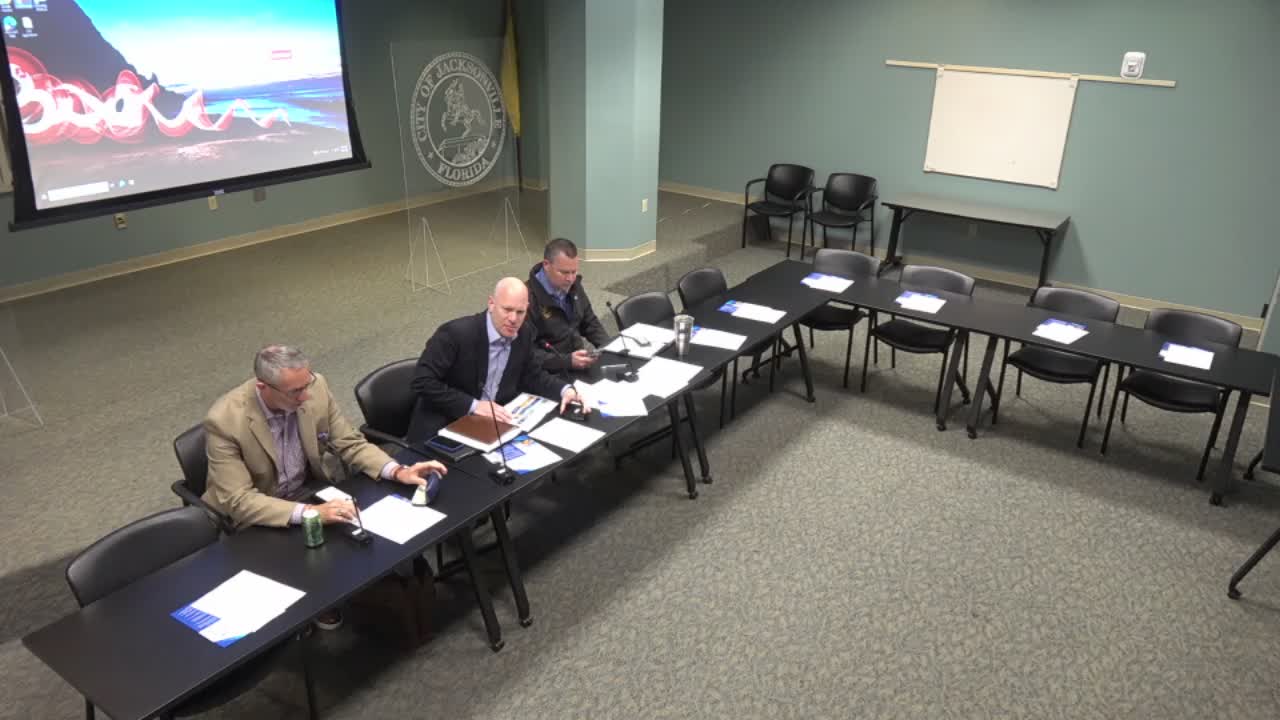
Jacksonville officials brief council on $117 million Fulton Cut power-line project as emergency one-cycle bill heads to committees
Summary
Jacksonville officials on March 18 briefed city council members on the Fulton Cut power-line project (bill 20250194), explaining why costs rose to $117,000,000, how procurement under Florida's Competitive Negotiation Act was handled, and how JEA, Jaxport and the city propose to fund the work. The bill was placed on an emergency one-cycle path and will go to four committees before a March 25 council vote.
Jacksonville officials on March 18 held a special briefing on the Fulton Cut crossing power-line project, bill 20250194, telling city council members why the estimated cost rose to $117,000,000, how procurement under Florida's Competitive Negotiation Act (CCNA) was handled, and how the project would be funded if the council approves the one-cycle emergency ordinance that will go to committee meetings next week and then the full council for a vote on March 25.
The briefing matters because the work to raise transmission lines over the Fulton Cut is intended to remove an "air draft" restriction that limits the size of ships that can call at Jaxport. Jaxport officials said the project is tied to the port's broader strategy to attract larger vessels and additional weekly services that they say would generate substantial state and local tax revenue and jobs if the project is completed on schedule.
At the March 18 briefing, Kurt Wilson, Transmission Division, JEA, said the project cost rose in stages. A 2020 feasibility study estimated roughly $45 million; competitive design-build procurement returned a Quanta proposal at about $90 million at 30% design; an additional $27 million reflects owner-purchased items and project-level costs such as towers, cabling, FAA lighting, owner's representative fees and insurance. "I would give it a 99% confidence that the GMP will hold on the 27," Wilson said of the owner-purchased portion, while noting tariffs and other unforeseeable factors remain a small residual risk.
Project procurement was governed by Florida's CCNA (chapter 287.055, Florida Statutes). Jason Reinhardt, JEA project manager, and Sebastian Khamis, JEA transmission engineer, explained that the CCNA selection matrix prioritized technical quality and experience rather than price; four teams submitted proposals and Quanta scored highest. Mary Stifopoulos, Office of General Counsel, described the post-ranking negotiation process under CCNA and confirmed that if negotiations with the top-ranked firm failed, procurement officials could proceed to the next-ranked firm.
Joey Grimey, chief financial officer, Jaxport, summarized the revised funding plan that JEA, Jaxport and the city negotiated after the higher price emerged. Under the proposal presented, JEA and Jaxport would each contribute $32.5 million; the city's previously budgeted $22.5 million (originally structured as $10 million in appropriated grants and $12.5 million in a loan to the port) would be converted to $22.5 million in grants spread toward the back end of the multi-year project. The package also includes $15 million from harbor-deepening savings that Jaxport says are already on deposit, and a $5 million city contingency that would be tapped only if overruns exceed the revised $117 million cap.
Jaxport presented an economic case for the work, saying the projected return on investment from enabling larger international vessels is roughly 2.9 times the public investment (rising to 4.2 if the port attracts a single additional weekly service of about 250,000 annual TEUs). "For the $117,000,000 investment from the community, we generate about $340,000,000 of state and local taxes," Grimey said, adding that the timeline to have the lines raised is driven by shipping schedules and quoted contractor price-hold deadlines.
Council members pressed procurement and fiscal-management questions, asking whether the city or the port had considered re-bidding after the 30% design price emerged and how the original feasibility study left out major cost components. Kim Taylor, city council auditor, noted that CCNA limits the degree to which price can be weighted at the selection stage and confirmed the statute cited in the procurement discussion: "It's in section 287.055." Reinhardt and JEA staff said the feasibility study was a high-level assessment of options rather than a guaranteed maximum-price estimate, and that the 30% design effort revealed substantial omissions (concrete foundations, number of construction crews, site access, and other large items) that accounted for much of the delta between the study and the contractor's 30% design GMP.
On funding details, Grimey and JEA staff said most of the project cost is contractually controlled: Quanta provided a guaranteed maximum price covering roughly $90 million of the project, and JEA and the port have already issued purchase orders for major materials in the $27 million owner-purchased bucket. City staff and auditors flagged a separate accounting matter: about $6.1 million from earlier harbor-deepening project savings is recorded on the port's balance sheet as payable to the city but was not showing as a receivable on the city's books; officials said they are working to reconcile and clarify that pocket of value.
No formal council vote was taken at the March 18 briefing. The bill (20250194) was placed on an emergency one-cycle path and will be routed to four standing committees'neighborhoods, rules, TEU (transportation/economic development/utility), and finance'before the full council considers it at the March 25 meeting. Public comment at the briefing included support for the project and a request that port and JEA consider adding or preserving public river access as part of related waterfront work. Resident John Nooney told the council, "I support the project... public access and water quality is a component."
Council members who spoke at the end of the briefing said they were satisfied with the information and supportive of moving the emergency ordinance forward to the committee and council process, while urging continued transparency on procurement, contingencies and the location of any unused funds that may benefit the city.
If the ordinance is approved on March 25 the city, JEA and Jaxport will move ahead under the funding terms described; officials said the project schedule aims to have lines raised to meet the port's late-2026/January-2027 operational timeline but several construction and permitting steps remain.