Get Full Government Meeting Transcripts, Videos, & Alerts Forever!
Get email alerts on the Zoning Pud topic
No spam. Unsubscribe anytime.
Developers agree to 50‑unit PUD, 25‑foot buffer and traffic study after Jacksonville community meeting
Summary
Jacksonville City Councilman Reginald Gaffney Jr. and local residents heard developer commitments to a 50‑unit Planned Unit Development, a 25‑foot natural buffer and a traffic study during a community meeting about a proposed subdivision near Bridges Road and Quiet Country Lane.
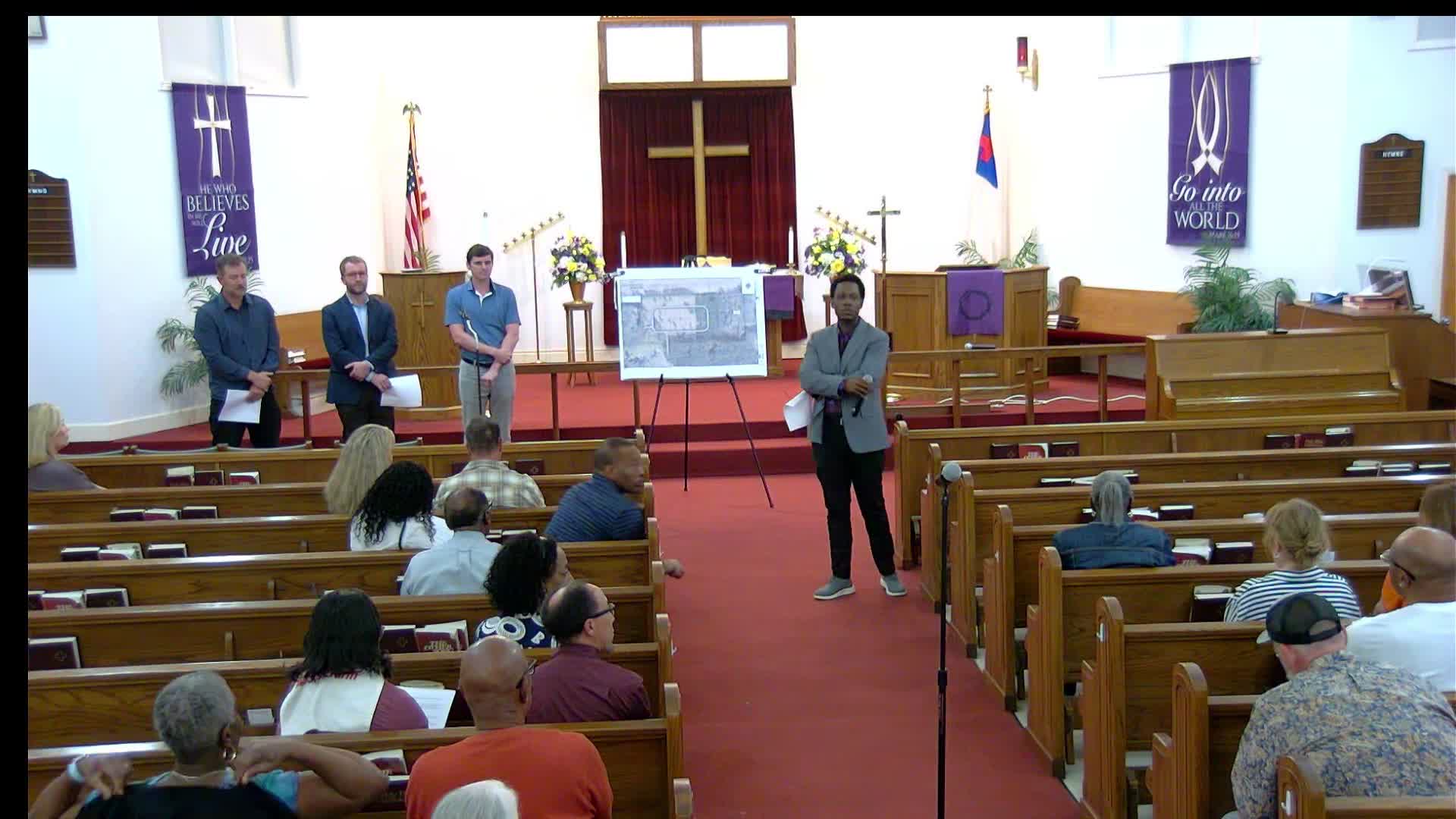
Jacksonville City Councilman Reginald Gaffney Jr. and residents heard a presentation Thursday from the developer of a proposed housing project near Bridges Road and Quiet Country Lane, after which the applicant agreed to convert its rezoning request to a Planned Unit Development and to several written conditions, including a 50‑unit cap and a 25‑foot natural buffer along the southern property line.
The developer’s attorney, Hayden Phillips, told the meeting that Coastland Group LLC would switch the application from a conventional RLD‑70 rezoning to a PUD so the city and neighbors could hold the project to a specific site plan and written description. “We are agreeing to a total of 50 units,” Phillips said, adding the firm would submit a site plan and PUD written description that would cap density and include the commitments presented to the community.
Neighbors said the project’s traffic, school capacity and the proximity of the subdivision entrance to existing driveways were their chief concerns. Erin Abney, chief of current planning for the City of Jacksonville, explained the review process and the criteria the planning department uses, including the city’s comprehensive plan designation of Low Density Residential (maximum 7 units per acre) and transportation reviews. “From our quick review…50 single‑family homes is a very, very low traffic count,” Abney said, while noting formal traffic and agency reviews occur after a complete application is filed.
Why it matters: converting to a PUD allows legally enforceable, written conditions to be attached to the zoning approval (for example: capped unit count, minimum lot width, buffers and façade or square‑footage standards). Residents said without a PUD, a conventional rezoning approval could result in fewer enforceable protections.
Key commitments and clarifications
- Project cap and lot minimums: The developer said the PUD would cap the project at 50 homes and require a minimum lot width of 70 feet. Hayden Phillips said earlier plans showed higher counts (141, 58, then 53) and that the developer had reduced the count to 50. (Hayden Phillips, developer representative.)
- Southern buffer and building height: The team agreed to a 25‑foot natural buffer along the entire southern boundary with an intervening fence placed behind the new lots and to preserve existing trees there. They also agreed to single‑story restrictions on at least six to 12 homes along that southern edge. (Hayden Phillips.)
- Driveway/ingress: Developers confirmed the access point closest to some existing homes will remain a single entrance and that a private driveway—not a full city‑standard road—will serve the adjacent private lot to the west. The developer said there was no practical alternative for ingress/egress because of wetlands, JEA easements and a privately owned lot abutting the site. (Hayden Phillips; developer team.)
- Utilities: The developer said sewer and water service would be tapped from JEA infrastructure to the north; residents would not be forced to connect to JEA if lines pass in front of their houses. (Hayden Phillips.)
- Traffic study and improvements: The developer committed to completing a traffic study covering Quiet Country Lane, Bridges Road and the Bridges & Dunn intersection in coordination with the city. If the study shows improvements are warranted, the developer said it will perform required improvements, potentially including a turn lane. Several residents urged sidewalks, road widening and traffic calming; Erin Abney said such measures are evaluated as part of the transportation review. (Hayden Phillips; Erin Abney.)
Community concerns and context
Residents raised several concerns during the meeting: local school capacity, the effect of construction‑period trucks on narrow neighborhood roads and lawns, potential cut‑through traffic if adjoining parcels later develop, relative lot sizes and the effect on property values, drainage and flooding on local ditches, and whether the city or state (FDOT) has authority or funds to widen Dunn Avenue. Multiple speakers singled out the location of the subdivision entrance as particularly burdensome to the nearest neighbor. (Multiple residents: Lena Correa Perez; Vernon Cole Sr.; James Sampson; Vanessa Rogers; others.)
Planning department role and process
Erin Abney described how the city evaluates PUD applications: compatibility with the comprehensive plan’s Low Density Residential designation, density, internal and external compatibility (including roadway capacity) and input from reviewing divisions such as transportation and drainage. Abney said the planning department forwards proposals to Duval County Public Schools for capacity review and that final, written staff reports and interdepartmental analyses are produced after a formal PUD application is submitted. (Erin Abney.)
Next steps and local decision process
Councilman Reginald Gaffney Jr. said the developer’s shift to a PUD will delay the timeline and offered to hold at least one more meeting between neighbors and the development team before the application is finalized. A group of residents agreed to serve as a neighborhood working group to compile conditions and meet with the developer; the councilman asked community members to email additional requests to his office. The group also took a nonbinding show of hands at the meeting, after which the majority present expressed support for pursuing the PUD route rather than opposing a conventional rezoning in court or at a formal hearing. The councilman and participants emphasized that the PUD is not city approval and that formal approval will still require staff analysis, public hearings and council action. (Reginald Gaffney Jr.; multiple residents.)
What was not decided
No formal city vote or final approval took place at the meeting. The developer did not file a finished PUD application during the meeting; Erin Abney said the planning department would need the official site plan and written description to complete its review. Several residents requested specific written guarantees (for example, minimum heated square footage) to be included in the PUD; those items remained to be finalized in the resident committee’s meeting with the applicant. (Erin Abney; Reginald Gaffney Jr.; residents.)
Ending
The developer said it would prepare a PUD application reflecting the commitments presented and work with the neighborhood group to refine written conditions before filing. The councilman said he would delay further procedural steps so the community working group and the developer could meet again and finalize the items to be written into the PUD. No formal city action has been taken; any final zoning decision will follow the city’s standard staff review, public hearing and council vote process.