Chester County retirement fund posts quarterly loss; board hears questions on real estate allocation and funded ratio
Loading...
Summary
At its Feb. 26 meeting, the Chester County Employees Retirement Fund heard a performance update showing a -1.2% loss in Q4 and a rebound in January; the board and a public commenter discussed the fund's real estate allocation (8.1% at Q4, 8.6% in January) and the timing of the actuarial funding report.
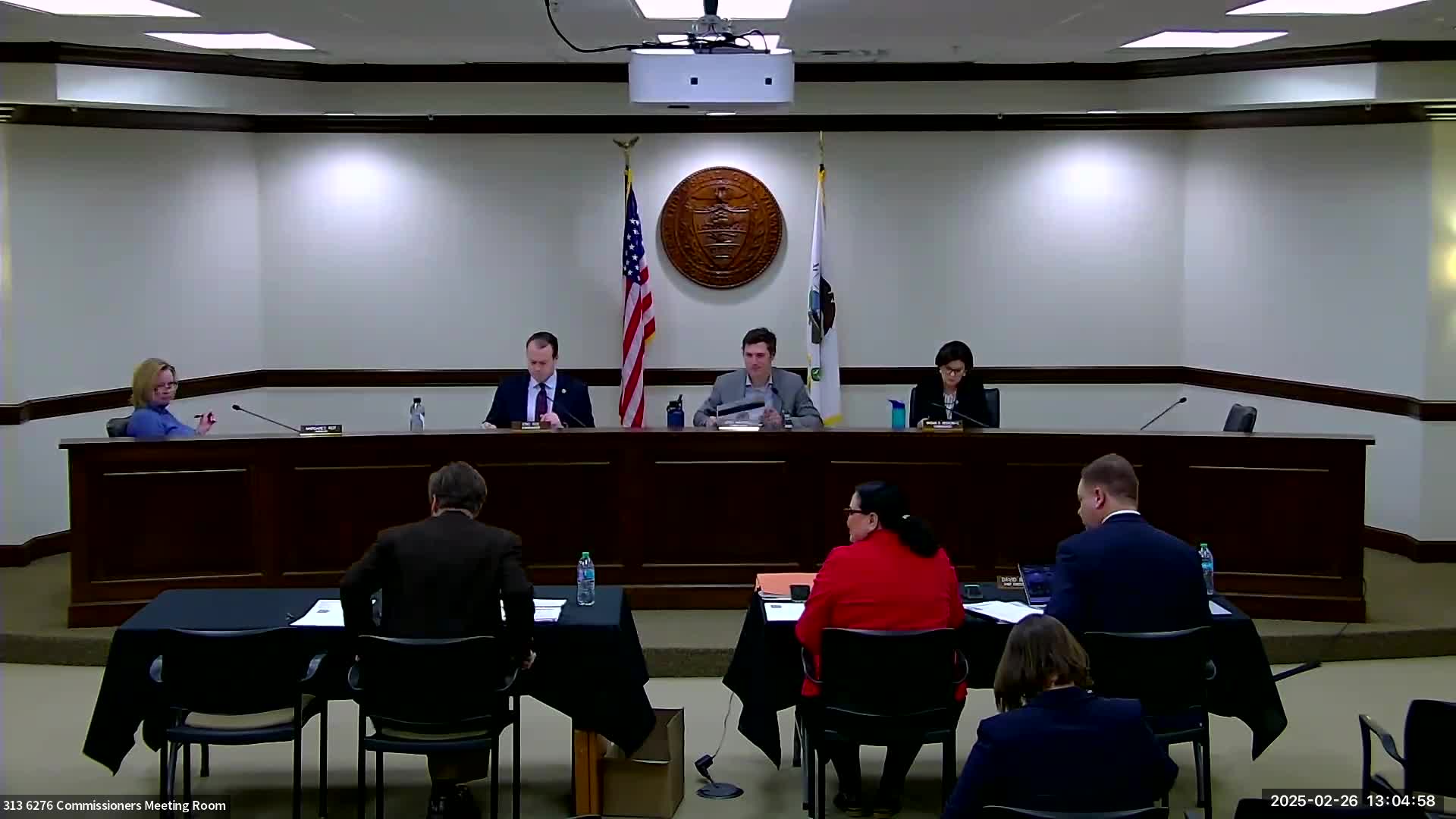
Chair Josh Maxwell presided over the Chester County Employees Retirement Fund retirement board meeting on Feb. 26, 2025, where the fund’s consultant delivered a market and portfolio performance update and answered questions about the portfolio’s real estate exposure and the plan’s funded ratio.
The fund’s consultant, Steve, told the board the portfolio lost 1.2% in the fourth quarter of 2024 but was up 10.3% for the year and rose about 2.5% in January 2025. “The portfolio lost 1.2% in the fourth quarter,” he said. He reported the fund began the quarter at $562,700,000, had $238,000 in net withdrawals, $4,100,000 of income and $10,800,000 in capital losses, ending the quarter at $555,700,000; the consultant said the portfolio was near $569,000,000 in January.
Why it matters: the board’s long-term return target is 7% and the consultant said the fund remains close to that target over the past 10 years. The board must weigh asset allocation choices — particularly real estate and international equity — against market uncertainty, interest-rate moves and managerial performance.
On markets, the consultant described an unusually flat bond yield curve and recent yield moves that affected performance: short-term yields near 4.3%, long-term yields near 4.5%, and a fourth-quarter move in long rates from about 4.3% up to 4.7% before falling back to roughly 4.5% in February. “Bond rates moved from about 4.3 up to 4.7%. Then it came back down in February to this 4.5% we are right now,” he said, noting that those moves hit the long end of the portfolio in the fourth quarter but that higher short-term cash yields have partially offset volatility.
The consultant identified manager-level drivers. He said Walter Scott was the weakest-performing manager in the fourth quarter due to international market moves but had outperformed in January, posting about 4.8% for the month versus a 4% benchmark. He characterized international equity as both a source of volatility and diversification.
Real estate allocation and limits drew a public question. James D’Eluzio of Penn Township asked for the dollar value of the fund’s real estate holdings and whether the allocation exceeded a prior board limit of 10% of the portfolio. The consultant pointed the board to the allocation table and reported that real estate was 8.1% of the portfolio at the end of the fourth quarter and 8.6% at the end of January. He also summarized the policy bands for real estate: minimum 5%, target 10%, maximum 15%.
On the funded ratio and actuarial timing, Julie (staff) told the board the plan is above 80% but the actuarial report as of Dec. 31, 2024, had not yet been received. Julie said the report is typically delivered in May and that staff had just provided requested documentation to the actuary; she estimated it would take “about 6 or 7 weeks” after the actuary receives the information.
Board members and the consultant discussed allocation strategy. The consultant said the board could choose to increase the real estate allocation toward its 10% target but warned timing risk: “There is a slightly riskier answer, which is to say, yes. Let's put more money into real estate when we're already asking questions about real estate. But you're gonna get the timing wrong no matter what you do,” he said.
Other routine items: the board approved the minutes of Oct. 30, 2024; adopted the meeting agenda for Feb. 26; and confirmed the 2025 retirement board meeting schedule and advertisement. All were approved by voice vote with no recorded opposition.
The board moved to public comment (non-agenda items) after the report; one commenter addressed real estate allocation and the funded ratio. The meeting adjourned the public portion and moved into executive session in the same room.
No new policies, ordinances or contract awards were decided at the meeting; the session’s substantive action was the update and the discussion of allocation and actuarial timing.