
Santa Maria outlines $500 million wastewater upgrade, new wells and landfill improvements
Get AI-powered insights, summaries, and transcripts
Sign Up Free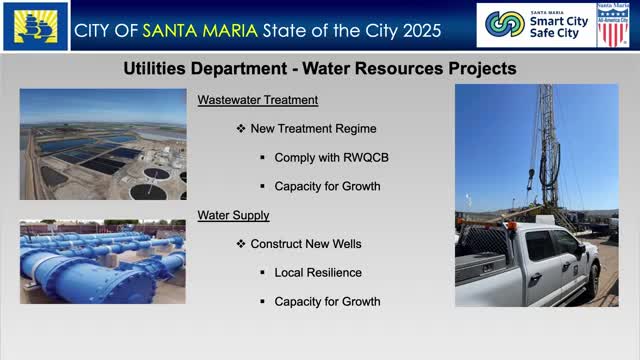
Summary
Utilities director Chad Springer said the city must upgrade its wastewater treatment plant to meet new Regional Water Board effluent limits and to provide capacity for growth; the project is currently estimated at about $500 million.
Chad Springer, director of utilities, told the State of the City audience that the city must update its wastewater treatment plant to comply with a new regional general permit and to provide capacity for projected population growth. Current early estimates put the wastewater project in the $500,000,000 range.
Springer said the city’s existing wastewater plant cannot meet the effluent discharge requirements established by the regional water quality control board, prompting an update to the wastewater master plan and a significant capital project. The upgrade is intended to both meet regulatory limits and add capacity for the additional 30,000–40,000 residents officials project over the coming decades.
On drinking water, Springer said the city operates six groundwater wells, holds an entitlement to more than 17,000 acre-feet of state water, and treats an average of just over 6,000,000 gallons per day at the wastewater plant. To improve local resilience and meet future demand, the city is drilling its first new groundwater well in over 30 years, connecting an existing previously separated well to the distribution system, and preparing sites for the next groundwater well.
Springer also described recent solid-waste and landfill work: weekly organics collection was implemented in January to comply with SB 1383; last year the collections fleet handled roughly 70,000 tons of trash, 10,000 tons of recycling and 8,600 tons of organics, and the landfill buried about 150,000 tons. The city completed a landfill gas flare project to meet air-quality requirements and expanded an existing landfill cell (Cell 1 Phase 2) to extend the facility’s life.
Springer said the landfill’s methane gas is captured and sent to a third party; it is used to generate electricity via reciprocating engines and supplied via pipeline to Marian Medical for cogeneration, providing beneficial reuse instead of flaring when possible.
City officials said these utilities projects are large, long-term capital needs tied both to regulatory compliance and to accommodating expected population growth.