Get Full Government Meeting Transcripts, Videos, & Alerts Forever!
Get email alerts on the Human Trafficking topic
No spam. Unsubscribe anytime.
Senate committee keeps human-trafficking signage requirement but scales back some mandates for private businesses; adds massage-parlor oversight language
Summary
The Corrections and Criminal Law Committee advanced an amended House bill that requires human-trafficking awareness materials at state rest areas and makes posting optional for many private businesses, while adding and then moderating regulation of certain massage establishments; the amended bill passed the committee unanimously.
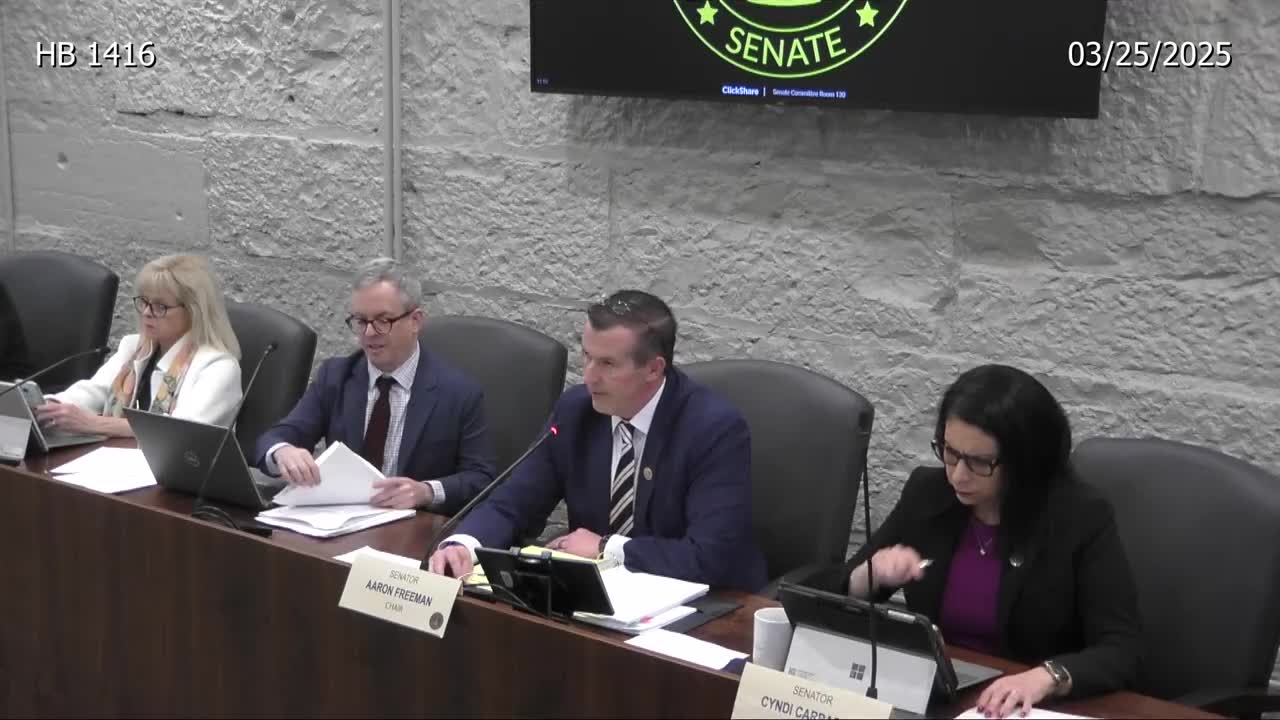
The Corrections and Criminal Law Committee advanced House Bill 1416 on Tuesday after several hours of testimony and floor debate, approving an amended version that retains mandatory postings at state rest areas, makes most private-business postings optional, and adds new record-keeping and display requirements for certain storefront massage establishments — language that the committee later softened from mandatory to permissive for some poster requirements.
Representative Bartlett, the bill sponsor, told the committee the measure is intended to increase awareness of human trafficking by placing posters in rest-area bathrooms and by encouraging hospitality and service workers to complete a short training. "Human trafficking is the worst crime that can possibly be committed," Bartlett said, adding the bill would require posters at state-owned rest areas and create a training module for hospitality workers.
The committee considered Amendment 7, which would change many private-business posting duties from "shall" to "may" while keeping state rest-area postings mandatory. Senator Taylor led extended debate opposing the change and arguing the only private space where trafficking victims are commonly alone is the restroom; Senator Taylor said mandatory postings could make a difference in identifying victims. Other senators, including Senator Brown, described existing voluntary industry efforts: hotels and convenience stores already deploy training and signage in some locations.
Several witnesses spoke in favor of the bill and provided data during testimony. Shannon Schumacher, CEO of The Villages of Indiana and executive director of Prevent Child Abuse Indiana, said the organization serves more than 1,200 foster children statewide and that child-welfare systems are disproportionately represented among trafficking victims; she called the bill "a start." Jess Kearns, president and founder of Raindrops Rising Foundation and identified in committee as a survivor, described the restroom or transport as one of the few private moments victims may have and urged stronger measures; she also cited national statistics and comparisons to other states.
Senator Bohachik offered a separate, broader amendment (Amendment 4) that would impose licensing-display, advertising and record-keeping requirements on certain massage establishments, prohibit housing workers on-site, require client records be retained for one year, and bar advertising on adult-oriented websites. The senator said the language was modeled on measures enacted in other states and reflected local law-enforcement requests to address illicit storefront operations.
After committee debate, sponsors agreed to a committee amendment that converted several poster-display mandates in the massage-parlor language from "shall" to "may." The amended amendment passed by consent and a subsequent roll call on the amendment package passed 7–1. The final amended bill then passed the committee on a 9–0 vote.
Chair Senator Greg Freeman closed the hearing by saying the committee would continue to refine the bill but urged members to advance the measure. "We'll work on it," he said as the committee recorded a unanimous vote to move the amended measure forward.