Get Full Government Meeting Transcripts, Videos, & Alerts Forever!
Get email alerts on the House Budget 101 topic
No spam. Unsubscribe anytime.
Appropriations hearing features dozens of budget requests: Choice program, military base grants, medical education, mental health and local projects among asks
Summary
Advocates and agency representatives appeared before the Appropriations Committee to press for specific line items in the biennial budget (House Bill 101), requesting funding for home‑based aging services, military base infrastructure, graduate medical education slots, behavioral‑health crisis services, nonprofit security grants, conservation programs and local Main Street initiatives.
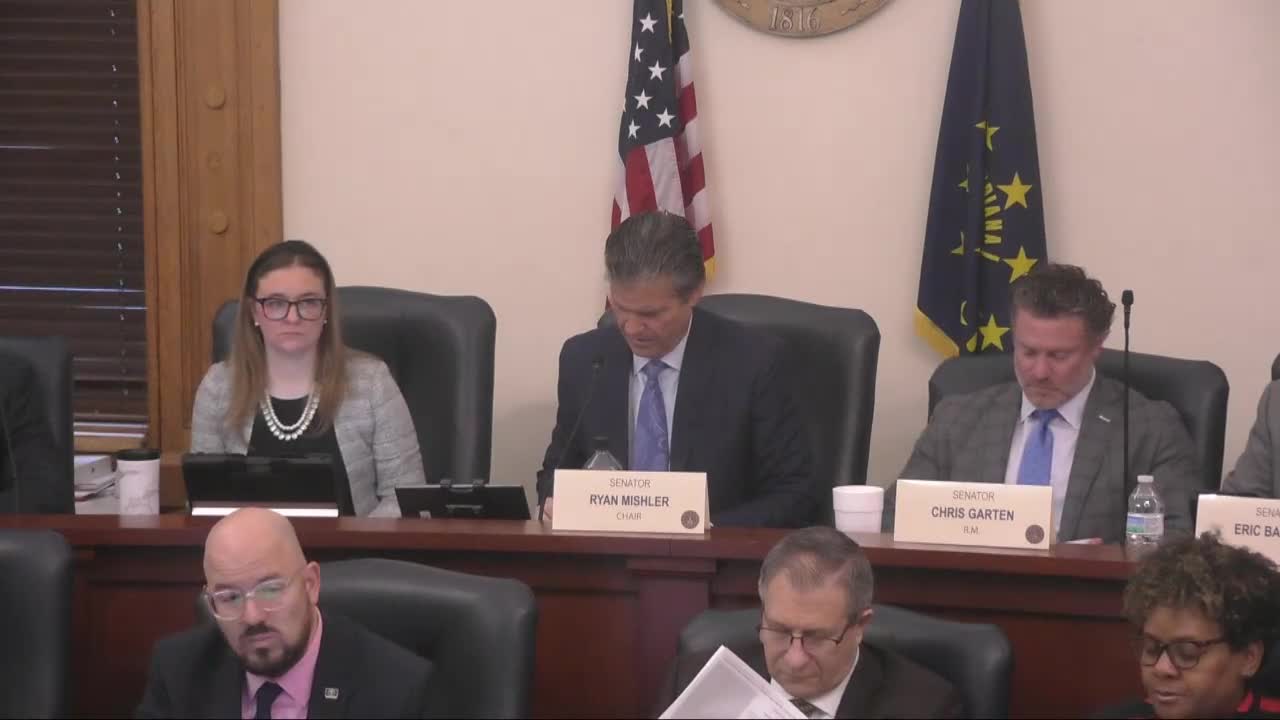
The Appropriations Committee heard hours of public testimony on the biennial budget contained in House Bill 101, with witnesses from health care, mental-health, education, veterans, conservation and community redevelopment groups seeking targeted funding for programs and services across the state.
Speakers asked the committee to retain or increase specific line items in the budget: advocates for Indiana's Choice program urged retaining $48,000,000 and removing a proposed transfer of Choice dollars to Medicaid; defense- and economic-development witnesses urged a $50,000,000 appropriation for a proposed Indiana Military Base Infrastructure Grant Program; medical education advocates asked for more funding to expand residency positions (the Graduate Medical Education board currently has $7,000,000 in the base budget but requested up to $13,500,000'$14,000,000 for projected needs); and behavioral health groups said implementation of the crisis continuum (including the 988 call system and mobile crisis services) will require additional recurring funding beyond the $50,000,000 included in the introduced budget.
Other requests included nonprofit security grants for at-risk faith and community organizations ($5,000,000 over two years suggested by Jewish and civil-rights organizations); funding for food banks and anti-hunger programs; preservation of Indiana Main Street program staff funding (witnesses said proposed cuts would effectively remove statewide technical assistance); support for the Benjamin Harrison Conservation Trust and state parks operating increases; and continued or added funding for disease-diagnostic laboratories and public health, childcare supports and workforce housing programs.
Below are selected, attributed highlights from witnesses who testified on the record. Where witnesses provided a numeric request or evidence, that figure is noted. The transcript records questions from committee members and answers but does not show final committee decisions on these requests.
Choice (Aging services) Hannah Carlock of RJL Solutions and the Indiana Association of Area Agencies on Aging urged retaining "the Choice budget at $48,000,000" and asked the committee to "eliminate the transfer of Choice dollars to Medicaid." She described Choice as a Medicaid-diversion initiative that funds short‑term home modifications and in‑home services for Hoosiers not yet eligible for Medicaid and provided an example of a 59-year-old who avoided long‑term placement after modest home modifications.
Military base infrastructure Matt Craig and Jim Tidd, speaking on defense investment, asked the committee to include $50,000,000 in the budget for an Indiana Military Base Infrastructure Grant Program to address aging base infrastructure and attract federal and private investment. Craig said Indiana's bases and defense industry contribute billions annually and warned that infrastructure failures could threaten mission readiness; he cited an example project at NSA Crane with an estimated cost of $3.5 million to address electrical outages.
Graduate medical education and workforce Dr. Richard Feldman, former state health commissioner, and others urged increased funding for the Graduate Medical Education Board. Feldman said the current $7,000,000 line is insufficient to meet projected needs and cited requests totaling $13,500,000 to $14,000,000 a year to expand and sustain residency slots. He said expanding residency positions is key to keeping medical graduates in the state and increasing primary-care capacity.
Medicaid buy-in (MedWorks) and disability employment Tom Krishan of The Arc of Indiana and advocates asked the committee to expand Indiana's Medicaid buy‑in (MedWorks) by raising income and asset limits. Krishan recommended increasing the income limit to 500% of the federal poverty level and raising the asset limit to $20,000, noting MedWorks participation was about 2,775 people in December and arguing higher limits would encourage employment without risking loss of essential coverage.
Behavioral health and crisis services Stephanie Anderson of Mental Health America of Indiana and Beth Keeney of Lifespring described expansions of the crisis continuum and the 988 system. Anderson said the behavioral health commission identified roughly $53,000,000 in additional annual funding needs for crisis continuum items beyond amounts in the introduced budget and that $13,200,000 of that would support federally required 988 call center costs. Keeney requested funding to continue rollout of crisis services (the group cited 43,000 contacts in 1 year and projected growth) and asked for new line items for room-and-board support for group-home settings.
Nonprofit security grants and community safety David Sklar of the Jewish Community Relations Council and Miriam Dant of the Anti‑Defamation League supported a state nonprofit security grant program to help faith-based and nonprofit organizations pay for cameras, lighting, perimeter protections and security staffing. Sklar outlined a $5,000,000 over two years proposal and said local communities currently shoulder growing security costs.
Main Street and local economic development Multiple Main Street directors and representatives (Marsh Davis of Indiana Landmarks, Carrie Barrett of Newcastle Main Street, Kelly Humberkausser of Main Street America, and others) asked the committee to restore or preserve funding for the Indiana Main Street program. Witnesses said a proposed cut to OCRA general funds would eliminate staff who provide training and technical assistance and would sharply reduce leverage that creates private investment in downtowns.
Conservation and parks Speakers including Tim Maloney of the Indiana Conservation Alliance and Andrea Huntington of the Indiana Land Protection Alliance urged continued funding for the Benjamin Harrison Conservation Trust and increased maintenance and operating funding for state parks, citing visitor use numbers and economic benefits from outdoor recreation.
Other requests Requests and items presented to the committee included: funding for Feeding Indiana's Hungry (food banks); support for ALS grants ($1,000,000 line suggested to assist people with motor-neuron disease); a newborn tax credit proposal (repurposing a $1,500 exemption into a refundable $500 credit); public health and tobacco-tax measures (multiple speakers urged a $2 per-pack cigarette tax increase with parity for other tobacco products and reinvestment in prevention); and continued funding for the Avian/Animal Disease Diagnostic Laboratory operating needs.
What the transcript shows and does not The transcript records detailed testimony and many committee questions. It does not record final committee decisions on House Bill 101 funding requests during this session; aside from House Bill 1637 (a separate agenda item that passed in the committee), the hearing function was to receive testimony. Witnesses frequently cited numerical requests or program needs; the article notes those figures where the witnesses supplied them on the record.
A staff member for multiple witnesses provided data and examples during testimony; several requests asked the committee to consider matching or recurring appropriations rather than one-time transfers.
For follow-up: committee staff and appropriation drafters will need to reconcile requested amounts with the revenue forecast and policy priorities before the committee takes any appropriation votes.