Get Full Government Meeting Transcripts, Videos, & Alerts Forever!
Get email alerts on the Court Appointed Attorneys topic
No spam. Unsubscribe anytime.
Committee approves technical fixes and partisan-composition change to bill on court-appointed attorneys
Summary
The Corrections and Criminal Law Committee approved technical amendments to a bill on court-appointed attorneys and related boards, including a change that adjusts political-party representation on a prosecutorial commission to a 4-to-1 majority limit; the committee voted to send the amended bill to appropriations.
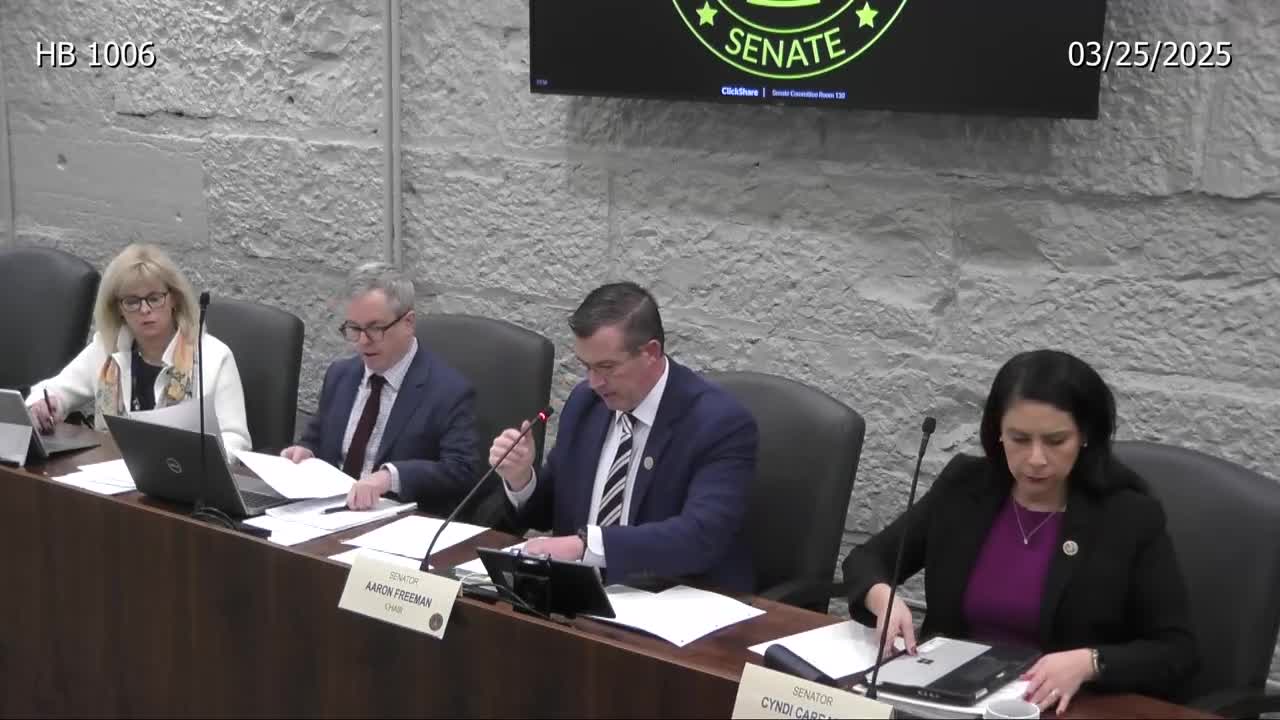
The Corrections and Criminal Law Committee on Tuesday approved three amendments to the bill commonly cited as H.B. 1006, including a technical cleanup and a change to the political-party composition of a commission that oversees court-appointed attorneys.
The chair, Senator Greg Freeman, led the committee through Amendment 14, which adds two judges to the commission on court-appointed attorneys and clarifies that counties may be reimbursed up to 27.5% for the salary of a deputy prosecutor — not for support staff pay, as could be read under the prior language.
“Amendment 14 … clarifies that the maximum reimbursement to a county for a deputy prosecutor is 27.5% of the elected prosecutor’s salary,” Freeman said during explanation of the amendment. The committee adopted Amendment 14 by consent.
A second technical change, Amendment 20, harmonizes language about appointments, reappointments and reimbursement across multiple boards and commissions; the committee also approved it by consent.
The committee debated Amendment 22, which alters language about the political composition of a prosecutorial commission from a “3-and-” configuration to a “4-to-1” configuration. Supporters argued the change reflects the current distribution of elected prosecutors in the state; opponents said the Legislature should avoid writing temporary political majorities into permanent law.
Senator Freeman said the 4-to-1 language “is the current makeup of the current situation,” and added that a future General Assembly could change it if the political distribution shifts. Senator Taylor and others objected, saying laws should be written for the long term and that the proposal risks codifying a transient political balance. Senator Lee framed the issue as a fairness concern for judicial-related panels and opposed the amendment.
The committee approved Amendment 22 on a 5–3 vote. The committee then moved the amended H.B. 1006 to the Senate Appropriations Committee; that motion passed 5–3.
Committee members asked about fiscal impacts; the chair said he did not have an updated fiscal estimate in committee and noted that committee practice is not to prepare fiscal notes for amendments before appropriations receives the measure.
Notes: The committee also recorded brief discussion on whether amendments created new duties that would require appropriations; the bill was recommitted to appropriations for further review.