Get Full Government Meeting Transcripts, Videos, & Alerts Forever!
Get email alerts on the Utility Regulatory Changes topic
No spam. Unsubscribe anytime.
Committee advances IURC agency bill; raises state pipeline penalties to federal levels
Summary
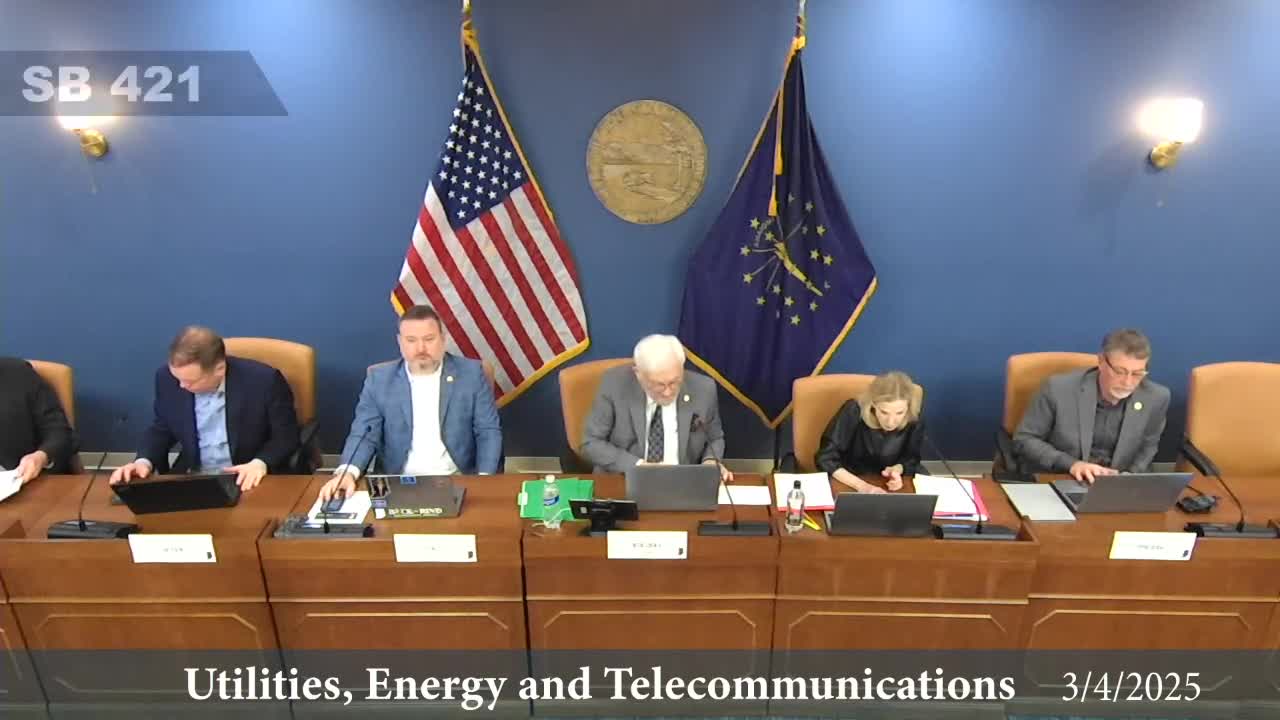
Senate Bill 421, the Indiana Utility Regulatory Commission (IURC) agency bill, was advanced by the committee. The bill aligns state pipeline safety maximum penalties with federal limits and makes several administrative updates to notice and reporting provisions, supporters said, to avoid federal takeover of enforcement.
The Utilities, Energy and Telecommunications Committee advanced Senate Bill 421, the IURC’s agency bill, which includes a package of administrative updates and a provision to raise state maximum civil penalties for pipeline safety violations to match federal maximums.
Luke Wilson of the IURC told the committee the federal Pipeline and Hazardous Materials Safety Administration (PHMSA) informed the state that, unless Indiana raised its penalty maximums, federal authorities would assume enforcement. "The federal government notified us over the summer that if our the state did not raise its penalties, the federal government would take over the enforcement of those penalties and did so on January 1," Wilson testified, describing the practical consequence that PHMSA had assumed enforcement authority earlier in the year.
Wilson outlined four main provisions in the agency bill: adding a court‑reporter definition to the utility regulation code, allowing notice publication on newspaper websites when the paper prints fewer than three issues weekly, repealing an unused program chapter, and increasing pipeline safety maximum penalties to federal levels. He told the committee historic state penalty limits were $25,000 per violation and $1 million for a series of violations; the bill would synchronize those ceilings with federal figures cited at the hearing: $200,000 per violation and $2 million for a series of violations.
Committee members asked about how penalties are assessed and where recovered funds go. Wilson said the increased maximums are already effectively in place because PHMSA is enforcing the higher penalties; he said that historically the state assessed roughly seven enforcement cases last year and that prior penalties had been deposited into the State General Fund. He explained that under federal enforcement the recovered penalties go to the U.S. Treasury.
Witnesses testifying on the bill included IURC staff, industry and advocacy organizations. Kerwin Olson of Citizens Action Coalition said he supported raising penalties for significant pipeline violations but raised concerns about DNR primacy and other rulemaking matters in later bills. Other witnesses, including representatives of utilities and industry groups, testified in favor of the administrative clarifications and stronger penalty authority.
The committee recorded a roll‑call passage with 12 members voting in favor, one excused. The bill will move forward for additional legislative steps.