Get Full Government Meeting Transcripts, Videos, & Alerts Forever!
Get email alerts on the Attorney General Litigation topic
No spam. Unsubscribe anytime.
Attorney general asks for flat budget, highlights opioid settlement, tech litigation, robocall and consumer enforcement wins
Summary
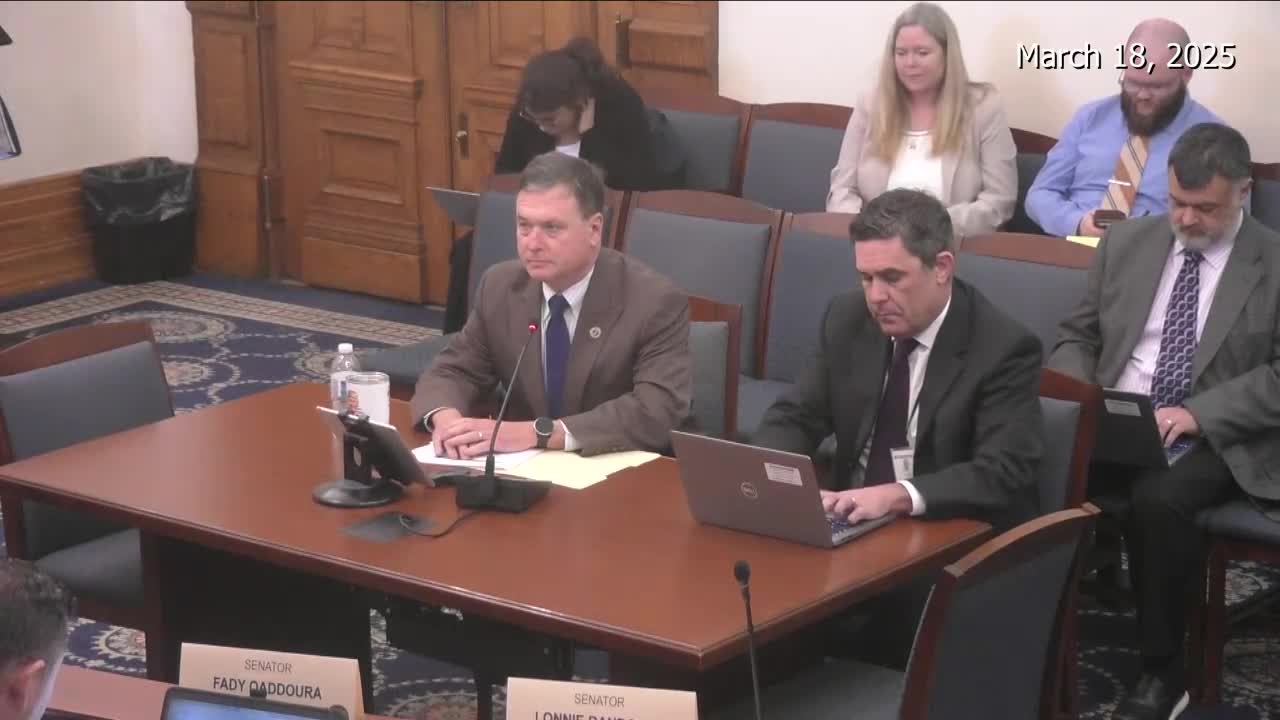
Attorney General presented a no-increase budget request to the committee, reviewed major litigation priorities including the opioid settlement and big-tech and robocall efforts, and summarized recoveries from consumer- and Medicaid-related enforcement.
Attorney General testified that his office would seek no increase to its base appropriation and credited recent technology and litigation investments with allowing the office to retain attorneys without a base-budget increase. "I'm proud to be here today to ask you for no increase," he told the committee.
The attorney general provided a divisional overview: about 370 staff manage roughly 27,000 active cases, he said, and the office's litigation work produced recoveries and savings. Notable numbers supplied to the committee included a nearly $1 billion master opioid settlement negotiated for Indiana (with a stated roughly even split between state and local distributions), $17,600,000 recouped in fiscal year 2024 by the litigation division, and more than $700,000 in judgments obtained by the homeowner-protection unit in fiscal 2024.
He described litigation priorities that include defending state statutes in federal and state court (citing recent appellate decisions allowing enforcement of age-verification and other laws), an ongoing suit against TikTok, and an independently negotiated $20,000,000 settlement from Google over location-tracking practices. He also briefed the committee on antirobocall work in which Indiana leads a multistate task force; he said the office is pursuing large multisite robocall cases and coordinating with telecom carriers.
On consumer enforcement, he summarized work by the homeowner-protection unit, which investigates alleged failures to maintain habitable rental properties, noting prosecutions and alternative compliance agreements in multiple cities. "Once the tenant pays the rent... duties are owed," he said, describing the office's approach when public or taxpayer money is involved.
On Medicaid fraud, he summarized the Medicaid Fraud Control Unit's (MFCU) federal funding structure ("funded by a 75% federal grant and a 25% state match") and said the unit had recovered roughly $4,000,000 in the current budget period, including criminal recoveries from durable medical equipment vendors.
Committee questions ranged from the cost structure for the office's tech litigation (some contingent-fee arrangements were reported) to the operation of a public education portal run by the office that catalogs parental and teacher submissions about K-12 instruction. The attorney general said the portal is an internal, in-house effort the office validates before posting and that submissions may include material from teachers, parents and administrators.
Ending: The committee thanked the attorney general for testimony. Members signaled interest in the Medicaid fraud work and the opioid settlement distribution, and indicated they may follow up with specific oversight or funding questions.