Get Full Government Meeting Transcripts, Videos, & Alerts Forever!
Get email alerts on the Agriculture Rural Development topic
No spam. Unsubscribe anytime.
Indiana lieutenant governor urges funding for agriculture, rural development and new faith-based initiatives
Summary
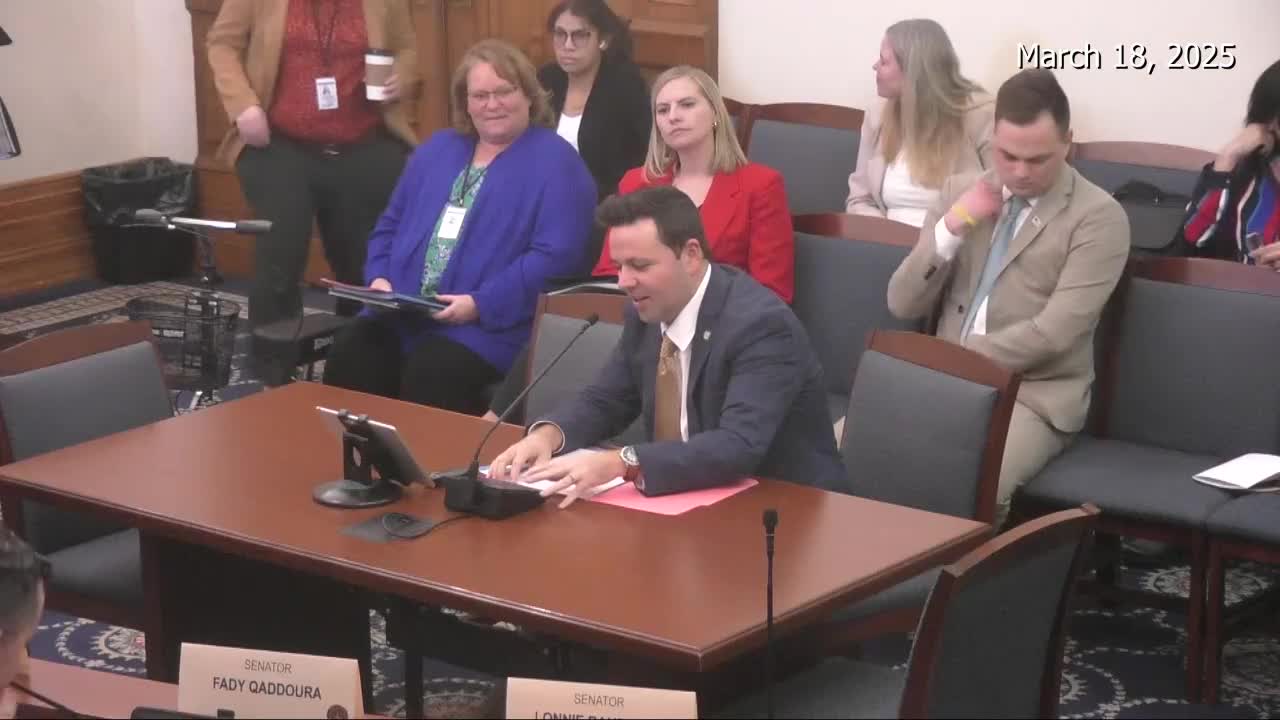
Lieutenant Governor Beckwith presented the lieutenant governor's office budget, seeking funding for the Indiana State Department of Agriculture, the Office of Community and Rural Affairs and a $3 million faith-based initiative tied to mental-health and community response work.
Lieutenant Governor Beckwith told the Senate appropriations committee that his office would prioritize "fiscal responsibility, respect for taxpayers, and a commitment to creating an environment where freedom and opportunity can flourish." He outlined budget requests for agencies under the lieutenant governor's statutory oversight and sought new funding for a faith-based initiative aimed at mental-health and community response work.
Beckwith said the Office of the Lieutenant Governor serves, by statute, as the secretary for the Indiana State Department of Agriculture and oversees the Office of Community and Rural Affairs (OCCRA). He described ISDA as a "liaison between the government and farmers," citing agriculture's economic contribution to the state and telling the committee the department is under-resourced compared with neighboring states.
Why it matters: Beckwith framed the requests as investments to sustain rural economies, help farmers through market uncertainty and preserve small-town Main Street projects. He asked senators to restore or preserve several programs and to consider a new $3 million line item for a faith-based initiative that would coordinate clergy and local nonprofits with state mental-health resources.
Beckwith said Indiana agriculture contributes "$35,100,000,000 to Indiana's economy," and noted the state has roughly "over 94,000 farmers" and "53,599 farming operations." He said ISDA supports programs including soil conservation, grain-buyer oversight (where he described an audit-and-software response to prior problems) and FFA outreach to more than 14,000 FFA members.
On OCCRA, Beckwith urged continued funding for Community Development Block Grant administration and for programs such as Indiana Main Street and Stellar Pathways. He said those programs have produced measurable local investment and job creation, and criticized a governor's proposal that would have removed some of that funding from the agency's budget.
On faith-based initiatives, Beckwith asked for $3 million to create a small office and a program director position to run statewide roundtables, connect religious leaders to local government and to seed small community projects. "We are going to partner with the mental-health department," he said, adding the program would also address homelessness, disaster response and community support. In answer to senators, he said the ask is a new appropriation because previous administrations redirected funds from other agencies to underwrite similar work.
Committee members pressed Beckwith for details on how the faith-based initiative would interact with Medicaid-funded services and community mental-health centers. Senator Brown asked whether the program would duplicate existing Medicaid or FSSA supports; Beckwith replied that his office intends to build partnerships rather than replace clinical services and that some participating ministries may not yet be Medicaid-qualified providers.
Beckwith and his staff also answered questions about specific budget line differences between the administration's request and the House-passed bill. He identified the historic-preservation grant and an existing grain-buyer appropriation (roughly $600,000 prior funding for grain buyers) as areas where numbers differed and said they would provide a more detailed variance list to the committee.
Beckwith closed by saying the lieutenant governor's office and its agencies are "running on duct tape and bailing wire" but can produce strong returns on modest investments: "We're not asking for a ton. Just a little bit. And you're going to get a huge return on your investment."
Ending: The committee followed with detailed questions and asked for written variance lists on budget differences. Beckwith provided staff contacts and offered to return with finer budget mappings if the committee requested them.