Get Full Government Meeting Transcripts, Videos, & Alerts Forever!
Get email alerts on the Nursing Workforce topic
No spam. Unsubscribe anytime.
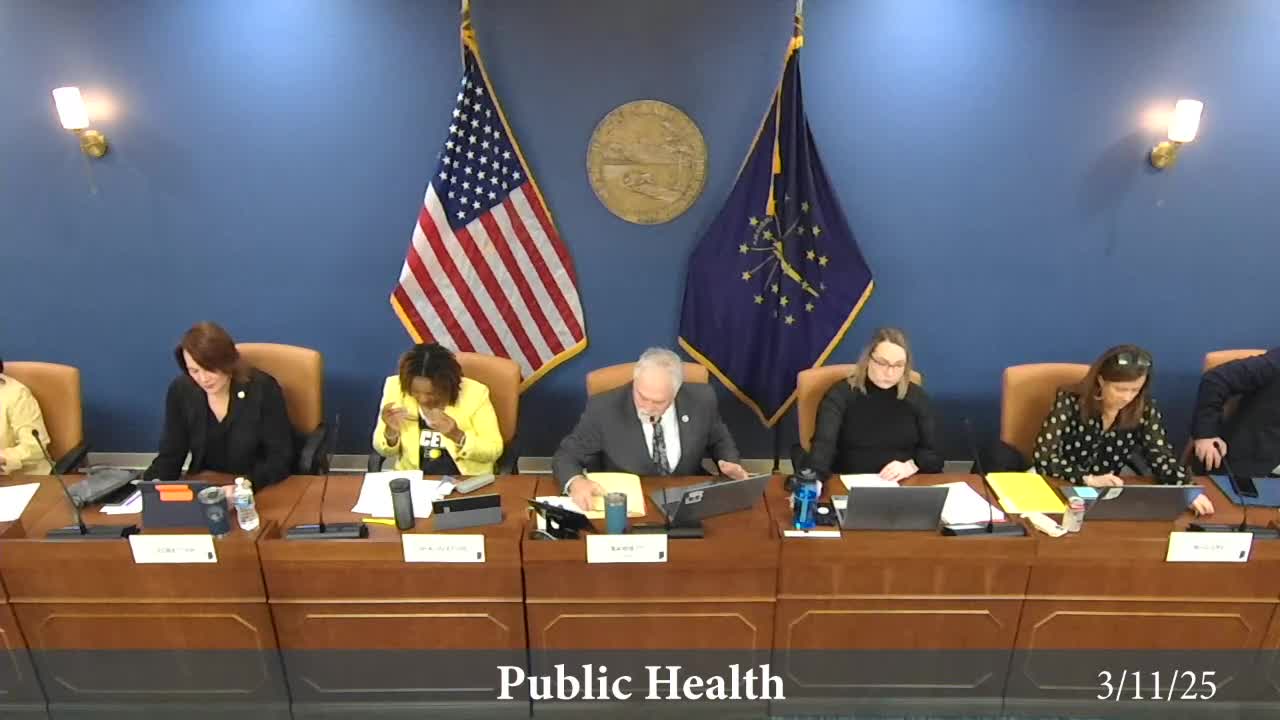
Committee approves bill to expand practical nursing pipeline, adds board seats and conditional admission pathway
Summary
The House Committee on Public Health voted to pass Senate Bill 176, which adds two seats to the Indiana State Board of Nursing and allows conditional admission of high‑school students into state‑accredited practical nursing programs provided they obtain a diploma before graduation.
The House Committee on Public Health on Oct. 27 passed Senate Bill 176, a nursing workforce measure that increases the Indiana State Board of Nursing’s membership and clarifies admission rules for practical nursing programs.
The bill, offered to address a shortage of licensed practical nurses, raises the board’s size from nine to 11 members, increases the number of registered nurses on the board and specifies that at least one member have prescriptive authority and one be a faculty member. It also amends program admission rules to allow applicants to begin a state‑accredited practical nursing program without a high school diploma or equivalent, provided they obtain that diploma or equivalent before completing the program.
Sen. Yoder, who presented the bill and two committee amendments, described SB 176 as “primarily a nursing pipeline bill” aimed at expanding providers and board oversight. “We’re trying to increase providers. There’s a known deficiency,” Sen. Yoder said while explaining the amendments that were accepted by consent.
Kimberly Wigan, assistant vice president for nursing at Ivy Tech Community College, told the committee Ivy Tech offers practical nursing on 19 campuses and plans pilots that allow qualified high‑school seniors to begin nursing coursework, with the requirement they submit diplomas before finishing the third semester. “This pathway would require the students then to submit the high school diploma or its equivalent to finish the third semester,” Wigan said, adding Ivy Tech will pilot the program at four campuses in 2025.
Representatives of long‑term care and industry — including Grant Auchenbach of Creek Devault for the Indiana Health Care Association and Gretchen Gutman of Cook Group — testified in support, saying the long‑term care sector has struggled to recover staff levels after the COVID‑19 pandemic and needs more LPN candidates. Katie Feely, CEO of the Indiana State Nurses Association, also testified in support.
Committee members asked about program quality controls, clinical training capacity and how many LPNs progress to RN degrees. Wigan said Ivy Tech will maintain competitive admissions standards, require TEAS testing and continue general education requirements; she said about half of Indiana students begin at the LPN/associate level and roughly 30% stop at the associate level, based on internal data.
The committee approved the bill as amended and conducted a roll call. The clerk recorded an 11‑vote majority in favor; the committee chair announced, “Bill passes 11.”
SB 176 now advances in the legislative process with the board membership change and student admission clarification enacted in the amended version.
Details recorded at the hearing indicated Ivy Tech is piloting conditional admission at Evansville, Madison, Sellersburg and Richmond, and that the system reported a 97.1% first‑time pass rate for practical nursing graduates in 2024.