Get Full Government Meeting Transcripts, Videos, & Alerts Forever!
Get email alerts on the Public Safety topic
No spam. Unsubscribe anytime.
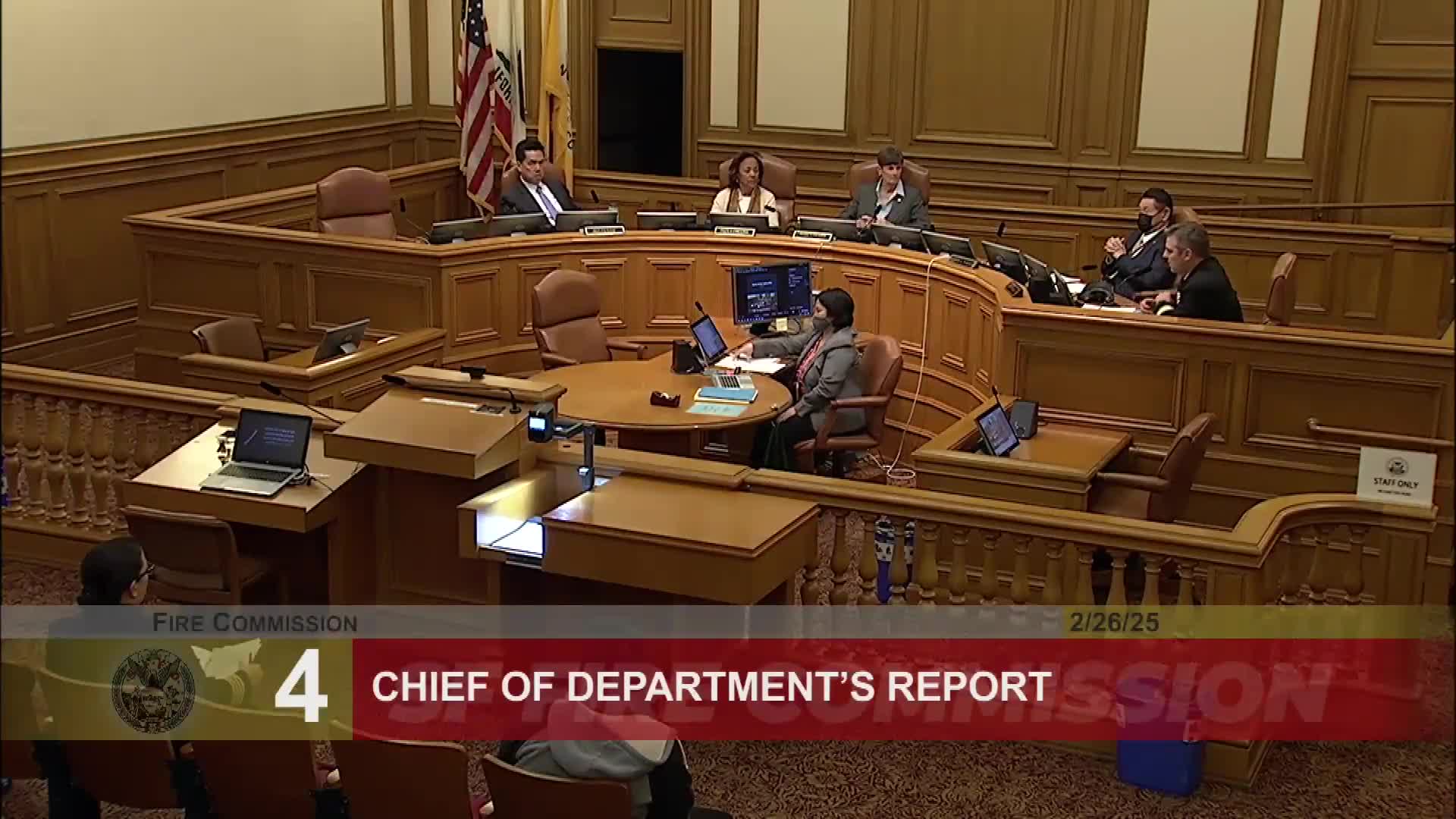
Fire commission approves $218,447 EMS pain‑med study as chief warns of deepening city budget gap
Summary
The San Francisco Fire Commission on Feb. 26 approved a $218,447 grant for the Fire Department’s emergency medical services to participate in a study comparing fentanyl and ketamine for prehospital trauma pain, while department leaders outlined staffing, training and wellness programs and warned of major city budget shortfalls.
The San Francisco Fire Commission on Feb. 26 approved a $218,447 grant for the Fire Department’s emergency medical services to participate in a study comparing fentanyl and ketamine for prehospital trauma pain, while department leaders outlined staffing, training and wellness programs and warned of major city budget shortfalls.
The vote passed after a presentation from Mark Corso, the department’s finance director, and a program briefing from Deputy Chief Chi Pang. Corso told the commission the funding is routed from the U.S. Army Medical Research Acquisition Activity through the University of Pittsburgh and the Regents of the University of California, San Francisco. Deputy Chief Chi Pang described the research: “The PAIN study stands for a prehospital analgesia interventional study,” Pang said, explaining the randomized, double‑blind protocol will compare pain control, blood‑pressure effects and mortality for patients in shock who cannot give consent.
The study approval is retroactive in form because contractual paperwork was delayed, Corso said; the department has not received funds and will be reimbursed for approved costs. Pang said training for the study has already reached about 350 paramedics; enrollment of patients will be gradual because the study targets trauma patients who meet a shock definition (for example, a heart rate greater than systolic blood pressure).
Why it matters: the study could influence field care for severely injured patients and comes as the department prepares to press budget priorities amid looming shortfalls. Chief Dean Crispin used his departmental report to flag citywide fiscal stress and to list operational priorities. “We’re unable to meet the required target budget reductions of 15% for the other departments,” Crispin said, adding that cutting to that level would “endanger our members and not be in the best interest of the public.” He asked the commission to support advocacy for fleet, facilities and staffing needs.
Crispin also reviewed recent department activity and initiatives. He recognized the recent retirement of Assistant Deputy Chief Julie Mao and thanked the department’s affinity groups for event staffing. The chief and command staff described large‑scale event planning and exercises that included the Lunar New Year parade and the NBA All‑Star weekend, neighborhood ride‑alongs with several supervisors, and Monday command‑staff emergency drills focused on earthquake scenarios.
Staffing and recruitment details in the report included class and exam dates: the department expects a new lieutenant eligibility list on March 11; a Level 1 (EMT) academy is scheduled to start April 7 with about 15 trainees, and a Level 2 (paramedic) cohort is scheduled to start May 5 with about five trainees. Chief Crispin said the department is beginning background checks and the onboarding process for those classes.
Crispin and Deputy Chief Sayumi Brannan gave an overview of ongoing occupational health and wellness research. Brannan summarized a range of studies and programs under way: a nutrition study with baseline DEXA scans, an environmental fuel‑pump monitoring pilot already collecting data, an infrared sauna study at UCSF (timing under evaluation), and a department‑produced 20‑minute documentary honoring Lieutenant Brian Kiono, who died in 2024 after a cancer diagnosis. The department expects results from a study labeled in the record as the “ciforophane” study in April or May, per Brannan’s report.
Public commenters raised local safety concerns tied to city planning decisions. Eileen Bokin of the Coalition for San Francisco Neighborhoods urged the commission to consider the Great Highway’s role in emergency response. “The roadway could also be used for mutual aid and yet the section of the Great Highway between Skyline and Sloat is scheduled to be closed permanently,” Bokin said, citing the Oceanside Treatment Facility and shoreline erosion discussions. Chief Crispin told the commission he had met with neighborhood stakeholders and supervisors and said the department is working on potable water supply upgrades and other infrastructure measures to improve response access in the Sunset District.
Other public commenters included residents pressing for consistent response procedures in narrow alleys and neighborhood events. A neighborhood organizer who identified herself as Patricia, representing area merchants and neighbors, described difficulties getting department representatives to attend community meetings and urged better field coordination.
Votes at a glance: the commission approved routine minutes from the Feb. 12 meeting (motion approved) and unanimously voted to approve Resolution 2025‑1 to retroactively accept and expend the $218,447 grant for the PAIN study. Commissioners also voted to go into closed session under applicable state and local rules and later voted not to disclose closed‑session discussion.
What’s next: department leaders said they will continue to press the mayor’s office and the Board of Supervisors for budget support for fleet, facilities and personnel. The PAIN study still requires completion of full contract language and final signatures at the Board of Supervisors level before funds are reimbursed and patient enrollment begins in earnest.