Get Full Government Meeting Transcripts, Videos, & Alerts Forever!
Get email alerts on the Parking And Ev Infrastructure topic
No spam. Unsubscribe anytime.
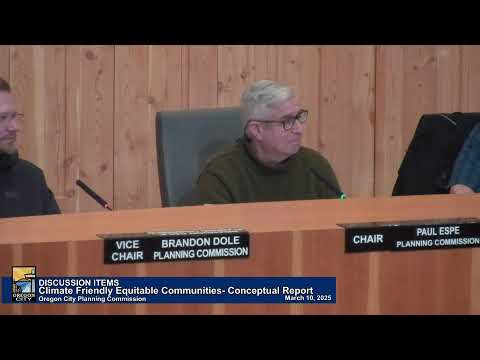
Oregon City planning commission reviews climate-friendly parking rules; recommends tree canopy and EV conduit requirements
Summary
The Oregon City Planning Commission on March 10 reviewed a conceptual report to align city code with new Oregon Administrative Rules that reduce parking minimums, require vegetated or solar‑equipped parking lots, and mandate EV‑ready infrastructure for many new developments.
The Oregon City Planning Commission on March 10 reviewed a conceptual report to bring city code into compliance with new Oregon Administrative Rules governing parking, landscaping and electric‑vehicle infrastructure.
Consultant Brian Davis of Studio Davis told commissioners the state rules aim “to reduce the construction of underutilized overabundant parking” and to make new parking more climate‑friendly through landscaping and EV requirements. The report recommends eliminating parking minimums inside a half‑mile buffer around the city’s most frequent transit line (Line 33) and the downtown regional center, tightening citywide parking maximums for multifamily units in some zones, and adding design standards such as a 40% mature tree canopy for large parking lots or an alternate solar option when canopy is infeasible.
Why it matters: the city must adopt code changes by June 30 to comply with the statewide rules. Commissioners and staff discussed policy tradeoffs that affect development cost, pedestrian safety, and long‑term urban canopy. The commission will forward recommendations to the City Commission and hold a public hearing on April 14 with final code hearings expected before the June deadline.
Key recommendations and clarifications
- Parking minimums and the compliance boundary: The conceptual approach would remove parking minimums inside the identified half‑mile buffer around Line 33 and the downtown Metro regional center. Outside the buffer, the draft retains modified requirements and management alternatives. The map shown to the commission places those exempt areas in downtown and along the frequent transit corridor.
- Tree canopy or solar for parking lots: The report proposes requiring that parking lots achieve a tree canopy that covers 40% of the lot at maturity (the rule’s minimum for larger lots). City staff and commissioners favored trees over a state fee‑in‑lieu because a state fund would not guarantee money returning to Oregon City. Commissioners asked that the tree list prioritize native species and “right tree, right place” guidance to avoid poorly suited species in constrained planting islands.
- Electric‑vehicle readiness: The draft code would require conduits and electrical capacity so that when applicants build parking, at least 40% of new parking spaces for residential developments of five or more units be “EV‑ready.” Davis summarized the state implementation guidance for electric service capacity and said the definition the report recommends tracks the OAR/ORS language for conduit, labels and stub ups to parking spaces. Commissioners asked staff to coordinate with the building/electrical divisions about whether the land‑use code should specify ampacity or defer that technical definition to the electrical code and building review process.
- Bicycle and micromobility parking: The consultant said Oregon City’s existing bike‑parking rules are largely compliant but recommended clarifications to ensure accommodations for family or cargo bikes and to identify key destinations (schools, libraries, grocery stores) where on‑street and short‑term parking should be prioritized.
- Parking maximums and redevelopment: Cities over 25,000 are required to adopt parking maximums; the staff recommendation would adjust some multifamily maximums downward to meet state thresholds and consider applying a single citywide maximum rather than a separate downtown buffer. Commissioners raised questions about when redevelopment or repaving would trigger new requirements; staff said that commonly applied triggers include changes in use, expansion, grading or changes to parking count, and they will seek DLCD clarification about thresholds for nonconforming situations.
Commissioner direction, concerns and next steps
Commissioners asked staff to pursue incentives — for example, density or other development allowances — to encourage reserving space or providing conduit for future EV chargers rather than attempting to mandate reserved unimproved land (which the state’s definitions tend to treat as parking). Commissioners also recommended prioritizing native, long‑lived tree species for parking lot canopy where appropriate and urged coordination with the Natural Resources Committee and the city’s approved street tree list.
The commission voiced support for the conceptual report’s recommended code path and, in discussion, instructed staff to forward a recommendation to the City Commission that does not include the state fee‑in‑lieu option. Brian Davis said the next municipal steps are a presentation to the City Commission at its March 11 work session and a planning commission public hearing on April 14; staff noted the city must complete code changes to meet the state compliance deadline at the end of June.
Votes at a glance
- Approval of meeting minutes (02/24/2025): Motion to approve moved by Commissioner LaSalle and seconded by Commissioner Laws; roll call vote passed (tally: yes 7, no 0). No other formal votes on CFEC code changes were taken at the March 10 meeting.
What remains uncertain
Staff and commissioners identified several items that require follow‑up rather than immediate code language: whether the land‑use code should specify charger amperage or leave technical ampacity to the electrical/building code; how nonconforming parking lots and partial repaving projects will be treated in practice; and the exact triggers for redevelopment that would require bringing an existing lot into conformance. Staff said they will seek clarifications from the Department of Land Conservation and Development (DLCD) and the building division and return with recommended code language at the planning commission’s next scheduled public hearing on April 14.
Speakers and attribution
Statements about state rule interpretation and draft recommendations are attributed to Brian Davis (Studio Davis, consultant) and to Oregon City staff (Aquila). Commissioner remarks and directions are summarized as actions by the Oregon City Planning Commission (named commissioners appear where they spoke in the transcript). Direct quotations in this story are from Brian Davis’s presentation.