Get Full Government Meeting Transcripts, Videos, & Alerts Forever!
Get email alerts on the Housing topic
No spam. Unsubscribe anytime.
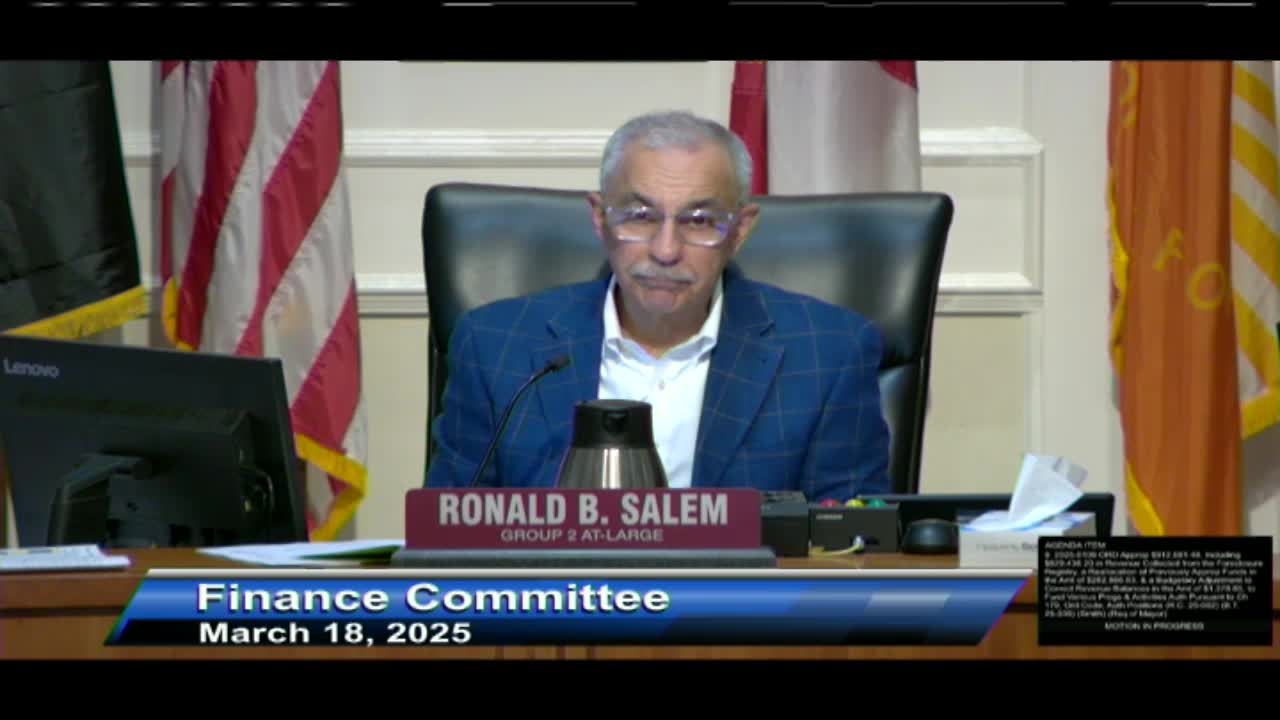
Committee hears overview of foreclosure registry fund; approves spending bill with neighborhood uses
Summary
Housing staff briefed the committee on the foreclosure registry fund — a $250-per-foreclosure fee split between a registry vendor and the city — and described current programs funded by the account, including foreclosure intervention, blight removal and a $5,000 neighborhood matching grant. Committee approved Bill 20 25 1 09 6-0.
Housing and Community Development staff presented a briefing on the city’s foreclosure registry fund and the programs it supports, and the Finance Committee approved the related bill (20 25 1 09) on a 6-0 vote.
Program summary: staff said the registry requires lenders who file foreclosure actions to register the property and pay a $250 fee; a private registry vendor receives $100 and the city receives $150 per filing. Since inception the fund has generated roughly $13 million in revenue, staff reported.
How the city uses the money: staff outlined three broad strategies established in state updates to the program. Strategy 1 — direct impact — funds foreclosure intervention and counseling programs delivered by Jacksonville Area Legal Aid, Jacksonville Urban League and other partners; those services include mediation, housing counseling and limited direct payments to prevent foreclosures. The department has also blended SHIP (state) funds with registry funds to increase assistance.
Strategy 2 funds neighborhood-level blight removal and the Jacksonville Assistance and Relief (JAR) program run through Municipal Codes for mowing, boarding and targeted demolitions. The fund also supports an appraisal-gap program used to help development where appraised values lag construction costs. Strategy 3 funds community outreach and education, including a neighborhood matching grant (up to $5,000 per award) and multi‑week neighborhood leadership training.
Questions from council: council members asked whether the $5,000 matching grant level could be raised; staff said the department is considering increasing that amount in the next RFP cycle and provided application and past-award statistics. Members also asked whether registry funds are being used for heirs’ property legal work; staff said heirs’ work is currently funded through SHIP dollars but that registry funds could be directed to that use if council chose to prioritize it.
Vote and next steps: the committee approved the bill as amended (voice vote recorded as 6-0). Staff said the next matching-grant RFP will open in July and that they will bring options to council if the department recommends increasing individual award sizes.
Speakers: Travis Jeffrey of Housing and Community Development led the presentation and answered committee questions.