Get Full Government Meeting Transcripts, Videos, & Alerts Forever!
Get email alerts on the Zoning Text Amendment topic
No spam. Unsubscribe anytime.
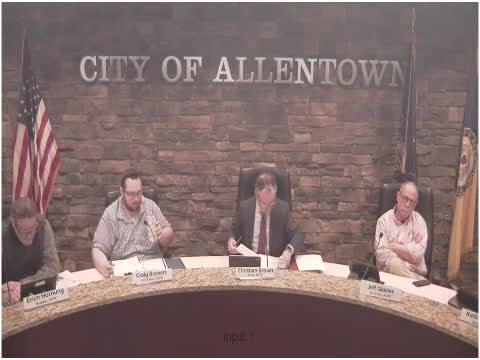
Commission recommends removing ‘senior citizens’ meal limitation from community-center definition
Summary
Planning staff and petitioners argued the line creates ambiguity for special-exception review; commissioners voted to recommend the text change to council amid public opposition from neighbors.
The Allentown City Planning Commission voted on March 11 to recommend a zoning-text amendment that would remove a sentence limiting meal preparation at “community centers” to senior citizens. The petition was filed by RCI Village Properties and the Lehigh Valley Conference of Churches and stems from a recent zoning hearing board decision and a subsequent appeal in common pleas court.
Mike Hanzo, the city zoning officer, summarized staff analysis and said the current definition — which says a community center "may include the nonprofit preparation and provision of meals for senior citizens" — is ambiguous and difficult to apply in special-exception reviews. Hanzo told the commission that "senior citizens is not defined under the zoning ordinance," and that an operator could not reasonably determine how the limitation would be enforced.
Naomi Centrella, an attorney for the petitioners, told the commission the sentence created uncertainty in recent litigation and that removing it would avoid future enforcement problems. "It is our position that Mr. Hanzo summarized the issue very well," Centrella said, and she urged the commission to recommend the interim change while the city’s full zoning rewrite is finalized.
RCI Village Properties and Ripple Community Inc. representatives, including executive director Sherry Bender, said the case arose from a special-exception denial for a proposed drop-in community center and that the language had the effect of blocking their application. Bender said the organization operates community programs but that the contested language has delayed their plans and could affect funding. "The longer we delay these next immediate steps, the longer the project gets pushed down the road," she said.
Opposition came from residents and the West Park Civic Association. A West Park representative read a letter that said the association "opposes pending bill 16-2025" and urged the commission to safeguard neighborhood character. Speakers at the meeting raised concerns about parking, public safety, and the placement of drop-in services in residential neighborhoods.
Commissioners and staff reminded the public that the planning commission’s vote is advisory: the amendment will go next to the Community Economic Development Committee and City Council, which will hold a public hearing before making a final decision.
A motion to recommend the amendment passed on a voice vote after commissioners discussed the ambiguity in the code and staff’s analysis that the change would primarily be a cleanup. Comments from the public and the petitioners will be included in the record to city council.