Get Full Government Meeting Transcripts, Videos, & Alerts Forever!
Get email alerts on the Hospital Operations topic
No spam. Unsubscribe anytime.
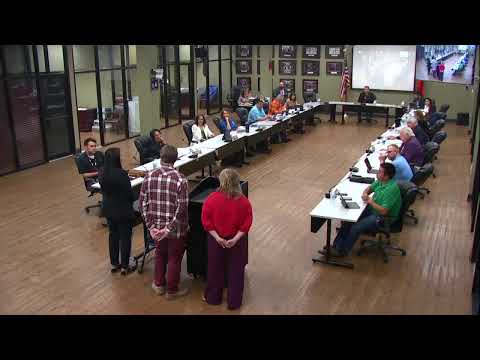
Claremore Indian Hospital reports surgery visits rise, begins Cherokee Nation EHR migration after 14-hour water outage
Summary
Hospital staff told the Cherokee Nation Tribal Council that aligning clinic schedules with Cherokee Nation increased February surgery clinic visits 52% and endoscopy procedures 63%; staff also held an electronic health record migration kickoff and weathered a 14-hour water-main outage that forced surgery and obstetrics diversions.
Captain Murray, presenting the Claremore Indian Hospital report, told the Cherokee Nation Tribal Council that surgery-clinic visits rose after the hospital aligned its surgery schedule with Cherokee Nation Health Systems.
The change led to a 52% increase in surgery clinic visits to 198 in February compared with February 2024 and a 63% increase in endoscopy procedures in the first month after scheduling changes, Captain Murray said. He also reported that the hospital hosted a three-day electronic health record (EHR) migration kickoff with Cherokee Nation Health Systems.
The EHR kickoff introduced staff to the Oracle/Cerner system used by Cherokee Nation and contrasted it with RPMS, the EHR used by Indian Health Service. ‘‘This was an introductory to the Oracle or Cerner version that Cherokee Nation uses the health record, comparing it with RPMS,’’ Captain Murray said, describing about 78 meetings or sessions for roughly 75 supervisors and frontline staff.
Hospital staff also described an operational disruption after a city water main break on Feb. 11. "The entire facility lost pressure ... we had to go on a little bit of a divert and surgery and OB divert," Captain Murray said. He said the facility remained on divert for about 14 hours while city crews attempted multiple repairs to an aging cast-iron main on the east side of the hospital.
Council members asked follow-up questions about the causes of the surgical uptick and about federal notifications. Captain Murray said the increase resulted in part from longer surgical clinic hours and flex scheduling—switching to a 10-hour day to add slots—and confirmed the hospital receives federal notices and sometimes seeks IHS exemptions when agency policy changes affect operations.
The report also included praise from council members for certification achievements at the facility. Councilor Sasha Black Fox Claws singled out a recent designation: "...Claire Moore was recently awarded to be certified safe infant sleep hospital ... First of IHS," and thanked staff for work on maternal and infant care.
Hospital staff did not present any motion or formal decision during the report; the council did not take an action on the items discussed.
The council discussion distinguished operational data and ongoing projects from formal decisions: the scheduling change and EHR kickoff were presented as implemented or planned operational changes, and the water-main outage was described as an incident that temporarily forced service diversions.