Get Full Government Meeting Transcripts, Videos, & Alerts Forever!
Get email alerts on the Capital Improvements topic
No spam. Unsubscribe anytime.
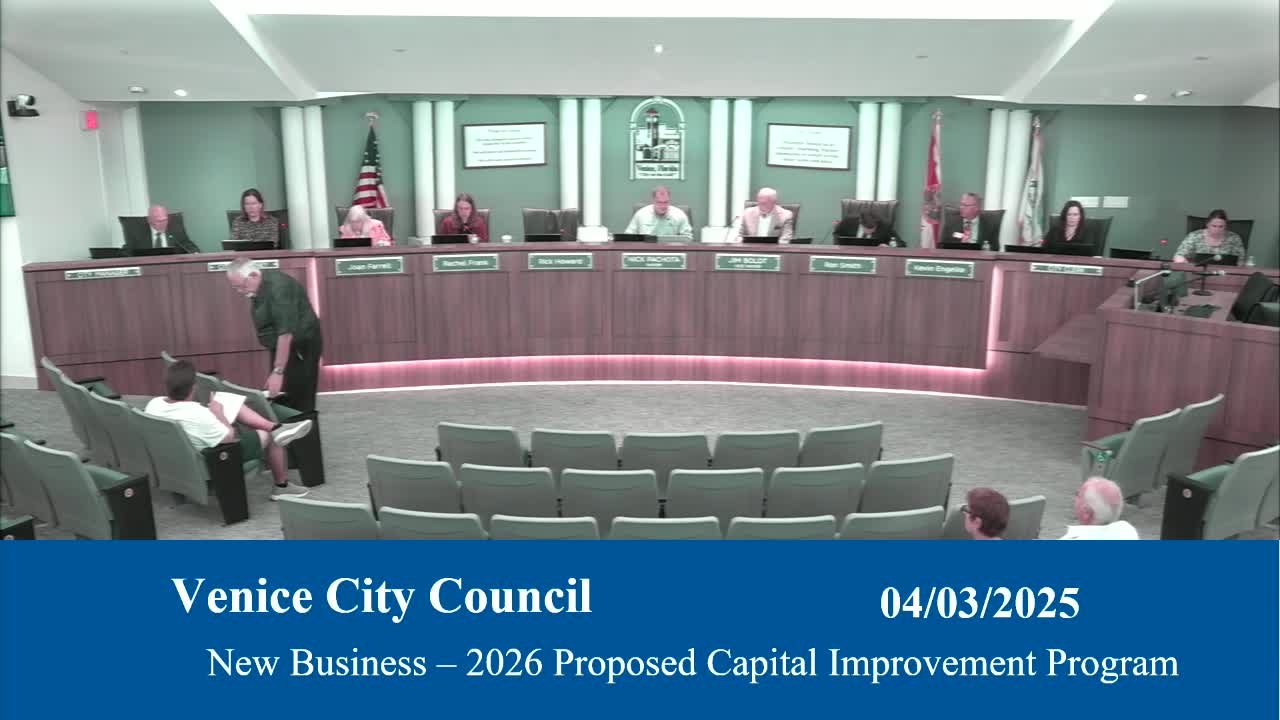
Venice council reviews five‑year CIP; members press to prioritize beach parking, jetty funding and stormwater work
Summary
At a capital improvement plan workshop, finance staff presented a five‑year, fluid CIP book with many new FY26 requests. Councilmembers pressed to accelerate some projects (beach parking, Broward Park) and to clarify funding sources as the city faces competing priorities including fire station needs, airport projects and stormwater responses.
The Venice City Council met for a capital improvement plan (CIP) workshop focused on a five‑year list of proposed capital projects and funding sources. Finance Director Linda Seni told the council the CIP is an early, nonbinding, strategic planning step: “This is a fluid, moving document. So I just wanna make sure that's not binding at this point.”
Council members and staff front‑loaded discussion around several items that councilmembers said should be priorities or re‑scoped: additional parking near South Brochard/Caspersen Beach, design funding for the Well Field Park interlocal agreement, storm damage repairs at Humphreys Park/South Jetty and airport, fleet and fire apparatus procurements, and several smaller public‑safety and amenities projects. Several councilmembers urged shifting some projects out of the general fund and using the city's one‑cent sales tax or outside grants where appropriate.
The council was shown a color‑coded CIP book. Councilman Smith praised the visual coding and urged caution at the number of new items appearing in the near term: “As a general rule, projects should progress through the CIP, first appearing five years out… then moving up until they finally eventually reach the next year column.” Smith and others noted many new “red” entries — projects appearing for the first time in FY26 — and asked staff to identify which items could be deferred to ease pressure on next year’s operating budget, particularly given expected union negotiations and staffing needs. Seni said projects can be moved between years and that council can add items up to adoption in September.
Funding choices surfaced repeatedly. Councilwoman Frank asked whether the Broward Park/South Brochard additional beach parking could be moved into the current fiscal year; Seni said the item could be funded from the general fund or reallocated to the one‑cent sales tax (which has been held for Fire Station 2 and a fleet maintenance facility). Council members discussed the possibility of Tourist Development Council (TDC) or other tourism‑related funds for beach and jetty projects but staff said the city had not formally requested TDC money for the Broward Park parking project.
Well Field Park: Seni said the CIP includes a $5 million contribution in FY26 tied to an interlocal agreement; subsequent years show $1 million per year over 15 years (a total program figure recorded in the CIP materials). Council members agreed the funding source is general fund reserves as presented, and Seni said that the $5 million was already earmarked in quarterly reserve reports.
South Jetty / Humphreys Park: the council discussed two Army Corps of Engineers (USACE) restoration models and the uncertain federal timeline. Acting City Engineer John Kramer told council the city lacks detailed federal project timing; design and construction sequencing depend on the Army Corps. Multiple council members favored moving the city’s local design funding back one year to avoid spending on work that might be undone by a future Corps project. Kramer agreed that delaying design by a year was appropriate given uncertainty.
Parks and playgrounds: Public Works Director Rick Simpson told council that some playground surfaces — notably at Legacy Park — deteriorated faster than expected because of new surface materials and storm damage, creating a safety concern. Simpson described the replacements as necessary to meet safety standards. Several councillors said they want staff to justify “end of useful life” designations given the large number of asset replacements showing up at once; Simpson said a 2025 facility condition assessment is nearly complete and will update prior 2017 data.
Public safety, EMS and fleet items: Fire Chief Frank Giddens described an EMS inventory control vending machine (electronic, climate‑controlled cabinet) as an accountability and waste‑reduction tool; he said it would improve tracking of controlled medications and help avoid expired supplies. He noted an estimated purchase cost above $30,000. Council also reviewed planned pre‑orders for a ladder truck and fire engine (procurements that lock in pricing but often arrive years later). City Manager LaValley told the council a prior multi‑year effort had restored the fleet replacement fund and that the city now budgets vehicle replacements in a structured way.
Other CIP notes: staff described a proposed $100,000 allocation for portable, impact‑rated vehicle barriers (for special events), a $115,000 project to make the city website ADA‑compliant, a $10,000 awning for the marine patrol building, and a $70,000 line listed as equipment for “ostrich rescue” (entered by department as presented). The council asked department heads to be ready with clarifications on urgency before final budget decisions.
Next steps: Seni said the CIP book is a working document and will be refined before June budget workshops and final adoption in September; projects can be added, moved earlier with budget amendments, or delayed. Councilmembers asked staff to present clearer funding recommendations for items they want accelerated (notably beach parking and certain park repairs) and to provide follow‑up details on grant opportunities for large coastal projects.
Ending: The workshop continued into topic‑specific presentations (airport, utility, stormwater and fleet funds) and concluded with audience participation, where residents asked for additional public outreach on stormwater and dredging concerns. The city emphasized the CIP is not an immediate appropriation but the first public step in setting priorities for FY26 and beyond.