Get Full Government Meeting Transcripts, Videos, & Alerts Forever!
Get email alerts on the Economic Development Border Cities topic
No spam. Unsubscribe anytime.
Senate committee advances changes to Border City enterprise zone bill after city leaders testify
Summary
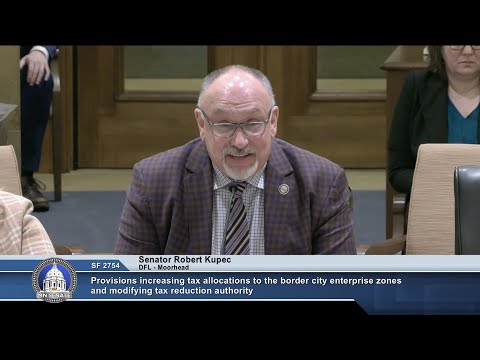
Senate File 2754, which would update Minnesota's Border City Enterprise Zone program for five cities along the North Dakota and South Dakota borders, moved forward in the Minnesota Senate Tax Committee on April 3 after committee members adopted an author's amendment and heard city officials testify in favor.
Senate File 2754, which would update Minnesota's Border City Enterprise Zone program for five cities along the North Dakota and South Dakota borders, moved forward in the Minnesota Senate Tax Committee on April 3 after committee members adopted an author's amendment and heard several city officials testify in favor.
Proponents told the committee the program helps border cities retain and attract businesses that might relocate to neighboring states with lower taxes or different incentives. Mayor Shelley Carlson of Moorhead said the bill would give cities more flexibility to “use those tools citywide” and help attract service, restaurant and experience-based businesses that community members are demanding. Carlson also recounted a downtown example in which “a long standing chiropractic business ... is building a new building in our downtown” and argued program changes would reduce eligibility confusion for businesses like that.
The bill would raise the program's annual appropriation from $750,000 to $1,500,000 and increase the income tax credit a border city may provide an employer from $3,000 to $5,000 per employee per year. It would remove existing geographic restrictions on zone size and add reimbursement for land-acquisition costs tied to business expansion when a city determines the expansion is needed to avoid a business relocating out of state. The sponsor said the bill also aims to eliminate restrictions that have made service, experience-based and some franchise businesses ineligible.
East Grand Forks economic development director Maggie Brockling told the committee the program has helped her city retain about 212 businesses since inception and, in her most recent report, retain roughly 270 jobs while adding about 260 new jobs. Brockling said border incentives in neighboring Grand Forks, N.D., create competitive pressure — she cited an example in which a proposed new movie theater in Grand Forks could saturate the local market and harm an existing East Grand Forks theater that served 220,000 patrons last year.
Committee members debated the scope of the program. An oral amendment from Senator Nelson sought to make the program statewide; Nelson later withdrew the oral amendment after the committee chair encouraged her to work with staff on a separate statewide proposal. The committee adopted an author's A2 amendment offered during the hearing to reorder and strike portions of the bill language, then laid the bill over for further consideration.
Action and next steps: The committee adopted the A2 author's amendment (voice vote) and laid Senate File 2754 over for potential inclusion in later tax legislation. No formal roll-call vote on the bill was recorded in the transcript.
Speakers during this item included the bill sponsor, several senators asking questions, and municipal officials who testified. Committee staff indicated the bill package reflects collaboration among the five border cities.