Get Full Government Meeting Transcripts, Videos, & Alerts Forever!
Get email alerts on the Youth Homelessness topic
No spam. Unsubscribe anytime.
LifeWorks: youth homelessness rising in Austin; agency urges prevention and more housing
Summary
LifeWorks told the Austin City Council Public Health Committee that youth homelessness has increased since 2020, the by‑name list has grown substantially, and the nonprofit is expanding housing and prevention programs while urging more targeted investments.
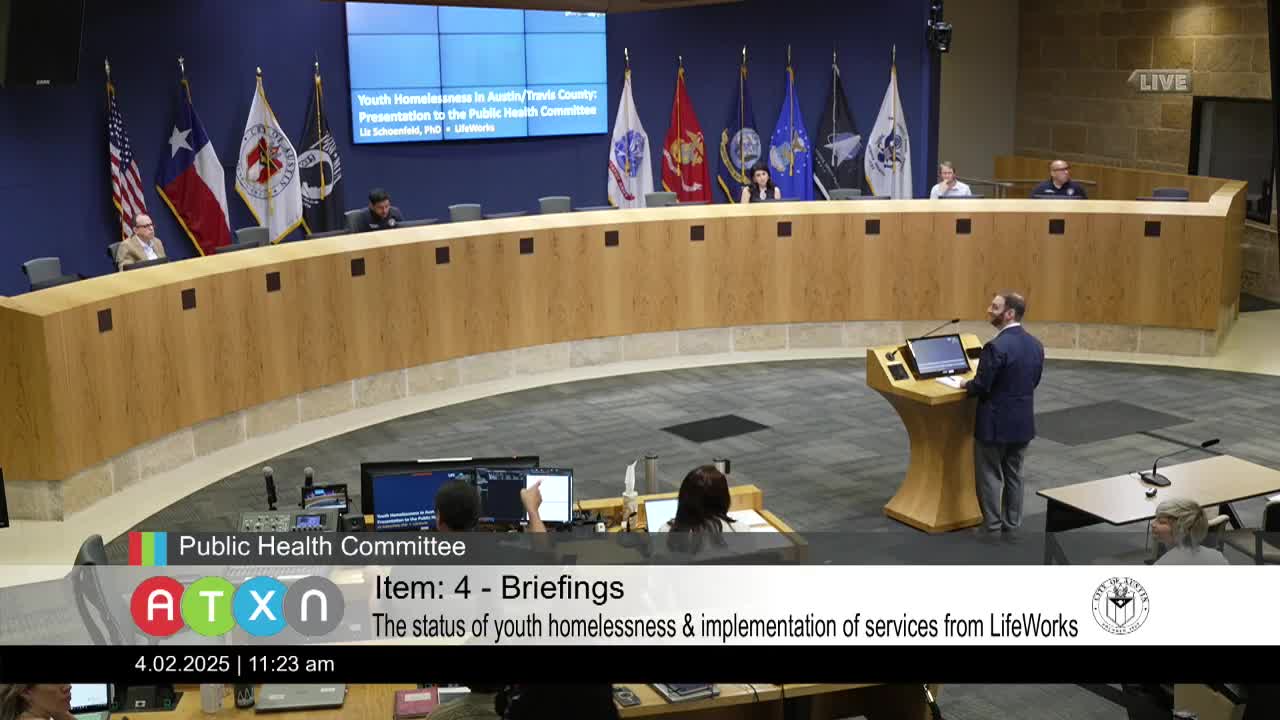
Liz Schoenfeld, chief executive officer of LifeWorks, told the Austin City Council Public Health Committee on April 2 that youth homelessness in Austin and Travis County has risen notably since 2020 and that the community must scale housing, prevention and supportive services to change the trend.
Why it matters: Schoenfeld described youth homelessness as a distinct phenomenon from adult chronic homelessness with different causes—family instability, foster care and juvenile justice system involvement—and said early intervention and tailored supports can prevent long‑term homelessness.
What LifeWorks presented
- Scale and scope: LifeWorks served about 2,700 young people last year across 19 programs. The organization said the youth cohort represents roughly 10 percent of the community’s homeless population (people ages 18–24). Schoenfeld presented by‑name list figures showing the youth count on that list has more than quadrupled since October 2020 and said the by‑name list stood at about 1,020 youth in the most recent month presented.
- Characteristics and risk factors: Schoenfeld said a high share of young people experiencing homelessness have histories of systems involvement. In a 2016 study with Chapin Hall, 76 percent of youth had foster care or juvenile justice histories; LifeWorks now estimates the combined share of youth with systems involvement at about 67 percent. She reported that roughly 57 percent of youth on the by‑name list have foster care histories and about one‑third have juvenile‑justice histories. Schoenfeld also said nearly 85 percent of youth reported primarily sleeping outdoors; two‑thirds met the federal definition for chronic homelessness, and nearly half had been continuously homeless for 12 months or more.
- Housing and program responses: LifeWorks operates housing and outreach programs, including street outreach and rapid rehousing funded in part by the city. Street outreach served more than 750 youth in the past fiscal year (compared with an expected 325). Rapid rehousing supported 277 youth in FY24, with 72 percent exiting to permanent destinations. LifeWorks said it administers about 85 percent of the community’s Foster Youth to Independence vouchers.
- New and planned investments: The agency said Works 3, an affordable housing project set to break ground later this year, will provide 120 units for youth, with 96 earmarked for youth transitioning from the by‑name list. LifeWorks also described prevention initiatives including a deflection program in partnership with the district attorney and the Excellence Project, a flexible assistance pilot that provided cash stipends (average <$3,500 per client) and a recent five‑year federal grant to expand services.
Committee discussion and priorities
Council members praised LifeWorks as a key local provider and discussed diversion, prevention and the need to invest in both housing and wraparound supports. Council Member Ryan Alter cited a diversion program that previously achieved about a 60 percent exit rate from literal homelessness to permanent housing and called for investment in front‑end solutions. Schoenfeld emphasized workforce services, community‑based counseling, peer support and case management as crucial wraparound services for youth.
Ending
LifeWorks and the Homeless Strategy Office said they have launched a task force to address the foster‑care to homelessness pipeline and will produce a report with policy proposals and financing options later this year.