Get Full Government Meeting Transcripts, Videos, & Alerts Forever!
Get email alerts on the Public Health Funding topic
No spam. Unsubscribe anytime.
Austin Public Health warns federal grant cuts already costing staff and services
Summary
Austin Public Health told the City Council Public Health Committee on April 2 that $15 million in immediate federal funding has been cut, costing positions and programs and putting additional grant-funded services and staff at risk without clear federal guidance on reimbursements.
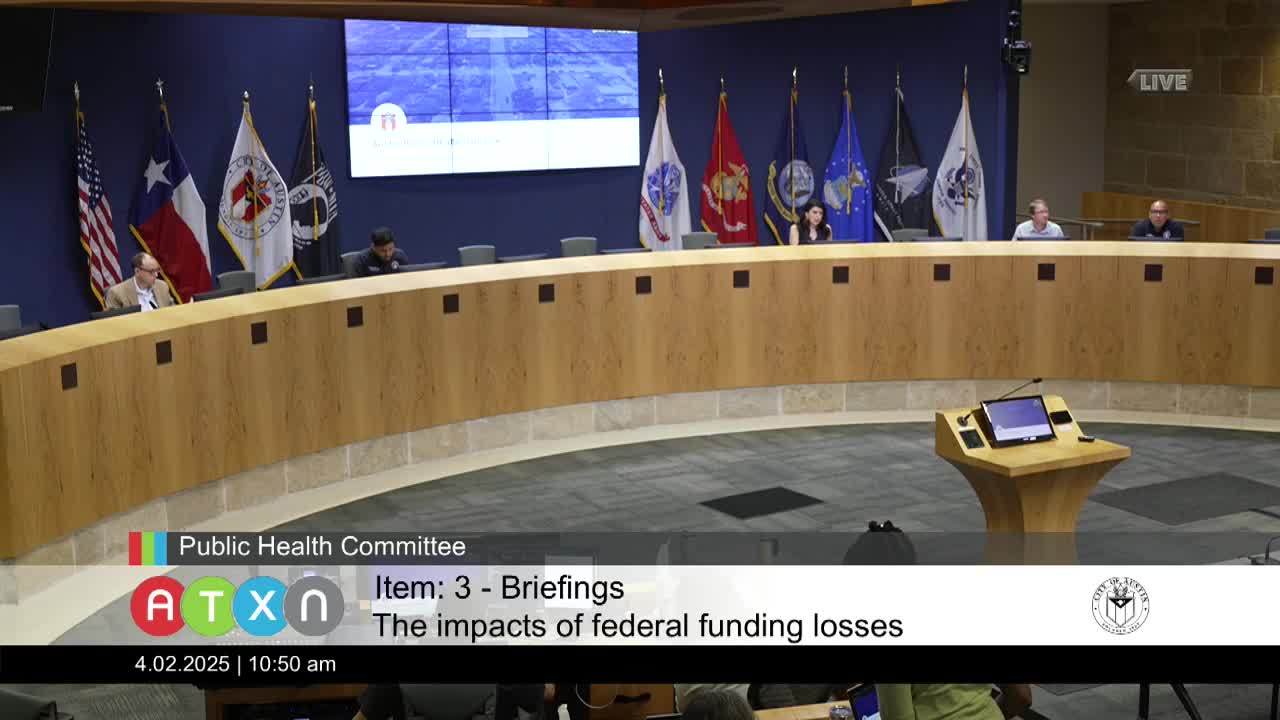
Austin Public Health Director Adrian Sturrup told the Austin City Council Public Health Committee on April 2, 2025, that the department has already experienced roughly $15,000,000 in immediate federal funding losses that have affected staff and services and that additional grant funding remains at risk.
The presentation, given in City Council Chambers at 10:01 a.m., laid out the department’s fiscal picture for fiscal year 2025: a total budget of about $131,000,000, with roughly $92,000,000 in general fund support (about 70 percent of the department’s budget) and nearly $39,000,000 in grant funding. Sturrup said grant-funded positions make up a disproportionate share of the department’s full-time equivalents (FTEs): grant dollars represent about 30 percent of the dollar budget but support roughly 51 percent of APH FTEs.
Why it matters: Sturrup and Deputy Director Cassandra De Leon said federal and state notices have left local public health agencies uncertain about reimbursements. The department reported having absorbed some earlier reductions but said new cancellations have forced program closures and staff impacts. Sturrup described the situation as ‘‘death by a thousand cuts’’ and said the department is prioritizing statutory responsibilities while seeking community and philanthropic partners to preserve core services.
Key details from the briefing
- Immediate losses and staffing: The department reported approximately $15,000,000 in immediate federal funding reductions already realized, affecting about 50 positions (a mix of full-time and temporary). Sturrup said earlier grant reductions in fall 2024 affected 35 positions; APH absorbed 23 of those by reassigning staff or using vacant positions.
- Programs and staff named as lost or at risk: among items Sturrup listed as cut or canceled were the refugee medical services clinic (13 staff), a tobacco cessation program (Breathe with Pride — 2 staff), the GoATX youth employment program (about 25 summer interns and 3 full‑time staff), COVID vaccination staffing (7 staff), and a diabetes care program (2 staff). The department also identified potential additional at‑risk funding of about $7,800,000 that would affect roughly 57 more FTEs if it were lost; Sturrup said those at‑risk projects include health equity work, some HIV/STI programming, youth programs, and COVID‑19 surveillance work used for other communicable disease response.
- Service impacts and caseloads: De Leon reported specific patient impacts tied to the refugee clinic contract: between February and July the department had 595 scheduled initial refugee clinic appointments, 8,647 scheduled screenings, 1,608 scheduled vaccine appointments and 883 unscheduled referrals for people assigned to Austin and Travis County. Sturrup said the refugee program represented about $5,000,000 of funding.
- Public‑health responsibilities emphasized: Sturrup stressed that some work is statutorily required (disease surveillance, communicable disease investigation, food safety inspections, environmental health), while other services are contract or grant funded and may be candidates for handoff, partnership, or community support. He noted the department’s work identifying measles cases, coordinating labs, and conducting behind‑the‑scenes surveillance, citing how pandemic-era funding had been used to ‘‘right‑size’’ capacity and respond to emergent needs.
Committee reaction and next steps
Committee members thanked APH leadership and described the cuts as a challenge that will affect upcoming city budget deliberations. Council Member Jose Velasquez said programs ‘‘save lives’’ and urged creativity in filling gaps. Council Member Ryan Alter and others emphasized that community testimony earlier in the meeting had ‘‘put a face’’ on services supported by APH grants.
Sturrup said APH is developing recommendations for the city manager’s office that prioritize statutory duties first, identify services that could be shifted to partners, and list services the city may no longer be able to support without outside help. He also said the city manager had authorized extending employment for affected staff for 30 days while the department explores options for reassignment or alternative funding.
What APH requested or proposed
Sturrup asked for time and ‘‘space of grace’’ as state and federal notifications continue to shift. He said the department is in active conversation with local foundations and other partners about how best to protect core services and employees and will present refined recommendations to the city manager and council.
Ending
Committee members said APH’s briefing will inform upcoming budget hearings. Sturrup and De Leon said information is evolving and the department will update the council as new federal or state guidance arrives.