Get Full Government Meeting Transcripts, Videos, & Alerts Forever!
Get email alerts on the Stateworkforce Budget topic
No spam. Unsubscribe anytime.
Senate jobs committee hears emergency shortfall in vocational rehabilitation funding; several workforce and small‑business relief bills laid on table
Summary
A state program that helps Minnesotans with disabilities prepare for and keep employment is facing an immediate funding cliff that prompted staff layoff notices and warnings the program will be unable to serve hundreds of participants.
A state program that helps Minnesotans with disabilities prepare for and keep employment is facing an immediate funding cliff that prompted staff layoff notices and warnings the program will be unable to serve hundreds of participants.
Chandra Peterson, a career counselor with Vocational Rehabilitation Services (VRS), told the Senate Jobs and Economic Development Committee that VRS "helped 9,492 Minnesotans with disabilities gain successful employment" from 2019–2023 and that federal reimbursements returned $25,800,000 to the program in that period. "The work that we do at VRS is very important and vital to Minnesotans with disabilities and the state's economy," Peterson said.
The department’s shortfall has already produced personnel actions. "On Monday, March 31, VRS staff received a layoff notice," said Sheena Jewison, a VRS rehabilitation counselor speaking as a member of the Minnesota Association of Professional Employees union. Jewison said rumors of layoffs and a hiring freeze prompted her to accept a new job outside the agency; she warned that "nearly 2,000 VRS participants will be left without a dedicated staff they can rely on to help them navigate their path to employment and self sufficiency."
Why it matters
VRS provides counseling, work‑readiness training and workplace accommodations that permit many clients to earn wages off public benefits. Committee members and testifiers said the program produces measurable economic returns — including participant wages and federal reimbursement — and that sudden staff reductions will disrupt services to people who need hands‑on case management.
Committee action and next steps
Committee members laid Senate file 30‑32 (the VRS funding bill) on the table for possible inclusion in the committee’s omnibus package while they assess options. DEED staff told the committee they had already enacted cost‑saving measures including hiring freezes and voluntary separation packages; committee members pressed DEED to provide a clearer accounting of how one‑time federal and state funds were used and what amount is needed to stabilize ongoing services. The governor’s revised recommendation includes $5,000,000 per year; committee discussion put the likely full gap in the ballpark of $10–13 million per year pending final accounting.
Other bills heard (highlights)
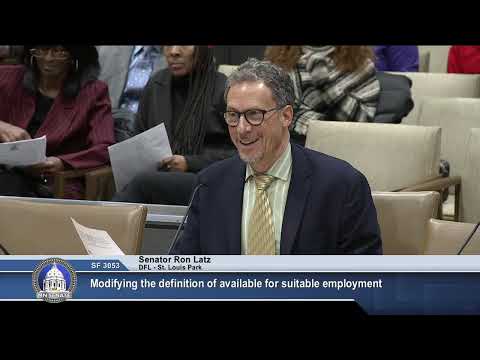
- Unemployment eligibility for remote job searches (Senate File 3053): Senator Lats introduced a bill to allow an active job search conducted remotely to qualify a claimant for unemployment benefits; the author said "our current statute prohibits doing an out of state online job search, and still qualify for unemployment insurance." The committee adopted an A‑1 amendment requiring that a remote job‑searcher be able to appear in person for a scheduled interview to remain eligible. SF3053 as amended was laid on the table for possible inclusion.
- Small‑business construction mitigation in St. Paul (Senate File 2520): Darlene Lavelle, executive director of the East Side Neighborhood Development Company, described an unexpected MnDOT closure that began on a Monday and "is devastating for small businesses." Arcade Laundromat owner Nick Ressler said access to his store was blocked and "since Monday, our business has dropped more than 50%." The bill requests $2.2 million in one‑time grants to support small businesses along Arcade Street and East Seventh Street during staged Highway 61 construction; SF2520 was laid on the table for possible inclusion.
- Workforce development and youth programs: The committee heard several funding requests for existing workforce programs, including: • YMCA of the North (Senate File 2874) — requested $450,000/year for career pathways and youth job training; SF2874 was laid on the table for possible inclusion. • Prepare Minnesota (Senate File 2811) — a proposal to fund statewide test and licensure preparation for students and dislocated workers; an A‑2 amendment was adopted and SF2811 as amended was laid on the table for possible inclusion. • Pillsbury United Communities (Senate File 3088) — continued funding for a career pathways program that places participants into short vocational trainings and internships; SF3088 was laid on the table for possible inclusion. • MABEL (Minnesota Association of Black Lawyers) law‑school pathway (Senate File 3111) — a college‑to‑law‑school pipeline program that the committee heard from student participants; SF3111 was laid on the table for possible inclusion. • ALMAOON / North at Work (Senate File 2877) — nonprofit career services including CDL and boiler licensing; SF2877 was laid on the table for possible inclusion. • Boulder Options youth mentoring (Senate File 2718) — youth 1‑to‑1 mentoring and the "I Believe I Achieve" program; SF2718 was laid on the table for possible inclusion.
What lawmakers said
Several members expressed sympathy for businesses and program clients but also concern about precedent and statewide fairness. One senator cautioned that a targeted mitigation fund could create a "Pandora’s box" of requests from other localities; others urged the committee to seek a broader, system‑level solution such as MnDOT mitigation policies or stronger verification and oversight at DEED.
Closing note
Committee members said they will continue gathering data — including DEED’s detailed accounting of prior one‑time spending and an updated estimate of the VRS gap — before final decisions. Multiple bills were carried over for possible inclusion in the committee’s omnibus jobs bill; no final enactments were made at the March 31 hearing.