
Demographer: Tempe Union enrollment likely to decline for several more years
Get AI-powered insights, summaries, and transcripts
Sign Up Free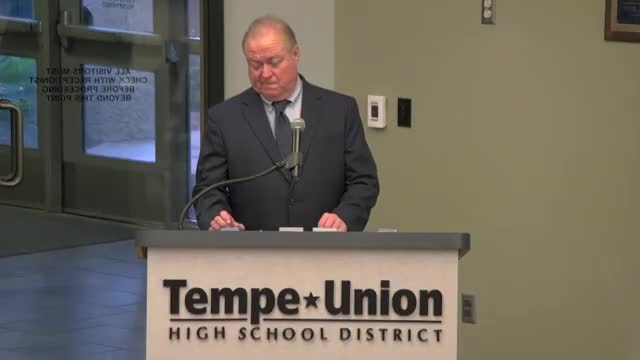
Summary
Applied Economics demographer Rick Brammer told the Tempe Union High School District governing board that district enrollment has fallen since 2020, that birth-rate and choice programs are reducing future cohorts, and that planners should expect several more years of decline absent a change in 'service rate.'
Rick Brammer of Applied Economics told the Tempe Union High School District governing board during a study session that the district has lost roughly 1,500 students since 2020 and is likely to see declining enrollment for several more years.
Brammer said total enrollment this year was down about 300 students from the prior year and that the district's cumulative loss since 2020 is "about 1,500 students," a decline larger than the loss in the entire prior decade. "By my calculations, we have 6 or 7 more years of of decline," he said.
The numbers matter because the district uses enrollment to set staffing, budgets and facilities plans. Brammer said two factors are driving the change: a smaller high-school-age population and increasing use of choice programs. He told the board that the share of residents age 18 and under has fallen over the last 14 years and that statewide birth-rate declines mean smaller cohorts will continue to reach school age for several years. He also said that choice providers and voucher-style programs have accelerated enrollment declines since 2020.
Brammer described the district's analysis approach as twofold: a macroeconomic, district-level model and a fine-grained "grid-level" model that examines quarter-mile planning units. He said the grid modeling shows pockets of growth in the northern part of the district where recent multifamily development has—unexpectedly—yielded some family households, while the southern portion continues to show aging populations and larger losses.
He offered specific figures: about 2,400 students who live in or within a mile of the district attend charter schools; roughly 13,000 housing units were built in the district in the last 10 years (about 91% multifamily); planners estimate roughly 15,000 additional housing units could be built over the next 10 years, most of them multifamily; and the net gap this year between school-age population and in-district enrollment was about 4,200 people.
Brammer said the district's "service rate" 'the share of school-age residents who attend district schools'is the largest unknown in forecasting. "How many people are gonna choose you?" he asked the board. He said the district must be conservative in projections because the recent pattern has been that a falling service rate produces faster enrollment declines than demography alone would predict.
Board members asked about nearby districts and special-education or choice eligibility. Former member Hodge asked whether problems in neighboring Scottsdale could affect northern attendance; Brammer said that could occur, citing past instances where reputation issues caused enrollment shifts. Vice President Steele asked whether districts that enroll out-of-district students accept those with IEPs and Section 504 plans; Brammer said he would follow up and investigate differences in practice.
The presentation closed with Brammer urging the district to use the grid-level data for planning and to consider marketing and perception as variables that could change enrollment outcomes.
Ending: The board received the demographer's report as an informational study-session item; no formal vote accompanied the presentation.