Get Full Government Meeting Transcripts, Videos, & Alerts Forever!
Get email alerts on the Public Safety Facilities topic
No spam. Unsubscribe anytime.
Nogales police outline plan to build Public Safety Operations Center at old armory
Summary
Police officials described plans and funding for a Public Safety Operations Center (PSOC) at the former National Guard Armory and said the city’s 9-1-1 answering point (PSAP) would move there if renovations proceed. Officials also described grant awards, infrastructure needs and high call volumes that motivated the project.
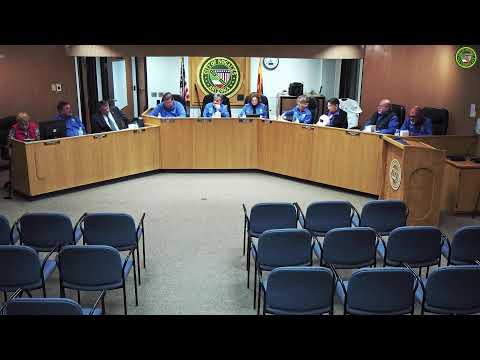
Police Chief Carlos Jimenez and Assistant Chief Robert Gallegos briefed the Nogales City Council on April 2 about plans to convert the former National Guard Armory on West Western Avenue into a Public Safety Operations Center, or PSOC, and to relocate the city’s 9-1-1 answering point (Public Safety Answering Point, PSAP) there.
Jimenez said the department aims to complete the PSAP portion of the PSOC by spring 2026 and that the armory conversion is driven by long-running facility deficiencies at the current Nogales Police Department building, which dates to 1972. “Our NPD facilities date back to 1972 and…have not had any meaningful updates,” Jimenez said. He told council members the current building lacks secure areas to receive, process, interview or hold arrestees, witnesses or victims.
Assistant Chief Robert Gallegos detailed operational drivers for the project and how regional cross‑border activity increases demands on local public safety operations. He told the council that Nogales’ permanent population is about 19,770 but that the city handles a much larger daily and annual flow of people and trade, including millions of pedestrian and vehicle crossings and substantial freight traffic. He described spikes in calls during major incidents and cited the department’s 2023 workload statistics: 58,614 total calls for service and average dispatcher processing time of one minute 52 seconds per call.
Officials described recent grant work and funding requests that have supported planning and early renovation. In 2023 the department received an Arizona Department of Emergency and Military Affairs award to buy radio equipment to transition to the Arizona Wireless Integrated Network (AZ‑WINS); Jimenez said the grant amount was $10,763,350 and that equipment purchases are underway. In April 2024 the department submitted a congressional appropriation request for $15,477,000 to fund administration and investigative offices at the PSOC; that appropriation request was not funded and will be resubmitted, Jimenez said. Separately, in December 2024 the department was awarded a $1,370,000 grant from the Arizona Department of Public Safety border support program, contingent on a City of Nogales matching amount; the council previously approved the match in February 2025, Gallegos said. Combined PSOC-specific funding described in the presentation totaled $2,740,000 (the $1,370,000 award plus the matching amount), with some additional equipment line items the department listed bringing a cited project total to about $3,146,280.
Gallegos reviewed the armory’s renovation needs: replacement of undersized and aged electrical service (upgrading from single‑phase to a 480‑volt, three‑phase service), a new backup generator sized and integrated with the new electrical service, full replacement of HVAC systems (current units use phased‑out R‑22 refrigerant), roof repairs, perimeter fencing and exterior lighting upgrades, plumbing and sewer upgrades, and extension of the city’s fiber network with a redundant microwave link to support dispatch, AZ‑WINS radios and corporate city networking. He showed a conceptual PSAP floor plan that would create roughly 1,300 square feet for dispatch with six stations, a supervisor’s office, training/conference space, secure interview/holding rooms and evidence/storage areas.
Gallegos used two past critical incidents — an April 2018 officer‑involved shooting and a later officer‑involved shooting at a Walmart — to illustrate how communications and dispatch capacity are essential during multi‑agency emergency responses. He played portions of dispatch radio recordings and summarized how dispatchers coordinated public calls, multiagency radio traffic and medical responses under pressure.
Council members asked about jurisdiction during multi‑agency incidents, interoperability with state and federal partners, and the timing for remaining funding requests. Gallegos said the AZ‑WINS transition will improve statewide radio interoperability and that the department coordinates with the county sheriff and Arizona Department of Public Safety on critical‑incident investigations.
No formal council action was taken during the presentation; officials asked for continued council support as the department pursues construction funding and completes design work. The police presentation and supporting slides were presented for council information and to seek continued backing for the armory conversion, as described at the meeting.