Get Full Government Meeting Transcripts, Videos, & Alerts Forever!
Get email alerts on the Veterinary Services topic
No spam. Unsubscribe anytime.
Minn. bill would let commercial feed businesses employ veterinarians to address rural shortages
Summary
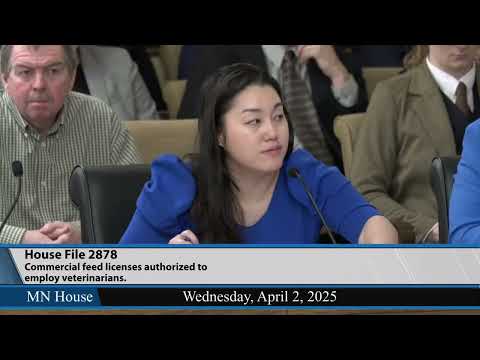
Representative Joe Murphy introduced House File 2878 to the House Ag Finance and Policy Committee, proposing to allow businesses holding commercial feed licenses to employ veterinarians as a means to expand veterinary services in rural Minnesota.
Representative Joe Murphy introduced House File 2878 to the House Ag Finance and Policy Committee, proposing to allow businesses holding commercial feed licenses to employ veterinarians as a means to expand veterinary services in rural Minnesota.
Murphy said the bill’s purpose is “to improve opportunities for veterinarians, new and the ones that are aging out, to improve availability for needed services for livestock producers and pet owners.” He told the committee that changes made in 1997 restricted veterinary employment to veterinarian-owned businesses and that opening employment to commercial feed businesses would give aging veterinarians more options when transitioning ownership and ease start-up barriers for younger veterinarians.
Perham feed-store owner Joseph (Joe) Dahl testified that his family’s feed and pet services business has experienced a local decline in veterinary capacity: “Over the past 10 years, many vets within 25 mile radius of Perham have retired or closed their practices.” Dahl said closures and retirements have left producers and pet owners with appointment waits of “weeks and even months” and argued the change would let veterinarians practice medicine without the burden of business ownership.
Dr. Trevor Ames, a retired veterinarian testifying for the Minnesota Veterinary Medical Association (MVMA), thanked Murphy for addressing rural shortages but said the MVMA could not support the bill as written. Ames said the association and the Minnesota Board of Veterinary Medicine have questions about whether feed mills are appropriate locations for companion-animal clinical services and how the veterinary practice act and current licensing intersect with the bill. He said the MVMA looks forward to working with Representative Murphy and the Board to resolve those concerns.
Committee members discussed the driver of the shortage: student debt, long hours, and the difficulty of buying or running small veterinary practices. Murphy and supporters said the bill is intended to preserve local access by enabling alternative employment models rather than forcing clinicians to manage a practice. Several members, including Representative Nelson and Representative Burkel, expressed support and said the bill could complement other tools such as loan forgiveness, which Ames noted has had a 95% retention rate for rural recipients since 2009.
No formal vote was taken on the bill; Representative Murphy moved to lay HF 2878 over for possible inclusion, and the motion was renewed and granted by voice vote.
Ending: Committee members signaled willingness to work with stakeholders including the MVMA and the Minnesota Board of Veterinary Medicine on governance and practice-location concerns before the bill moves forward.