Get Full Government Meeting Transcripts, Videos, & Alerts Forever!
Get email alerts on the Attorney Fees Litigation topic
No spam. Unsubscribe anytime.
Committee hears bill to cover attorney fees from Minnesota Chamber lawsuit; laid over
Summary
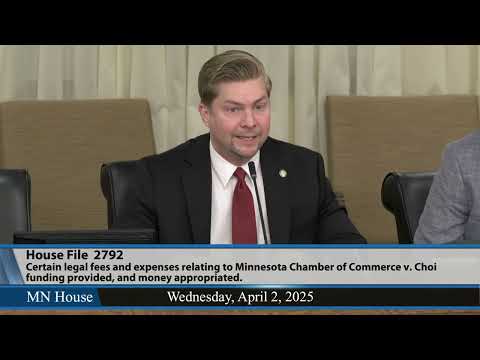
The Elections, Finance and Government Operations Committee heard House File 2,792, a contingent appropriation to cover attorney fees awarded to the Minnesota Chamber of Commerce after a federal court blocked parts of 2023’s House File 3. The committee laid the bill over for possible inclusion.
The Elections, Finance and Government Operations Committee on Feb. 12 considered House File 2,792, which would provide a contingent appropriation to cover attorney fees and costs awarded to the Minnesota Chamber of Commerce after a federal court struck down parts of 2023’s House File 3.
The bill’s author said the appropriation is meant to ensure state and local entities are not left with accumulating interest or additional cost while the precise fee amount is determined. Brian Cook, director of taxes, fiscal policy and elections for the Minnesota Chamber of Commerce, told the committee the chamber prevailed on constitutional grounds and has sought $754,234.15 plus additional costs; the Minnesota Campaign Finance and Public Disclosure Board has disputed about $160,000 of that claim and Ramsey County has sought to be excluded from liability. "We support this contingent appropriation to ensure any court ordered fees are paid promptly, preventing interest accrual and additional taxpayer burden," Cook said.
The chamber’s suit challenged a 2023 law that amended Minnesota Statutes §211B.15 and sought to restrict political speech by entities it labeled "foreign influenced." The transcript records that U.S. District Judge Tostrud issued a preliminary injunction on Dec. 20, 2023, and on Feb. 7, 2025, granted summary judgment permanently blocking enforcement of the statute on First Amendment grounds. The district court found the statute both overbroad and underinclusive, citing its expansive definitions and selective exclusions for entities such as labor unions and nonprofits.
Representative Greenman questioned whether it is premature to act before the court issues a final fee determination and criticized the policy at the heart of the 2023 law while acknowledging the state is bound by the district court decision. The bill’s author and supporters argued the state needs to plan for a substantial legal obligation that they say is the consequence of a foreseeable legislative mistake.
Chair Quam moved to lay the bill over for possible inclusion; the motion carried and the bill was laid over.
Why it matters: If the court orders payment of attorneys’ fees, state finances could be affected by a six-figure obligation; the bill would make a contingent appropriation so funds are available without delay.
Votes and action: House File 2,792 was laid over for possible inclusion (motion to lay over made on the record). No final appropriation was enacted at the committee level.