Get Full Government Meeting Transcripts, Videos, & Alerts Forever!
Get email alerts on the Optometry Scope Injections topic
No spam. Unsubscribe anytime.
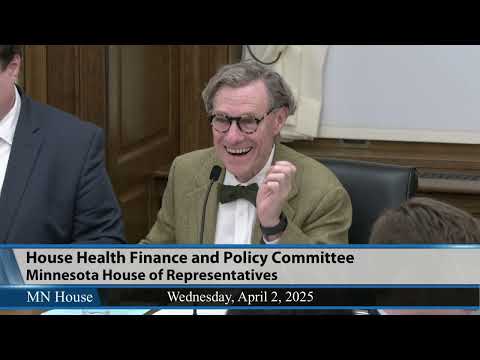
Committee rejects amendment to remove optometry injection authority; omnibus health bill moves to general register
Summary
The House Health Committee considered a large health-policy omnibus (House File 2464, DE1-1) and rejected an amendment that would have removed optometrist authorization to perform certain ocular injections. The DE1-1 amendment package was adopted and HF 2464 was placed on the general register as amended.
The House Health Committee took up House File 2464 (DE1-1), a multi-article health-policy package that includes changes ranging from pre-hospital overdose-data sharing to optometry scope-of-practice changes and a renaming/expansion of the Higher Education Facilities Authority to allow issuance of bonds for health projects.
Representative Liebling offered the A2 amendment to remove the provision that would expand optometrists' scope to include several ocular injection procedures. She argued the change posed patient-safety risks because the record did not clearly establish standardized training and supervision for performing injections into eyelids, ocular muscles, and intraocular spaces.
“I really believe that if we pass the bill as is and allow optometrists who may or may not be trained ... we are really putting Minnesota patients at risk,” Representative Liebling said. She asked for a roll-call vote and framed her amendment as a patient-safety measure that would not block other non-injection scope changes.
Supporters of the scope expansion urged the committee to modernize optometry practice and noted broad national adoption of many provisions. Chair Behrman said some changes already appear in many states and argued that modernizing scope helps recruit professionals to Minnesota. “These injection procedures are authorized by the National Board of Examiners since 2012,” he told the committee, noting that several states already allow similar practices.
Representative Gilman said licensed optometrists have completed multi-year education and that allowing the practice would expand access, particularly in rural areas. Opponents, including Representative Bonner and Representative Carroll, stressed the lack of transparent data on how much supervised training injection procedures require and warned about potential irreversible harm to patients' vision.
The committee took a roll-call vote on the A2 amendment. The recorded result was 4 ayes and 17 nays; the amendment failed. The four members recorded as voting in favor were Representative Bonner, Representative Carroll, Representative Hewitt and Representative Liebling. The DE1-1 amendment packet was later adopted by voice vote, and the chair's motion to place House File 2464 on the general register as amended carried by voice vote.
What it covers: Staff described the DE1-1 amendment as divided into two articles. Article I consolidates multiple bills on health policy, including provisions on sensitive examinations, environmental lab technical fixes, pre-hospital overdose-data sharing with ODNAP, maternal death studies, updates to the safe place for newborn statute, child-trafficking evaluation requirements, and various scope-of-practice changes. Article II would rename the Higher Education Facilities Authority to the Health and Education Facilities Authority and allow bond issuance for health projects.
Formal action: The committee rejected the A2 amendment (roll-call: 4 ayes, 17 nays). The DE1-1 amendment package was adopted; the committee placed House File 2464, as amended, on the general register for further consideration.
Next steps: With HF 2464 placed on the general register, sponsors and stakeholders said they expect additional technical work and continued stakeholder engagement on specific provisions, including scope-of-practice training standards and implementation details for authority expansions.