Get Full Government Meeting Transcripts, Videos, & Alerts Forever!
Get email alerts on the School Health Epinephrine topic
No spam. Unsubscribe anytime.
Committee lays over bill allowing broader epinephrine-delivery systems in schools
Summary
House File 2489 would replace EpiPen-specific language with a generic "epinephrine delivery system" definition and let districts obtain standing orders and condition-specific protocol from the Minnesota Department of Health; sponsor said the change accommodates new nasal delivery products and eases standing-order access for districts.
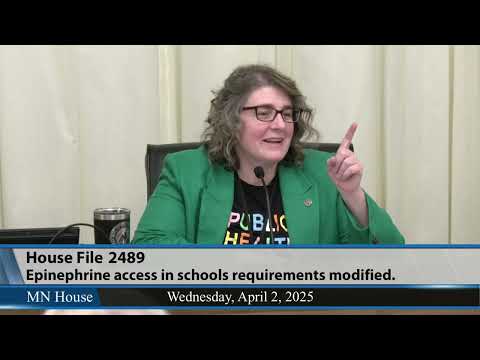
Representative Vernick introduced House File 2489 on April 2, asking the House Health Finance and Policy Committee to update Minnesota law governing school access to emergency epinephrine.
Lede: The bill removes language that names epinephrine injectors or EpiPens and replaces it with the broader term “epinephrine delivery system,” defined as an FDA-approved single pre-measured dose, and authorizes districts to obtain standing orders and condition-specific protocols from the Minnesota Department of Health.
Nut graf: The change is intended to allow schools to stock newer delivery methods, including pre-measured intranasal epinephrine, while enabling statewide standing orders for distribution modeled on existing naloxone standing orders. The author said the measure responds to school nurses’ requests to improve timely access to life-saving medications.
Supporting testimony: Representative Vernick said the bill was brought by school nurses and described the change as accommodating new delivery technology and improving access. Members who spoke in favor included Representative Keeler, who relayed a constituent’s account supporting the nasal product; Representative Carroll recounted a family experience with severe food allergy; Representative Gilman asked about costs and expiration; the author said she would follow up with cost information.
Outcome: No public testimony was recorded; committee members offered supportive comments and the chair laid House File 2489 over for possible inclusion in the omnibus bill.
Ending: The bill aims to make Minnesota law technology-neutral about epinephrine delivery and to reduce barriers for districts seeking standing orders from state public health authorities; the author and committee members said they would pursue follow-up on cost and standing-order logistics.